

Landlords face crackdown under Renters’ Rights Act as councils gain powers to issue hefty fines
10 months ago | 6 comments


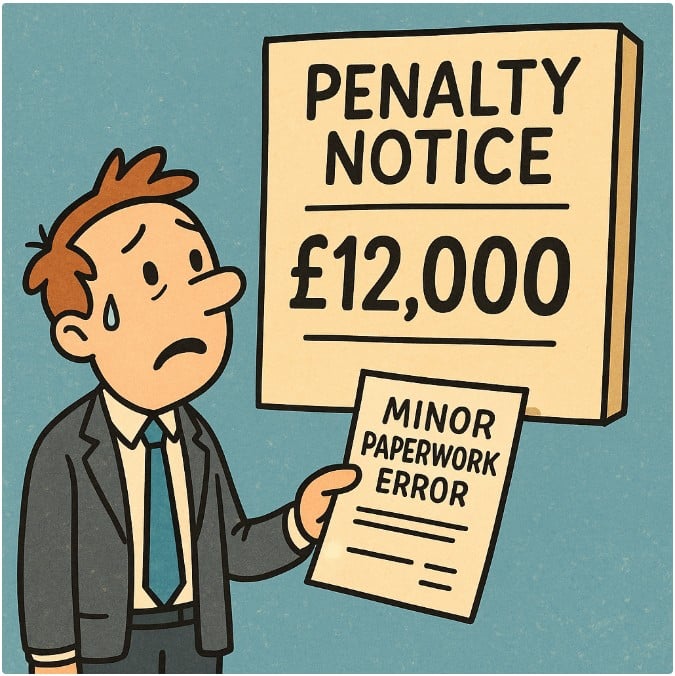
The government has released new civil penalty tables under the Renters’ Rights Act 2025, and the figures are outrageous. The official guidance, published this week on GOV.UK, sets out a scale of fines that start at £3,000 and climb to £35,000 for the most serious breaches. Many of these offences were previously treated as routine compliance matters. They now come with penalties that will feel closer to corporate regulation than traditional housing enforcement.
The largest penalties stand out immediately. A breach of a banning order carries a starting figure of £35,000. Using a possession ground that the landlord “knew or should have known” could not be met attracts a penalty of £30,000. Reletting a property during a no-let period is marked at £25,000. Even administrative failures, such as entering a selective licensing area without the correct licence, are set at £12,000.
These numbers land at a time when operating margins have already been eroded by increased regulatory overhead. The message is hard to miss. Compliance is no longer a procedural expectation, it is becoming a major financial risk factor. That change will shape the decisions of every landlord, whether they own one property or several hundred.
A comparison with other UK penalty regimes is also revealing. Many workplace safety offences attract lower penalties than the amounts now set for common licensing breaches. A failure to meet gas safety obligations in a rental property can trigger fines larger than penalties issued to companies that mishandle hazardous equipment. Even misleading rent advertisements carry a penalty of £4,000, which is more severe than fines issued for a range of trading offences in small businesses.
Landlords will question the fairness of these discrepancies. A documentary oversight or a misfiled possession claim may now result in a penalty that exceeds fines levied against regulated businesses in sectors with far higher operational risks. That tension will amplify political and industry debate, because the contrast is difficult to ignore once the figures are placed side by side.
Local authorities are likely to respond quickly. The guidance allows councils to retain revenue from civil penalties to support further enforcement activity. This creates a self-funding model that did not exist with the same clarity before. Enforcement teams that once struggled with budget constraints may now be encouraged to act more frequently and more assertively. Councils will focus on licensing, documentation, advertising and property condition, because these areas now offer significant financial return.
Lenders will take notice as well. A single penalty of £20,000 or more can alter the affordability profile of a portfolio. Breaches involving possession grounds will catch particular attention, because lenders rely on orderly tenancies to control arrears risk. Insurers will likely tighten underwriting for landlords who self-manage or operate in older properties, especially where documentation or licensing may be inconsistent.
Letting agents will face new pressures. The guidance implies shared responsibility in several areas, and agents who manage documentation or advertising on behalf of landlords could be scrutinised more closely. This will push agencies to adopt stricter internal controls, which may in turn increase costs for landlords who rely on full management services.
Tenants will experience the changes too. Councils will intervene earlier in disputes. Penalties allow enforcement without court delays, which means issues around licensing or documentation are likely to escalate more quickly than before. Some tenants will welcome the added oversight. Others may find that the heightened rules lead landlords to withdraw from riskier areas of the market.
Professional advisers will warn landlords to treat possession decisions with far more caution. The £30,000 penalty for relying on the wrong ground introduces a subjective test that invites argument over what a landlord “should have known”. That point alone will generate litigation, appeals and case law in the years ahead.
The guidance signals a tougher era. It reflects a political intention to make enforcement more visible and more costly. For landlords, it introduces a level of regulatory exposure that feels disproportionate when placed alongside penalties used in other sectors.
This is the landscape now set before the private rented sector. Success will belong to those who tighten their compliance processes, document every decision and treat governance as a central part of property management. The figures published this week send a clear warning. Mistakes will carry serious consequences, and the financial risks of non-compliance have never been higher.
| Offence | Civil penalty |
|---|---|
| Unlawful eviction and harassment (s1(2) and (3)) | £35,000 |
| Breach | Civil penalty |
|---|---|
| Attempting to let the property for a fixed term (s16E(1)(a)) | £4,000 |
| Attempting to end the tenancy by service of a notice to quit (s16E(1)(b)) | £6,000 |
| Attempting to end the tenancy orally, or require that it is ended orally (s16E(1)(c)) | £6,000 |
| Serving a possession notice that attempts to end the tenancy outside of the prescribed section 8 process (s16E(1)(d)) | £6,000 |
| Relying on a ground where the person does not reasonably believe that the landlord is/will be able to obtain possession (s16I(1)(e)) | £6,000 |
| Failing to provide a tenant with prior notice that a ground which requires it may be used (s16E(1)(f)) | £3,000 |
| Failing to issue a written statement of terms within 28 days of an assured tenancy coming into existence (s16D) | £4,000 |
| Failing to provide an existing tenant with prescribed information about changes made by the Renters’ Rights Act (paragraph 7 of schedule 6 to the Renters’ Rights Act 2025) | £4,000 |
| Offence | Civil penalty |
|---|---|
| Relying on a ground knowing the landlord would not be able to obtain possession or being reckless as to whether they would (s16J(1)) | £30,000 |
| Reletting or remarketing a property within the 12 month no-let period after using the moving or selling grounds (s16J(2)) | £25,000 |
| Continuing breach, or repeat breach committed within 5 years of receiving a penalty for first breach (s16J(3) and (4)) | Double the starting level for the two constituent breaches added together |
| Offence | Civil penalty |
|---|---|
| Failure to comply with an improvement notice (s.30(1)) | £25,000 |
| Mandatory HMO unlicensed (s.72(1)) | £17,000 |
| Additional HMO unlicensed (s72 (1)) | £17,000 |
| Knowingly permitting over-occupation of an HMO (s.72(2)) | £20,000 |
| Property subject to selective licensing unlicensed (s.95(1)) | £12,000 |
| Failure to comply with an overcrowding notice (s.139(7)) | £20,000 |
| Breach of HMO management regulations (SI 2006/372 and SI 2007/1903 (in respect of s257 HMOs) made under s234(1)) | |
| Failure to provide information to the occupier (regulation 3) | £3,000 |
| Failure to take safety measures (regulation 4) | £20,000 |
| Failure to maintain water supply and drainage (regulation 5) | £10,000 |
| Failure to supply and maintain gas and electricity or supply gas safety certificate (regulation 6) | £12,000 |
| Failure to maintain common parts (regulation 7) | £7,000 |
| Failure to maintain living accommodation (regulation 8) | £7,000 |
| Failure to provide adequate waste disposal facilities (regulation 9) | £7,000 |
No starting point for civil penalties for breaches of licensing conditions under sections 72(3) and 95(2) of the Housing Act 2004 are set out in this guidance, as those conditions may vary substantially between local authorities. Local housing authorities will need to determine and publish their own starting levels for civil penalties for these offences.
| Offence | Civil penalty |
|---|---|
| Breach of a banning order (s.21(1)) | £35,000 |
| Breach | Civil penalty |
|---|---|
| Discrimination against those on benefits or with children in the lettings process (s.33 and s.34) | £6,000 |
| Failure to specify proposed rent within a written advertisement or offer (s.56(2)) | £3,000 |
| Inviting, encouraging or accepting any offer of rent greater than the advertised rate (s.56(3)) | £4,000 |
54 comments on this article
A different perspective could help you spot an issue, avoid a mistake or find a better way forward. Read the comments and add your own views if you wish.
10 months ago | 6 comments

11 months ago | 14 comments

11 months ago | 10 comments
Member Since February 2018 - Comments: 628
11:04 AM, 11th December 2025, About 10 months ago
Reply to the comment left by David at 11/12/2025 – 10:41
“Shelter” and “Gen Rent” are complicit.
Member Since May 2014 - Comments: 653
11:33 AM, 11th December 2025, About 10 months ago
Reply to the comment left by David at 10:41
My blood is also boiling.
It is time this dreadful government was sent packing.
A slump in house building coupled with these anti – landlord policies is a guaranteed way of increasing the homeless problem.
There will be no space left to pitch the tents.
Member Since October 2019 - Comments: 444
12:05 PM, 11th December 2025, About 10 months ago
Looking at those fines – LLs could be completely destroyed. It would be ironic – ex tenants and ex LLs too, sharing the same doorway!
Member Since August 2013 - Comments: 324 - Articles: 1
1:40 PM, 11th December 2025, About 10 months ago
I wish I was on The Apprentice so I could point my finger at the government and say “You’re FIRED”.
But instead I find myself in the Dragons Den saying “I’m OUT”.
Member Since March 2018 - Comments: 198
2:00 PM, 11th December 2025, About 10 months ago
Do these fines also apply to corporate developers and landlords 🤔
Member Since January 2022 - Comments: 110
2:01 PM, 11th December 2025, About 10 months ago
This go’s beyond any reasonable limit!
I also 100% believe it will not apply to Social Housing and Council Property, much like EPC’s are no longer required, as they were so terrible!
A total P take, would a petition even be listened too, if we hit the 10k minimum?
This will drive rental prices through the roof and into space, add in all Landlords having to join a licencing scheme at hundred’s of pounds per property. This will also lead to the local Councils hunting for any little mistake or slip, to bring massive funding and / or just steal the properties under default ownership…. via fines
This will destroy the rental market RIP
Member Since April 2025 - Comments: 3
5:03 PM, 11th December 2025, About 10 months ago
Reply to the comment left by Paul Essex at 11/12/2025 – 08:41
Paul, they don’t expect you to continue.
They want you out.
A move towards the “you’ll own nothing” society that capitalism needs to survive.
The banks and venture capitalist firms will buy all the stock. Have the power to fight against legislation when they need to and eventually have it all written how they want it.
This will be the start of the end of small landlords.
Either go ltd and run it as a business or spend the rest of your free time ensuring your fully compliant – for free!
Member Since January 2011 - Comments: 12256 - Articles: 1481
5:10 PM, 11th December 2025, About 10 months ago
The last fine on the list really irks me. To be fair, they all do, but just suppose you advertise a property for £899 a month and the tenant says, let’s make it £900 because that makes it easier for me to reconcile my banking. If the landlord agrees he faces a fine of £4,000. It takes him over 333 years to recoup that £4,000 at £1 a month!
Member Since September 2023 - Comments: 92
7:47 PM, 11th December 2025, About 10 months ago
Reply to the comment left by The_Maluka at 11/12/2025 – 09:58
Although i think i understand the sentiment of what you are attempting to say that comes across like a LL should be “let off” regardless. If you knowingly beach or break legislation then it should be punished and stating that you will effectively recover fines and costs etc through rises etc (assuming its not just sale of stock) isnt a good look.
Not a criticism just an observation.
Member Since February 2024 - Comments: 92
9:02 PM, 11th December 2025, About 10 months ago
Hard to think of any other sector that is so severely punished for relatively small errors and omissions. It’s frightening. £3000 for failing to show the amount of rent in a written advert…Really?
Just out of curiosity, how do you advertise without it being written?