
Government vows to tackle rental discrimination in PRS
3 months ago | 28 comments


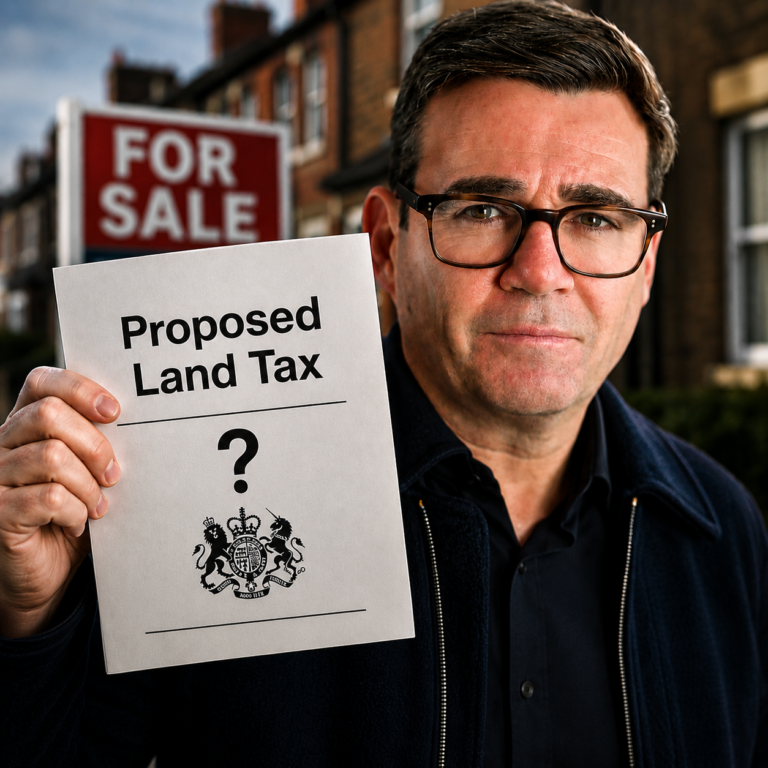
Hello, Andy Burnham has been reported to be considering replacing council tax and stamp duty with a new tax based on property values.
Under the proposal, the tax would be paid by property owners rather than tenants. Owner-occupiers would reportedly pay 0.48% of the property’s value each year, while landlords, overseas owners and second-home owners could face a higher rate of 0.96%.
For a landlord with a property worth £250,000, that would mean an annual bill of £2,400. On a £500,000 property, the charge would rise to £4,800 a year.
Would landlords realistically be able to absorb another cost of this size?
Some may try to recover it through higher rents, but that may not be possible if mayors are also given powers to freeze or cap rents.
Even without rent controls, tenants may simply be unable to afford the increases needed to cover the tax.
I also wonder whether the higher rate would lead to an exodus of overseas landlords and second-home owners, while persuading more UK landlords that remaining in the private rented sector is no longer financially worthwhile.
Could this proposal reduce the number of homes available to rent and push rents even higher?
Would a property tax of this size be the final straw for you, or could it be a fairer replacement for council tax and stamp duty?
Thank you.
Altan
96 comments on this article
A different perspective could help you spot an issue, avoid a mistake or find a better way forward. Read the comments and add your own views if you wish.
Previous Article
Buy to let lenders widen landlord options
3 months ago | 28 comments
3 months ago | 14 comments
4 months ago | 12 comments
Member Since January 2020 - Comments: 149
4:47 PM, 24th June 2026, About 3 months ago
Reply to the comment left by Keith Wellburn at 16:13
My understanding is that taxing land rather than property could kick-start building if planning laws allowed. (No point in sitting on costly land that’s not providing an income).
Clearly, land value in Westminster will be considerably higher than land value ‘up north’, but the principle still applies.
I can see the logic, though inhabited properties utilise local services and so I imagine that there will still be a requirement for council tax or rates to pay for these.
Member Since May 2018 - Comments: 2541
4:59 PM, 24th June 2026, About 3 months ago
Reply to the comment left by Ian Cognito at 24/06/2026 – 16:47
And that’s one of the reasons why it would be environmentally damaging and cause a lot of problems with sustainability.
If anybody wanted to start a debate about a fair and objective distribution of local property taxes to replace council tax then the way to do that would be to tax property on the basis of square metreage of living space under a roof of approximately 2 metres in height, i.e. just above the height of an average adult. This would be objective, and doing anything else would cause a lot of collateral damage. If you tax the land itself on the basis of the metreage of the plot you are going to end up filling in that pond, grubbing out that hedge, chopping down those trees, building on the garden, concreting over the front lawn to create additional car parking and doing a lot of other things that will have unintended consequences.
But this debate isn’t about fairness. This is about increasing the tax-take so that Andy gets his job and doesn’t have to tackle an unsustainable benefits bill.
And even if somebody did look at a ‘fairer’ way to allocate council tax on the basis of living space the review itself would be used to push the tax take up. For a property with a £2,200 tax bill the people doing the review would make sure that the ‘property tax’ ended up being £2,300. And if that were a bill for a rental property the landlord would have no choice but to reduce the risk of investment by increasing that to maybe £2,400. So the tenants would end up paying the £2,200 as extra rent in lieu of the council tax they used to pay, and they’d probably end up with another £200 on top of that.
There would be other undesirable consequences. At the moment many of us live 100 miles or more from our properties and we don’t know whether the bins have been collected or the potholes have been fixed. The only people who know that are the residents. Andy’s proposal to secure his new job would make central and local government less accountable. But left-wing governments don’t really believe they should be accountable anyway.
Member Since January 2020 - Comments: 149
5:08 PM, 24th June 2026, About 3 months ago
Reply to the comment left by Beaver at 24/06/2026 – 16:59
Whilst I would not trust any government to get it right, that does not make the principle wrong.
Member Since September 2018 - Comments: 3743 - Articles: 5
5:22 PM, 24th June 2026, About 3 months ago
Reply to the comment left by Ian Cognito at 24/06/2026 – 13:13
….the value of the land being dictated to by what is on it. If it were an empty field far easier (but this is also assessed on location to roads/train stations to name but a few).
Is one piece of land with a 3 story house on is really the same as the exact plot next door with 3 separate flats on exactly the same footprint?
A plot of land does not consume. It doesn’t need a dentist, doesn’t need go to school. It makes NO use of the service that the current council tax is personally charged to an occupant for. It is the OCCUPANT that pays for these council run services because they are the consumer.
There is already the clear argument to be had that a LL does not consume services when a property is in a void period so the overall tax generated from the property address is far higher than an owner occupied property.
Its going to be years before this is even at the consultation stage let alone anything else and major tax legislation has to go through many many hurdles first?
Any land tax would also have to apply to everyone if it is to exceed the income currently generated from CT (after all isn’t that the whole point more cash into the coffers??)
This will mean B2R corporates, social hosing providers and Councils themselves will need to pay. Investment in property across the board will fall to its knees. Literally this would tank the economy.
Member Since June 2019 - Comments: 969
5:23 PM, 24th June 2026, About 3 months ago
Reply to the comment left by Ian Cognito at 24/06/2026 – 17:08
Not sure why you think charging landlords double the new tax relative to owner occupiers is OK?
Member Since May 2018 - Comments: 2541
5:24 PM, 24th June 2026, About 3 months ago
Reply to the comment left by Ian Cognito at 24/06/2026 – 17:08
The principle of allocating local taxes based on square metreage of living space below 2 metres would at least be objective, i.e. not wrong per se, and it would then be more a debate about how you did it.
There is too much subjectivity in taxing land based on ‘property values’. You only know what a property is worth once you’ve built it and sold it. I suspect many developers (i.e. builders) would be in favour of a land tax of this type as it would create pressure to develop and of course the developers wouldn’t actually be paying the tax itself as it would be paid on an ongoing basis by the landowner.
Land taxes that create pressure to develop land have the potential to cause a lot of environmental damage, just as the EU’s Common Agricultural Policy created pressure to grub out hedgerows and copses and drain wetlands. If you tax on the basis of plot size that’s problematic. A lot of land can’t be developed, because of drainage issues for example, or other issues like restrictive covenants. Even if you get planning permission you can’t necessarily proceed. The only objective measure that makes sense is square metreage of living space excluding garages, outbuildings, lofts or basements that haven’t been converted. And then it comes down to the how.
As for HOW you do it, because I regard the current government as incompetent, I would have a serious concern that if the current government did this it would be a disaster and would make local taxation less accountable. But it doesn’t follow that any other government couldn’t review council tax using an objective measure like living space.
Member Since February 2020 - Comments: 395
5:40 PM, 24th June 2026, About 3 months ago
Taxed on square meters is a much fairer way. But as others have alluded to, its much more about being a cash grab.
Bank robbers rob banks, because that is where the money is, and land value tax advocates go to tax land because that is where the money is.
Its not about efficiency.
Additionally the thought that taxing unused land based on value will make that land come into use is flawed.
A piece of land that is not used, will not be worth much value and won’t be taxed much.
This is more of a value capture tax that has been rebranded with smoke and mirrors.
Member Since February 2020 - Comments: 395
5:45 PM, 24th June 2026, About 3 months ago
Reply to the comment left by Ian Cognito at 24/06/2026 – 16:47
Let me get this straight, putting a tax on something will increase supply.
Even if that was true, did you consider it would reduce demand?
If I was thinking of buying a propertyoff a developer before it was developed for a million, and then a land value tax was introduced, costing 10,000 each year, I would perhaps pay 900,00 for that.
Poof go the developers margins and the incentive to develop.
Its more likely the developers only buy the land, just before they are sure they will use it. Pushing down the land price for everyone, and raising less tax than planned.
Member Since May 2018 - Comments: 2541
5:50 PM, 24th June 2026, About 3 months ago
Reply to the comment left by Downsize Government at 24/06/2026 – 17:40
I don’t know whether anybody watched David Attenborough’s secret garden programme, but it’s worth watching on catch up.
https://www.bbc.co.uk/programmes/m002sthz
What the programme highlights is that some UK gardens are almost as biodiverse as rainforests.
But when it comes to land use for residential housing we’ve had problems in the past with accelerated run-off from properties as people have put hard standings down in place of their front lawns to create parking. When we lose what are in effect water meadows we increase the danger of flooding, especially in our cities. When we lose trees from urban spaces we don’t just lose biodiversity, we also make our cities hotter. There is a lot of collateral damage, unintended consequences. And many of us faced with the nonsense of trying to move properties from EPC band D to C are also aware that the science says we have failed to recognise the importance of wetlands in locking up carbon, and also not appreciated the speed with which they can do it. Maybe you should get your exemption from moving from band D to C if you didn’t send the bulldozer into your garden and take the chainsaw to your trees. Heaven help us all if the labour climate change hypocrite gets to be chancellor.
So when some politician trying to climb the greasy pole of politics comes out with some ill thought out ‘land tax’ idea based on property values it really ought to be ringing alarm bells, especially when it would make the taxation system less accountable to local residents.
Member Since November 2018 - Comments: 42
6:11 PM, 24th June 2026, About 3 months ago
Just getting my head around this so a 700K 3 bed house, 2 bedrooms and a box room, in the south east would pay the levy. So a 6 bed house, 700K in the north, with a couple of acres and out buildings would pay the same!!
Have I missed something?
My son owns a one bed flat in the south east, worth around 520K what would he pay?? Its all getting silly.