

Watch those pennies or it could cost you dear!

 by Ian Narbeth
Landlords and agents will need to be especially careful taking holding deposits when the Tenant Fees Act 2019 comes in to force on June 1st. No more than “one week’s rent” may be taken. That is defined as “the amount of the annual rent payable in respect of the tenancy immediately after its grant, renewal or continuance divided by 52.”
Many rents are quoted as a monthly figure. To get the weekly rent, multiply the monthly rent by 12 and divide by 52. What agents and landlords must not do is round to the nearest £1 without checking that they may have rounded up when instead they must round down.
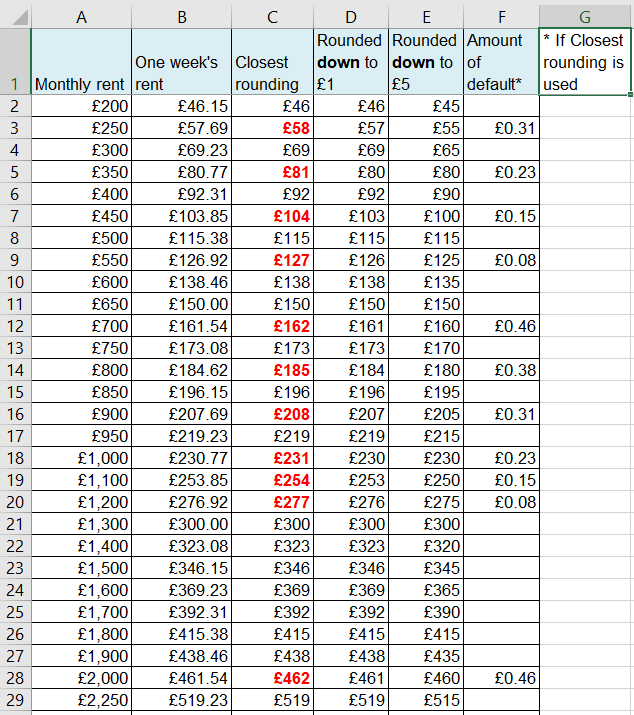
A monthly rent of £550 multiplied by 12 and divided by 52 gives £126.92 (to two decimal places). If this is rounded to £127 an extra £0.08 has been taken and this is a prohibited payment. Most tenants will not bother the council about an overpayment of £0.08. One trusts that Councils have better things for their officers to do than chase landlords for pennies.
However, that £0.08 overpayment will forever “lurk” as a prohibited payment. If it is spotted by the tenant or his advisers it may be used to ambush the landlord’s section 21 application. That application cannot be brought until the prohibited payment of £0.08 has been repaid. Even if the tenant has consented to the holding deposit being applied towards the rent or tenancy deposit: ‘Tenant Fees Act 2019 – Elephant trap for the unwary!‘ this will not prevent the point being taken.
The safe course is for landlords and agents to round down the holding deposit to the nearest £1 or £5 rather than risk an overpayment.
There is a simple Excel formula to round down a number in cell A1.
=FLOOR(A1,1) will round down to the nearest £1. The formula =FLOOR(A1,5) will round down to the nearest £5.
Click Here to download a spreadsheet showing these calculations or see below.
21 comments on this article
Learn from your peers’ experience
A different perspective could help you spot an issue, avoid a mistake or find a better way forward. Read the comments and add your own views if you wish.
Previous Article
Reneging on purchase deal after mortage has been paid?Next Article
Small Claims permitted after DPS award?
Member Since February 2016 - Comments: 986 - Articles: 1
2:37 PM, 22nd May 2019, About 7 years ago
What has this, once great, country has become?!
Member Since March 2015 - Comments: 1979 - Articles: 1
3:30 PM, 22nd May 2019, About 7 years ago
Reply to the comment left by Whiteskifreak Surrey at 22/05/2019 – 14:37
Rounding up/down aside, if you use the following calculation method, you arrive at a totally different answer altogether:
Multiply the monthly rent by 12 (months in a year), divide by 365 (days in a year) then multiply by 7 (days in a weeks)…or 35 days when calculating a maximum five week deposit.
Using the example in the original post, £550pcm with my above method equals £126.57(5), which is somewhat different to £126.92.
What are your comments/thoughts, Ian – is there an ‘official’ method of calculation?
Member Since July 2013 - Comments: 2081 - Articles: 21
3:52 PM, 22nd May 2019, About 7 years ago
Reply to the comment left by Luke P at 22/05/2019 – 15:30
Hi Luke
Yes, the official method is as I have described. Paragraph 3 of Schedule 1 to the Act says:
3 (3) If the amount of the holding deposit exceeds one week’s rent, the amount of the excess is a prohibited payment.
3 (4) In sub-paragraph (3) “one week’s rent” means the amount of the annual rent payable in respect of the tenancy immediately after its grant, renewal or
continuance divided by 52.
Effectively it’s as if a year had 364 days as 12/52 is the same as 12×7/364.
Member Since March 2015 - Comments: 1979 - Articles: 1
4:43 PM, 22nd May 2019, About 7 years ago
Reply to the comment left by Ian Narbeth at 22/05/2019 – 15:52
Thanks, Ian. Thank goodness they had the sense to define it explicitly.
Member Since July 2013 - Comments: 2081 - Articles: 21
4:51 PM, 22nd May 2019, About 7 years ago
Reply to the comment left by Luke P at 22/05/2019 – 16:43
It wouldn’t have killed the draftsman to add “rounded up to the nearest whole pound” but that would not have set another trap for landlords.
Member Since June 2013 - Comments: 1121
12:03 AM, 23rd May 2019, About 7 years ago
What did we expect folks when May’s housing policy adviser is ex- Shelter. Let’s hope when May goes the adviser goes too. https://www.estateagenttoday.co.uk/breaking-news/2018/4/mays-new-housing-adviser-is-ex-shelter-ex-livingstone-policy-chief?source=newsticker
Member Since March 2016 - Comments: 254
10:19 AM, 23rd May 2019, About 7 years ago
Can you remind me how existing deposits are handled?
These will normally always exceed 1 week’s rent.
Thanks
Hamish
Member Since April 2014 - Comments: 460 - Articles: 1
10:47 AM, 23rd May 2019, About 7 years ago
Doesn’t this show how crazy it has all become ? Poorly crafted and poorly written legislation just makes money for lawyers, who can earn thousands arguing over a few pence
Member Since July 2013 - Comments: 2081 - Articles: 21
10:52 AM, 23rd May 2019, About 7 years ago
Reply to the comment left by Hamish McBloggs at 23/05/2019 – 10:19Hamish
Tenancy deposits, taken when the tenancy is entered into, will be limited to five weeks’ rent (or six weeks’ rent where the annual rent is £50,000 or more). My piece is about “holding deposits” (what I used to call reservation fees or reservation deposits) taken when the parties agree in principle and the landlord takes the property off the market and checks references etc. before signing the AST.
Member Since July 2013 - Comments: 2081 - Articles: 21
10:58 AM, 23rd May 2019, About 7 years ago
Reply to the comment left by Annie Landlord at 23/05/2019 – 10:47Annie
I am doing my best to warn landlords so they don’t get caught out. I don’t think the lawyers will earn fees arguing about a few pence (unless someone takes a test case to appeal). It will be landlords ambushed at the door of the court because 9 months ago they took 8 pence too much holding deposit. Even though full credit may have been given for it, the law says the landlord has to “repay” it to the tenant, who then immediately owes that amount to the landlord. Tell your MP that he or she is a fool for voting for this nonsense.