

London council widens its landlord licensing as inspections uncover safety issues
10 months ago | 12 comments


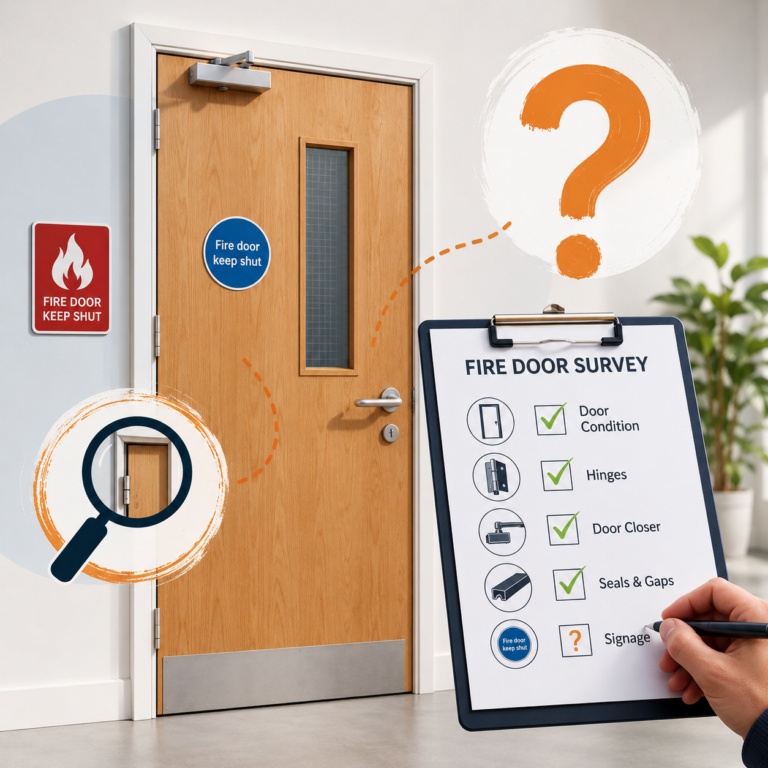
Hello, I am looking for advice on how to proceed regarding my flat’s main fire door. Our managing agent recently arranged for fire door surveys to be completed by an agency for all flats in our building.
The report requested that I complete the following repairs: replace the hinges and letterbox, ensure the gaps around the door are between 2–4mm (some of my current gaps are only 1mm), and install a door closer. The managing agent has instructed me to ensure an FD30 compliance certificate is issued for the door once the work is completed.
However, they have not provided a timeline for this work, nor have they explained the consequences if it is not done.
I invited two local carpenters to quote for the job. Both were happy to carry out the repairs specified in the report for £400–£500 (including parts), but both stated they are unable to issue an FD30 certificate. They mentioned they perform this type of remedial work almost daily due to recent legislative changes.
A third professional inspected the door and quoted £800. He pointed out additional issues not mentioned in the report, claiming that both the locks and the spyhole also need to be replaced.
A fourth professional stated he could complete the work and secure an FD30 certificate via BM TRADA. However, he noted that the spyhole and locks require a fire-resistant intumescent wrap to be compliant. Furthermore, he pointed out that the bottom of the door has a 15mm L-shaped cut to fit the raised threshold, which is non-compliant.
He proposed grinding down the raised threshold with an angle grinder, shaving the bottom of the door flat, and installing intumescent strips on all sides for £400. He warned that leaving the L-shaped cut as-is would result in an automatic inspection failure.
I was close to hiring him, but he insisted on cash payment, which made me uncomfortable, so I declined.
I then sought two more quotes from highly-rated, established carpentry businesses. The first provided an online quote for a brand-new door, stating they cannot repair the existing one because the L-shaped cut makes it an automatic failure. The second carpenter offered to complete the agency-specified repairs for £400, claiming the L-shaped cut is standard (noting that all flats in the building have it) and that intumescent strips are never applied to the bottom of a door anyway. Neither of these companies can issue an FD30 certificate.
I contacted the agency for clarification, but they refused to comment on items not in the original report (such as the locks or the L-shaped cut) without a reinspection and an additional fee.
I am in a difficult position. The agency will likely return next January on the managing agent’s instructions.
How likely is it that they will flag these additional issues (the locks and the L-shaped cut) during their next inspection?
Thank you,
Rita
40 comments on this article
A different perspective could help you spot an issue, avoid a mistake or find a better way forward. Read the comments and add your own views if you wish.
Previous Article
Housing crisis deepens as new build developments drop
10 months ago | 12 comments

6 months ago | 5 comments
2 years ago | 10 comments
Member Since April 2018 - Comments: 637
10:32 PM, 19th July 2026, About 3 months ago
Reply to the comment left by Tim Peters at 20:36
Thanks Tim.I have read The Regulatory Reform (Fire safety) order 2005 (as amended).
3.3.Fire-resisting doors.Your fire risk assessment should already have identified whether doors are adequate to resist the spread of fire and smoke and where it has been found that the existing door is inadequate and needs to be replaced this must be done by a competent person.
So the property manager should have done this in 2005/6 or advised the leaseholder.
I also found:
6.1 Regulation 10 requires that if the top storey of the building is above 11 metres in height (typically a building of more than 4 storeys) check flat doors at least every 12 months.
This would seem to confirm that if it 3 storeys or below you don’t need annual or 6 monthly checks.
Member Since October 2023 - Comments: 98
4:26 AM, 20th July 2026, About 3 months ago
Reply to the comment left by David at 19/07/2026 – 22:32
Agreed, but a building is not a static situation, and the regs require that the FRA is reviewed “regularly”.
At a review, you can’t determine if a door is “adequate to resist the spread of smoke and flame” unless you have checked it’s condition and compliance.
It isn’t defined exactly how often regularly should mean, but for low rise residential BS9792 suggests every 2 years.
I don’t think there is an issue if managers want to complete the check annually as that is the frequency specified in higher risk buildings and no one ever got prosecuted for doing more than is required.
What does annoy me is that managers use external (very expensive) firms to complete the checks. We put our caretaker through an online course in fire door inspection (cost about £200) and that ticks the box which says he is now competent to inspect fire doors. He then conducts the necessary checks (including an annual one of flat entrance doors) and completes an excel spreadsheet for our records. It probably takes 1 minute per door and we get them done over the course of a couple of days.
The main issue we find is with door closers. Sometimes tenants remove them as they find them awkward when bringing in shopping. We also once found a lock had been changed and didn’t have a thumb turn (not technically our problem but we made the landlord aware)
Member Since September 2013 - Comments: 242
11:32 AM, 20th July 2026, About 3 months ago
Reply to the comment left by rita chawla at 20:30
Hi Rita, that sounds pretty comprehensive. If the Front door is not mentioned then it would seem it is part of the block responsibility. In our flats the lease clearly says the windows and the Front door are both demised to us. A quick message to the leasehold advisory service would confirm this. I would contact them and then get back to your Landlord or the responsible person and tell them what you have been advised. You could quote the leasehold advisory service. Send the leasehold advisory service a copy of the relevant bit in your lease if you can, it is better than writing it yourself.
Member Since October 2023 - Comments: 98
11:43 AM, 20th July 2026, About 3 months ago
Reply to the comment left by LS at 20/07/2026 – 11:32
Rita….be very careful who you take “advice” from on a forum like this. Look at the decision in Marlborough Knightsbridge Management Ltd v Fivaz (2021) EWCA Civ 989,
The court of appeal decided (in simple terms) that there wasn’t much point in having a flat without a front door and therefore if the lease is silent as to it’s demise, it should be considered to have been demised and be the Leaseholder’s responsibility.
Your managing agent sounds to be doing the right thing in terms of they do have a duty to inspect, and it is probably your responsibility to fix. I know that isn’t easy, but if some doors have faults and others don’t it might explain why they are reluctant to get involved (even though it should be cheaper to bring a firm into make all repairs at the same time)
Member Since September 2013 - Comments: 242
11:52 AM, 20th July 2026, About 3 months ago
Reply to the comment left by Tim Peters at 19:47
I think you should finish the sentence then it is clear what i am saying. The law stands for all flats regardless of height i.e. they must be inspected and made fire safe. With regard to inspections I think everyone should read thes UK government rules rather than rely on our opinions. It clearly tells you how often the inspections should take place, and that it doesn’t need to be done by an expensive company. A porter or the like can do it. There is a very long check list of all the checks that need to be made and records must be kept of the inspections. Different time scales according to the height of the building. https://www.gov.uk/government/publications/fire-safety-england-regulations-2022-fire-door-guidance/fire-safety-england-regulations-2022-fire-door-guidance
Member Since September 2013 - Comments: 242
11:58 AM, 20th July 2026, About 3 months ago
I think it is incumbent on us all to make sure the fire safety is done properly and to check the checks are done as we have a duty of care to our tenants morally and legally. No cutting corners as I have seen here. i.e. Fire surveys, regulated contractors who issue a certificate of conformity etc.
Member Since September 2013 - Comments: 242
12:15 PM, 20th July 2026, About 3 months ago
Reply to the comment left by Tim Peters at 11:43
Tim you are quite right as I have already said about taking advice here, you need to check the official version. This is what I have found about the front doors, it is complicated. In Rita’s case it seems the landlord is saying it belongs to her.
In English leasehold law, the lease is what determines ownership and responsibility. If the lease expressly demises the walls, ceilings and windows but is silent about the flat entrance door, there are several possibilities:
1. The door is included as part of the demise, even though it is not mentioned separately. This can happen if the lease defines the flat broadly (for example, everything within the internal surfaces of the walls) and the door is treated as part of the flat.
2. The door is retained by the freeholder because it forms part of the structure or exterior of the building. This is common in modern leases, particularly where the entrance door is also a fire door protecting the common parts.
3. The lease is simply ambiguous. Older leases often do not deal with entrance doors clearly. In those cases, the wording of the whole lease, any plans, and the repairing covenants need to be considered together.
The repairing obligations can provide a clue
Even if the demise clause is silent, look at:
* the landlord’s covenant to repair;
* the leaseholder’s covenant to repair; and
* any clauses dealing with fire safety or common parts.
For example:
* If the leaseholder must keep “all doors and windows of the flat” in repair, that suggests the entrance door may be theirs.
* If the landlord must maintain the structure and all doors opening onto common parts, that points the other way.
Fire doors
A front door can be:
* owned by the leaseholder but subject to restrictions on alteration;
* owned by the freeholder; or
* owned by the leaseholder while the freeholder has rights to require it to meet fire safety standards.
Ownership and responsibility are not always the same.
You shouldn’t assume it is the block’s responsibility.
Silence in the demise clause does not automatically mean the door belongs to the freeholder or is the block’s responsibility. It means the lease needs to be read as a whole.
These 3 points need to be looked at.
* the demise clause,
* the repairing covenants (both landlord’s and leaseholder’s), and
* the plan attached to the lease (if there is one),
Perhaps Rita should contact the Leasehold advisory service with her documents for their advice or she could just accept as she has been instructed that she must get her door done herself. The cost will probably be much the same either way and it has to be done properly.
Member Since October 2022 - Comments: 436
7:06 PM, 20th July 2026, About 3 months ago
Having read Marlborough case, the LH hadn’t breached terms of his lease by replacing his door but as the door was not a chattel and is in that case part of the land so the landlord has responsibility for maintenance and repair in order to obtain a Fire Certificate.
The take away is landlords must not use generic terms ‘landlords fixtures’ but write what the fixtures are: windows, doors etc.
The judgement held in that particular case the LH hadn’t breached his lease which is what he was accused of.
Member Since October 2023 - Comments: 98
7:23 PM, 20th July 2026, About 3 months ago
Reply to the comment left by Kizzie at 20/07/2026 – 19:06
Yes but the takeaway is also that if the lease does not specify explicitly who owns the door, the CoA are going to take the view that it belongs to the flat (and therefore the Leaseholder).
So we agree, it is the landlord who has to maintain and repair it and not the management company
Member Since October 2022 - Comments: 436
10:03 PM, 20th July 2026, About 3 months ago
Reply to the comment left by Tim Peters at 20/07/2026 – 19:23
The takeaway is a reprimand to landlords who provide sloppily written leases so the man. Co. (who acts on behalf of the landlord) cannot pursue a leaseholder for a breach of lease contract when the LH changes their flat door.
The LL/Man. Co. could vary the terms of the lease and set out in detail what are landlords fixtures and prevent one LH setting the precedent as to the requirements for all the other flat doors in the block or having to compensate the LH for putting in the ‘wrong’ door in terms of a fire certificate for the whole block.
The judgement states the flat door is not a chattel (LLs fixture) it is attached to the land for which the LL/Man Co has the obligation to maintain and repair and recoup through service charge