

Book your Property118 consultation
1 year ago


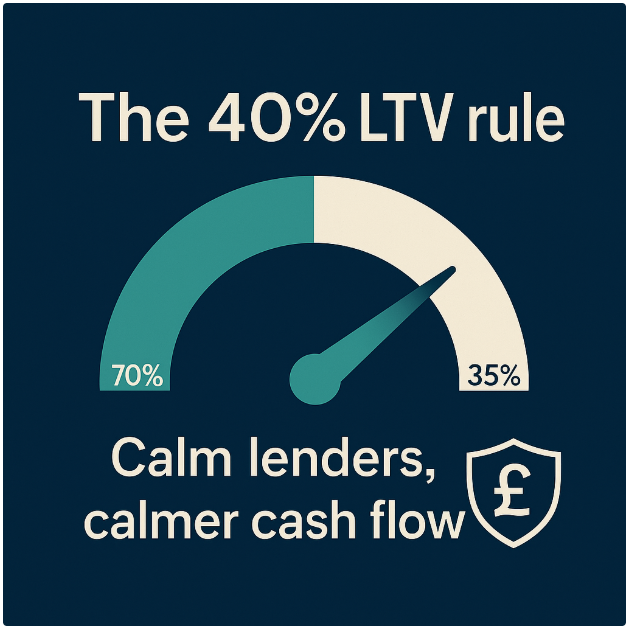
If you remember only one number for a calmer landlord life, make it this: around 40 per cent loan-to-value (LTV). It isn’t magic and it isn’t a promise—just a practical rule of thumb that keeps lenders comfortable, cushions rate shocks and gives you choices. Get close to 40 per cent (or step down via 45% → 42% → ~40%) and most portfolio decisions become easier.
Outcome: that’s the gap you aim to close via refinancing, a small number of selective disposals, or—in estate planning—a trustee loan from whole-of-life proceeds if a death occurs.
Same property, same rent—just a calmer balance sheet. That is the power of the rule of thumb.
Route to target: sell two weaker units for a combined net £180,000 (after fees, redemption and CGT), then refinance/repay a further £320,000 from the rest. Ring-fence a one-year buffer before any discretionary spend. Result: a resilient portfolio that underwrites well and runs quietly.
At bereavement, keeping lenders calm is everything. A trustee loan from policy proceeds lets you reduce LTV fast, maintain payments and buy time for an orderly plan—without commingling trust assets with lender redemptions. This dovetails with our whole-of-life and IHT guidance and keeps the portfolio bankable while probate runs its course.
Is 40 per cent the only “right” LTV?
No. Some portfolios sit happily at 45%; others prefer nearer 35%. The point is to choose a resilient target and work towards it.
What if I’m at 70% LTV today?
Step toward the target over 12–24 months—combine one selective disposal with staged refinancing. Document the plan so lenders see control.
Won’t selling to de-gear kill my income?
It can if you sell a strong unit. That’s why we model interest saved from debt repayment vs income lost from the sold rent stream, before deciding.
Do I need full valuations?
Start with AVMs. Upgrade to RICS where a lender or a transaction demands it, or where the property is unusual.
Use these alongside this piece to run the numbers and keep decisions commercial:
Whole of Life Insurance for Landlords — Keep Your Portfolio Bankable
Inheritance Tax for Landlords — Pay on Time Without Forced Sales
Exit, Refinance or Rebalance? A Decision Framework for Landlords
Net Proceeds Calculator: How Much Will You Really Have After Selling?
When Refinancing Beats Selling (And When It Doesn’t)
Our consultancy doesn’t only cover retirement, business continuity and legacy planning. It can also unlock the lifestyle you once dreamed about but forgot to implement.
Where our recommendations touch on areas requiring regulated input, we refer clients to appropriately authorised professionals for advice and execution.
3 comments on this article
A different perspective could help you spot an issue, avoid a mistake or find a better way forward. Read the comments and add your own views if you wish.

Previous Article
Cost remains biggest barrier to green home upgrades1 year ago
Member Since January 2025 - Comments: 132
10:35 AM, 6th October 2025, About 1 year ago
Buy-to-let only ever worked because of gearing and a financial system built to support it. For those unfamiliar with the concept, the model is simple: you invest limited capital, borrow the balance at around 4%, and aim to achieve returns of roughly 10%. The lower the return, the greater the leverage required to make any worthwhile profit.
Today, with little, none, or even negative real capital growth (once inflation is considered), the entire model becomes unsustainable. Lenders, of course, remain indifferent — their positions are well secured, and they profit on every pound lent, regardless of whether the borrower gains or loses.
That’s why lenders are comfortable at 40% loan-to-value: even in a market crash, their profits continue. But when lending thresholds tighten to that level, it’s not a sign of confidence — it’s a signal that better-informed minds and deeper research foresee trouble ahead. It is not cause for celebration but a warning of harder times to come unless the political course changes.
Why is it that organisations established to promote and protect the interests of land and property owners are now, one by one — including, sadly, Property118 as the last bastion — yielding to the dismantling of private land and property ownership? Why are they all repositioning themselves to profit from that dismantling rather than standing up for the very people they were created to represent? Perhaps they too see the same writing on the wall, and instead of fighting it, are adapting to survive within the new order that’s being engineered.
To make matters worse, the Green Party is now openly advocating for the abolition of private landlords altogether. While they are unlikely to form a government, their rhetoric will inevitably filter into mainstream politics, adopted by others seeking to attract the Green vote — and that is how damaging ideas gain traction.
Member Since May 2014 - Comments: 107
10:41 AM, 6th October 2025, About 1 year ago
Mark – I assume AVM means automated valuation model…not something everyone will be familiar with? Though any half decent-landlord should know roughly what their properties are realistically worth 🤔
Member Since January 2020 - Comments: 9
11:54 AM, 6th October 2025, About 1 year ago
Fantasy world figures, pay £320,000 off your borrowing to get down to 40%. If you did happen to have that money just sitting around, which is highly unlikely, there is something wrong if you cant get a return of well over what the borrowing costs are by investing it. Am I missing something??