

Case Study: How David Retired From Being a Landlord and Passed On His Legacy Early
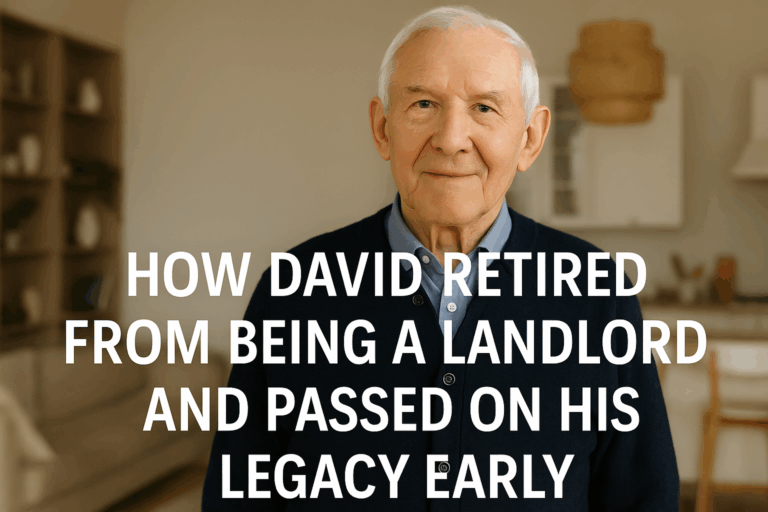
When “David” (not his real name) first came to us, he had what many landlords would see as the perfect position. After three decades of hard work, he had built a portfolio of 14 rental properties in his personal name, worth over £3 million, with modest loans and a reliable income that comfortably supported his retirement.
But beneath the numbers was a fear that had been growing quietly for years:
“I don’t want to leave my kids with a tax bill and a mountain of hassle. I want them to benefit from this, not spend years sorting out my mess.”
At 74, David had achieved what he set out to do financially. What kept him awake at night was not the value of his business, but what would happen to it, and to his children, when he was no longer there.
Only one of his three children had any interest in property. The others were successful in their own careers, with no appetite for tenants, mortgages or maintenance calls. David could see the risk: the portfolio he had built as a source of family security could easily become a source of family stress.
It wasn’t about chasing tax advantages. It was about kindness. David wanted to hand over value without handing over stress, and he wanted to do it while he was still alive to guide the process. That decision, to act now instead of leaving it to his Will, became the turning point in the story of his business and his legacy.
The Portfolio and the Problem
David’s rental business looked solid on the surface. Fourteen properties, a combined market value above £3 million, and loans low enough to leave over £2 million in equity. The income stream was strong and reliable. From the outside, there was nothing to worry about.
Once we worked through his Fact Find, the vulnerabilities became obvious:
- Every property was held in David’s personal name.
- There was no company structure to separate ownership from management or to ring-fence value for succession.
- No Will or Lasting Powers of Attorney were in place.
- There was no plan to address the very different needs of his three children, one of whom lived abroad and another who had no interest in property at all.
The risks went beyond tax. If David died or lost capacity without restructuring:
- Inheritance Tax exposure: With £2 million in equity sitting in his estate, almost all of it would face a 40% IHT charge.
- Frozen income: Rental payments would be suspended during probate, potentially for months.
- Lender pressure: Mortgages in his personal name could be called in immediately, forcing refinancing or distressed sales at the worst possible time.
- Family tension: The children would inherit a list of properties and liabilities, not a functioning business or a clear plan.
David put it bluntly during our discussion:
“If I died tomorrow, I’d be leaving them value on paper and chaos in reality.”
That single sentence defined the problem: the business he had built as a source of security could just as easily become a burden without the right structure in place.
The Turning Point
The moment that changed everything came not from an accountant’s spreadsheet but from an honest conversation over dinner. David casually raised the question of “what might happen one day” with the portfolio. His eldest son didn’t hesitate before replying:
“Dad, I wouldn’t even know where to start. I’ve got my own job and family. If you left it to me tomorrow, I’d probably have to sell the lot just to keep my sanity.”
It was a sentence that hit harder than any financial analysis. David realised succession isn’t automatic. Handing over properties is not the same as handing over a business. What his children needed wasn’t just value; they needed structure, clarity, and the ability to benefit without being trapped.
At the same time, David recognised a commercial reality. At 74, the lending environment was still favourable, but that window would not stay open forever. Acting now meant new financing could be secured while banks were still comfortable with him as a guarantor.
Fairness was the other driver. One child lived overseas, one had a demanding corporate career, and only the youngest had any interest in property. Without a plan, David feared the burden of management would fall on one child while the others benefited equally, a recipe for resentment.
As he put it during our first consultation:
“I don’t want my legacy to spark arguments. I want to hand over something that makes sense for all three of them, even if they want completely different levels of involvement.”
That mix of emotional clarity and practical urgency led to a big decision: David would not wait to pass the business through his Will. He would transfer ownership during his lifetime, ensuring his children inherited a fully structured company with his guidance, not instructions left behind.
The Plan
With the decision made to act during his lifetime, the goal was clear: remove the portfolio from David’s personal estate, give his children full ownership, and create a structure that would protect value and reduce future disruption.
The solution was a commercial sale of the entire portfolio into a newly created Family Investment Company (FIC), with all ordinary shares issued to his three children from day one. This was not a paper exercise; it was a genuine transfer of ownership designed to create a clean break and a clear future.
Funding the Purchase
The portfolio was professionally valued at just over £3 million. To complete the sale:
- The new FIC raised corporate mortgages against the properties, borrowing around 60% of the value.
- The balance between the sale price and the mortgage proceeds was left as a Director’s Loan Account (DLA) owed to David.
- David also advanced the cash required to pay the Stamp Duty Land Tax (SDLT), with that amount added to the DLA as a separate line item.
The DLA became a cornerstone of the plan. It gave David a secure retirement income as the company repaid the loan, and it created a flexible way to gift value gradually to his children using the seven-year rule without triggering new Capital Gains Tax events.
Stamp Duty Land Tax – The Six-Property Rule
Because 14 properties transferred in one linked transaction, the sale qualified under the six-property rule, meaning it was treated as non-residential for SDLT purposes.
- 0% on the first £150,000
- 2% on the next £100,000
- 5% on the remaining £2,750,000
Total SDLT: £139,500
Had the transaction been assessed under the residential surcharge rules, the bill would have exceeded £420,000. Using the six-property rule saved David’s family more than £280,000 in upfront tax.
Funding the SDLT via the DLA meant the company remained fully commercial while allowing the children to take ownership without needing to inject their own capital.
Why a Sale and Not a Gift?
David could have gifted the properties into the company, but a genuine sale offered two major advantages:
- It demonstrated the commercial nature of the transaction to HMRC and lenders.
- It allowed the DLA and SDLT advance to be documented as real debts, forming the backbone of both David’s retirement income and his long-term estate planning.
The Legal and Administrative Work
The new structure involved:
- Incorporating the new FIC and issuing all ordinary shares to the children.
- Securing and completing the refinancing across the portfolio.
- Drafting a robust shareholders’ agreement to protect the siblings and set out governance.
- Formally documenting the DLA and SDLT funding as commercial debts.
With ownership transferred and funding secured, the next step was to design the share structure inside the FIC to balance fairness, protect future growth, and ensure the business would remain resilient for generations.
The Tax Choice
A key part of David’s plan was deciding how to handle Capital Gains Tax (CGT) on the sale of the portfolio to the Family Investment Company.
Under normal circumstances, he could have used Incorporation Relief under Section 162 TCGA 1992, rolling the gains into the company and deferring any tax until a later sale. Instead, David chose to elect out of Incorporation Relief and crystallise the CGT immediately.
Why Pay CGT During His Lifetime?
David’s decision was not about chasing tax advantages. It was about creating certainty and removing future liabilities from his children.
He explained it in one sentence:
“I’d rather take the hit now on my terms than leave them a bigger problem to deal with when I’m not here.”
There were several clear reasons behind this approach:
Inheritance Tax versus Capital Gains Tax
The portfolio’s equity was over £2 million. If David had died holding the properties personally, nearly all of that value would have faced a 40% Inheritance Tax charge. By crystallising CGT at around 24% now, he was effectively trading a known, smaller liability for a much larger one later.
He also factored in what would happen if the properties continued to appreciate. At 74, there was every chance he could live another 15 years or more. If the portfolio’s market value doubled or even tripled in that time, a realistic outcome over such a period, the equity could have grown to between £8 million and £11 million even without paying down any loans. That would have pushed the potential Inheritance Tax liability to £3.2 million–£4.4 million, far beyond the current position and well outside what his children could manage easily.
A clean slate for the children
Paying CGT during his lifetime meant the company could be passed to his children with no deferred gain sitting under the surface, eliminating a hidden liability at a stressful time.
Control over timing and rates
CGT rates were lower than Inheritance Tax and could rise in future. Acting now locked in certainty under today’s regime.
Funding available from the transaction
The combination of corporate borrowing and the Director’s Loan Account created enough liquidity to cover the CGT in full without forcing asset sales or requiring his children to produce cash.
The Mechanics
- The properties were sold into the FIC at full market value.
- Incorporation Relief was formally disapplied via an election under s162A TCGA 1992.
- The CGT was calculated on the gain between David’s original costs and the agreed sale value.
- A portion of the mortgage proceeds and DLA funding was earmarked specifically to pay the tax.
By choosing to settle the CGT now, David ensured his children would inherit a company with no hidden time bomb of deferred tax and no exposure to a 40% Inheritance Tax charge on the value he had created over 30 years.
Structuring the FIC for His Children
Transferring the portfolio into a Family Investment Company achieved the first goal: removing the value from David’s personal estate and putting ownership in the hands of his children. The next step was designing the company’s share structure so that it would be fair, flexible and resilient for decades to come.
Freezer Shares – Locking in Today’s Value
With the portfolio now owned by the Family Investment Company, the next step was to design a share structure that would deliver three key objectives simultaneously: fairness among the siblings, protection of long-term value, and a business that his children could inherit without conflict.
Freezer Shares – Locking in Today’s Value
On completion, each of David’s children was issued a class of Freezer shares. These shares:
- Locked in the market value of the company at the date of transfer.
- Carried fixed or capped dividend rights to distribute existing rental income fairly.
- Had full voting rights, ensuring governance was balanced from day one.
The purpose of the Freezer shares was to separate the value David had already created from the growth that would come later, effectively capping what sat inside his children’s personal estates.
Growth Shares – Protecting Each Bloodline
To secure future value, three distinct classes of Growth shares were created, one for the benefit of each child’s bloodline.
Crucially, these were not issued to the children personally. They were placed into trust arrangements to:
- Keep all future growth outside the children’s estates for Inheritance Tax purposes.
- Protect the business against divorce, creditor claims or future relationship breakdowns.
- Ensure that each family branch benefited from the growth attributable to their line, preserving fairness across generations.
By doing this, David achieved a vital objective: his children inherited today’s value outright, while the wealth created in the future would be preserved and protected for their own children.
Tailored Rewards for Different Roles
Because only one of the children wanted to take an active role in overseeing the company, the structure separated ownership from management rewards:
- All three children held Freezer shares and received dividends equally, reflecting their equal ownership of the existing value.
- The child who agreed to manage the business was appointed as a director and received a modest salary plus the ability to earn bonuses based on productivity and performance.
This avoided resentment by ensuring dividends were fair regardless of involvement, while still recognising the extra responsibility taken on by the sibling running the day-to-day business. It also created a framework for the future: if none of the children wished to manage the company later, professional management could be appointed on the same basis without affecting family ownership.
Governance and Continuity
A detailed shareholders’ agreement was drafted to remove future uncertainty. It covered:
- How decisions would be made collectively.
- What would happen if one sibling wanted to exit.
- The process for appointing professional directors if no family member wanted to run the business in future.
David’s Role After the Transfer
David retained no ordinary shares and no equity in the company. His only financial link was the Director’s Loan Account, recorded as a genuine commercial debt. However, he stayed on as a non-shareholding director for a defined period to mentor his youngest son, who had stepped into a management role.
This served three purposes:
- It created a structured handover of knowledge and experience while David was alive to support it.
- It gave his son the confidence to take on leadership responsibilities with guidance, without creating long-term dependency.
- It reassured lenders and HMRC that while ownership had moved entirely to the children, operational continuity was planned and supported.
By separating immediate value from future growth and ring-fencing the latter for each bloodline, David created a structure that was not just fair today but resilient for decades to come.
The Outcome
When the transfer was complete, the business David had spent 30 years building had been reshaped entirely. What had been a personally owned portfolio was now a fully structured Family Investment Company with ownership and future value in the hands of the next generation.
For David
The change for David was profound.
Peace of mind: The fear of leaving his children with a logistical nightmare was gone. Ownership had passed, the governance was in place, and the business no longer sat within his estate.
Secure retirement: As a non-shareholding director, David held a documented Director’s Loan Account, giving him a flexible, guaranteed income stream without tying him to ownership.
A structured handover: Remaining on the board allowed him to mentor his youngest son during the transition, passing on knowledge while signalling that the business now belonged entirely to the children.
Freedom to step back: With management delegated and his role defined, David could finally enjoy his retirement without the constant pull of day-to-day property issues.
As he said, when the process completed:
“For the first time, I feel like I’ve finished the job I started 30 years ago. It’s not about building the portfolio anymore, it’s about handing it over properly.”
For His Children
The benefits to the next generation were just as significant.
- Full ownership: From day one, the children held 100% of the Family Investment Company and all rights to future growth, with the value created from that point onwards accruing entirely to their bloodlines through the Growth shares.
- Choice without obligation: The governance allowed them to benefit financially without being forced into management if they didn’t want to be.
- Fairness and protection: The Freezer and Growth share design ensured today’s value was shared equally, while future growth was ring-fenced for each bloodline through the trusts.
- Continuity: With the company structure in place, they avoided probate delays, frozen income and the risk of forced sales. The business could carry on seamlessly even if David stepped away completely.
One of the children summed it up during the final meeting:
“Dad hasn’t just left us a business, he’s left us options. We can keep it, grow it, or bring in management one day, without any pressure.”
By stepping back during his lifetime, David had given his family more than an asset. He had given them a functioning, protected business with clarity, fairness and the flexibility to fit their lives, and his own peace of mind in the process.
Lessons for Other Landlords
David’s story shows a reality that many landlords face but rarely address: building the portfolio is only half the job. Without the right structure, what you intend as a gift can easily turn into a burden.
The key takeaway is that planning early is not just a technical step, it is an act of kindness:
- Kind to yourself because it frees you from the fear of leaving chaos behind.
- Kind to your children because it gives them clarity and removes hidden stress.
- Kind to the business because it ensures continuity beyond a single generation.
The Family Investment Company, Freezer and Growth shares, and the Director’s Loan Account were just the tools. The real achievement was handing over ownership of the company and all future growth during David’s lifetime, while he was still there to guide the transition.
How We Help Landlords Do the Same
Our consultations are designed to take landlords through the same structured process David followed. It starts with a secure, comprehensive Fact Find created specifically for property businesses. This isn’t a surface-level review. It captures:
- The full picture of your portfolio and liabilities.
- Your family dynamics and long-term objectives.
- Your priorities for fairness, income and control.
Using your real numbers, we model different scenarios side-by-side, including:
- Full transfer into a Family Investment Company during your lifetime.
- Designing Freezer and Growth shares to balance fairness and protect future value.
- Creating liquidity through refinancing and Director’s Loan Accounts.
- Building governance so beneficiaries can inherit value without being forced into management.
The result is a detailed, plain-English planning report tailored to your business, supported by a clear implementation plan and optional project management if you decide to move forward.
A Final Thought
When David completed the process, he reflected on the experience:
“I thought I was doing this for them, but really, I bought peace of mind for me.”
If you have ever worried about what happens to your portfolio when you are no longer here, the best time to act is while you still have control. The greatest legacy you can leave isn’t just the value you’ve built, it’s the clarity and security to pass it on without burden.
Our consultancy doesn’t only cover retirement, business continuity and legacy planning. It can also unlock the lifestyle you once dreamed about but forgot to implement.
⚖️ Important Notice – Scope of Planning Support
Where our recommendations touch on areas requiring regulated input, we refer clients to appropriately authorised professionals for advice and execution.
BOOK A CONSULTATION


Previous Article
Landlord hate fuels disgraceful Edinburgh Fringe playNext Article
PBSA investment soars but supply issues remain