

Sell, Refinance or Rebalance: Landlord Decision Framework
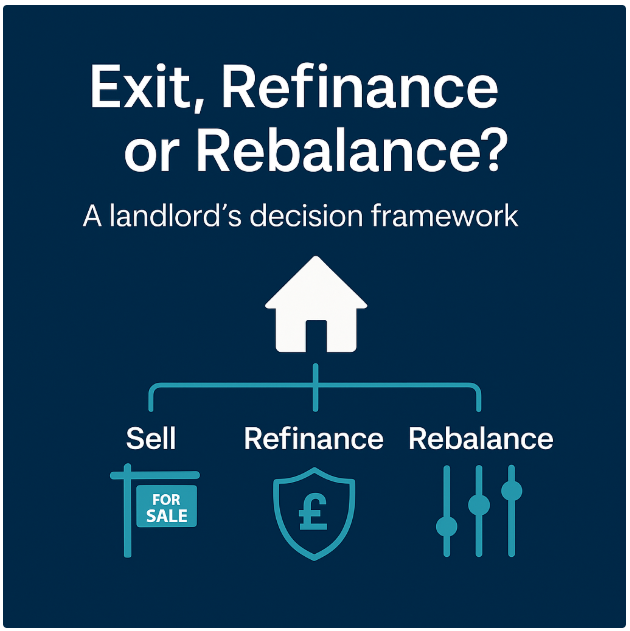

There is nothing wrong with selling. The key is to sell with your eyes open. Before you decide to market your properties and definitely before you accept an offer, check the true net proceeds after mortgage redemption costs and Capital Gains Tax, then compare that figure to a refinancing or partial sell-down plan that might deliver better cash flow and less hassle. This framework helps you decide calmly and commercially.
Companion guides
These pieces sit alongside this decision framework and help you compare selling with refinancing or rebalancing:
Case Study: How David Retired From Being a Landlord and Passed On His Legacy Early
Family LLP Secures £10m Portfolio with Valuations and Continuity Planning
How Landlords Can Future-Proof Their Property Portfolios and Inspire the Next Generation
How to use this framework
- Clarify your outcome. Are you seeking more free cash flow, less operational hassle, capital for another goal, or a glide path into retirement.
- Gather the right numbers. Use AVMs for quick values, your latest mortgage balances, any early repayment charges, and a simple CGT estimate.
- Run both cases. Compare net sale proceeds with a refinance or part-disposal plan targeted to a resilient LTV and a one-year liquidity buffer.
- Decide with a written plan. Lenders, buyers and advisers respond best to clear numbers and a tidy route map.
Step 1. Define success in plain English
- Increase monthly free cash flow.
- Reduce debt and improve sleep at night.
- Cut the maintenance burden and management time.
- Release a specific amount of capital.
- Ease into retirement without forced sales later.
Step 2. Gather the inputs
- Values: Portfolio-wide AVMs as a starting point. Upgrade to a full valuation only if a lender or transaction demands it.
- Debt: Balances, rates, maturities, early repayment charges, and any lender fees for consent or discharge.
- Costs to sell: Agent fee, legal fee, compliance certificates, expected void and minor works.
- CGT: Ownership splits, base costs and allowable improvements, estimated charge using current residential property CGT bands.
- Cash flow today: Net rent after realistic operating costs and a maintenance reserve.
Step 3. Calculate true net sale proceeds
Use a single property to illustrate the method, then scale across the portfolio.
- Assumptions: AVM £300,000. Mortgage £180,000. ERC 2%. Agent 1.5%. Legal £1,500. Base cost £200,000. Documented improvements £10,000. Annual exemption used elsewhere. Higher-rate CGT assumed at 24% for illustration.
Sale price: £300,000
Less agent fee (1.5%): £4,500
Less legal: £1,500
Net before mortgage: £294,000
Redeem mortgage: £180,000
Early repayment charge (2% of £180,000): £3,600
Cash before tax: £110,400
Capital gain: Sale £300,000 minus base and improvements £210,000 minus disposal costs £6,000 = £84,000.
CGT at 24% (illustrative): £20,160
Net cash after CGT: £110,400 − £20,160 = £90,240
Result. Despite a £300,000 sale price, you may finish with around £90,000 after costs, redemption and tax. Many landlords are surprised by how quickly sale proceeds shrink once the real deductions are counted.
Step 4. Compare with a refinance or partial sell-down
Now compare the sale outcome to a refinancing and de-gearing plan aimed at long-term resilience and better sleep at night.
- Refinance and de-gear: Target a portfolio LTV of about 40 per cent to keep lenders relaxed through stress tests. Aim for a one-year liquidity buffer to handle works and rate changes.
- Partial sell-down: Sell the weakest unit and use proceeds to repay debt on the keepers. The goal is a step change in cash flow without dismantling the best assets.
- Hold and tidy: If today’s LTV and cash flow are already comfortable, a governance clean-up and rent review plan can be more efficient than a disposal.
Quick comparison method
- Estimate annual cash flow lost if you sell (net rent less avoided costs).
- Estimate annual interest saved if you use net proceeds to repay debt elsewhere (net proceeds × assumed rate).
- Compare the two and factor in any change in maintenance burden and management time.
If interest saved is lower than the cash flow you lose, selling that unit may worsen monthly income, even if the balance sheet looks tidier. If interest saved and reduced hassle outweigh the lost income, a targeted disposal can be the right move.
Step 5. Improve the outcome before you decide
- Sequence across tax years: Spreading sales can help use more than one annual exemption and manage income bands.
- Sell the weakest first: Low yield, high capex forecast, complex management.
- Renegotiate fees: Small changes in agent fees and ERC timing can move the needle.
- Broker dialogue early: A short lender pack often unlocks better refinance terms for the keepers.
When selling is the right answer
- Persistent negative or marginal cash flow with no realistic rent reset.
- Large capex looming where payback is weak.
- Concentration risk in a sub-market you no longer believe in.
- Life priorities have changed and simplicity is the goal.
When refinancing or rebalancing is better
- You can reach a resilient target LTV and improve free cash flow by retiring the most expensive debt.
- One or two selective disposals can stabilise the whole portfolio.
- The asset you plan to sell is one of the better performers and would be costly to replace.
Numbers to prepare before you speak to lenders or buyers
- AVM snapshot for each property and a portfolio total.
- Debt schedule with balances, rates, maturities, ERCs.
- Estimated selling costs and a simple CGT calculation.
- Three-line cash flow for each unit: rent, operating costs, interest.
- One-page plan: sell, refinance, or rebalance, with reasons.
Our consultancy doesn’t only cover retirement, business continuity and legacy planning. It can also unlock the lifestyle you once dreamed about but forgot to implement.
⚖️ Important Notice – Scope of Planning Support
Where our recommendations touch on areas requiring regulated input, we refer clients to appropriately authorised professionals for advice and execution.
BOOK A CONSULTATION
Be the first to comment
Your experience could help the next reader
Have you dealt with something similar? Share what you learned, raise a question or offer a perspective your peers may find useful.


Not a member yet? Join In Seconds
Login with