
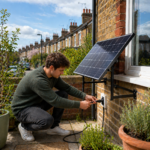
Renters may gain the right to install plug-in solar panels
6 months ago | 10 comments


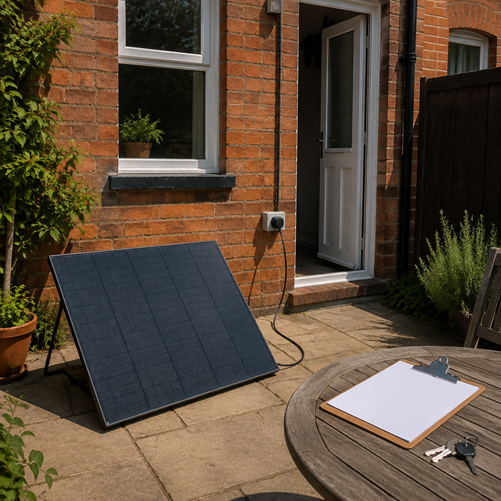
Landlords may now be asked to approve plug-in solar panels at rented homes after the devices became legal across Great Britain this week.
The government says the panels can be used from 27 August and could cut household electricity bills by up to £110 a year.
The devices can be placed in outdoor areas or on some balconies and plugged directly into a home.
Depending on the property, landlord, building owner or freeholder approval may be required, along with planning permission or listed building consent.
Energy secretary Miatta Fahnbulleh said: “Plug-in solar is a simple, affordable way for households to take control of their energy bills and start saving straight away.
“From this summer, we’re giving more families the ability power their homes with clean homegrown energy.”
Energy Saving Trust knowledge manager Joanna O’Loan said: “The arrival of plug-in solar panels represents a significant milestone in expanding access to clean energy for households across Great Britain.
She added: “While the savings will vary from home to home, plug-in solar panels will give more people greater control over their energy use and costs.
“As these products become more widely available, access to clear and reliable information is essential to help people make informed choices that are right for their home and budget.”
Each plug-in kit can produce up to 800W, providing as much as 20% of an average home’s electricity use.
When the sun is shining, that could power a fridge, television, Wi-Fi router, laptop, phone charger and an Xbox S at the same time.
The government says the panels require no installation cost and generate electricity without drawing power from the grid.
Their introduction follows independent safety testing covering the main electrical components and compatibility with UK wiring.
Amazon, Argos, Currys and Wickes have committed to stocking plug-in solar panels, while B&Q and Screwfix have also worked with the government on the rollout.
The UK safety specification is more stringent than Germany’s, where about half a million new devices were plugged in last year.
Almost 150,000 certified solar panel installations across the country were recorded during the first half of 2026, up 17% on the previous record set in 2025.
Certified battery installations reached 36,000 during the same period, almost double the number recorded a year earlier.
14 comments on this article
A different perspective could help you spot an issue, avoid a mistake or find a better way forward. Read the comments and add your own views if you wish.
Previous Article
Can plug-in solar panels improve a landlord’s EPC rating?
6 months ago | 10 comments
2 months ago | 16 comments
7 months ago | 6 comments
Member Since June 2013 - Comments: 732 - Articles: 1
10:47 PM, 29th August 2026, About 2 months ago
Reply to the comment left by Judith Wordsworth at 28/08/2026 – 10:40
its not installed – its a plug-in.
Member Since June 2013 - Comments: 732 - Articles: 1
10:52 PM, 29th August 2026, About 2 months ago
Reply to the comment left by Judith Wordsworth at 29/08/2026 – 09:40
ignore the silly photo. they can be plugged into an internal socket via an open window.
Member Since October 2013 - Comments: 1757 - Articles: 3
10:16 AM, 30th August 2026, About 2 months ago
Reply to the comment left by Joe Bloggs at 29/08/2026 – 22:52
That will work well when it’s freezing outside with an icy wind blowing through that open window! Let’s just agree these devices are simply impractical and not cost-effective for the majority of rental properties, especially flats.
Member Since June 2013 - Comments: 732 - Articles: 1
6:42 PM, 30th August 2026, About 2 months ago
Reply to the comment left by NewYorkie at 30/08/2026 – 10:16
I never claimed anything about their cost effectiveness!!!! I was correcting a misunderstanding about fixed wiring.
clearly they are mainly for use in summer when the sun is shining and for hotter climes.