
Heat pumps and solar panels will be required in new homes
7 months ago | 6 comments


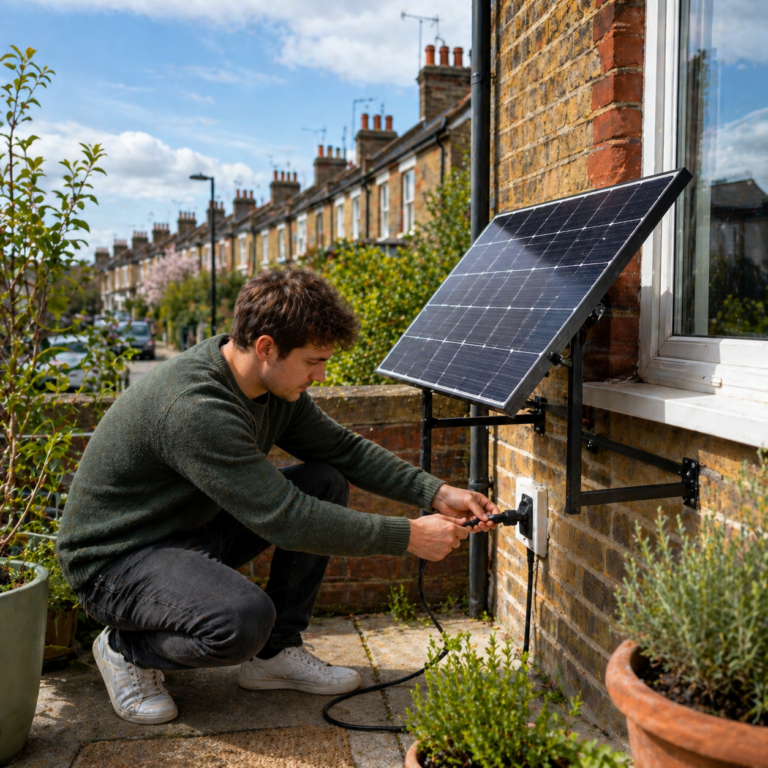
Landlords could soon be dealing with tenant requests to install plug-in solar panels, The i Paper reports.
It says that ministers are considering changes that may limit refusals as the technology reaches UK shelves this summer.
The proposals would give renters greater scope to fit the £400 systems.
Climate Minister Katie White has signalled legal changes could follow if permission from a landlord is routinely denied.
The minister said tenants should be able to install the panels, which plug straight into a mains socket and do not require an electrician.
Landlords would still be asked, but she said intervention remains an option if refusals become a ‘friction’ point.
That question extends beyond private landlords and includes freeholders in blocks.
They could also face limits on their ability to block installations on balconies or roofs.
Tenants would still be expected to seek consent, and officials are drafting guidance intended to reduce the scope for objections.
Work is underway within the Department for Energy Security and Net Zero and Ministry of Housing, Communities and Local Government to identify regulatory barriers.
Ms White told The i Paper: “We see this as an opportunity for renters, and I think most landlords will be wanting to support their occupants in terms of any opportunity to bring down bills.”
She said portability is part of the appeal and said: “Plug-in solar is great for renters because they can take it out the plug and take it with them when they end their rental agreements or if they move house.”
Government estimates suggest households could save up to £110 a year on electricity, with a £400 panel recouping its cost within four years.
Germany’s experience has seen one million households registering plug-in systems since 2019, with installations often mounted on balconies in flats.
In the UK, however, lease structures could complicate matters.
A spokesperson for Leasehold Knowledge Partnership told the newspaper that “the legal right to install solar panels on flat balconies will depend on a number of factors and everyone will need to check their lease”.
They added that many leases would require the building landlord’s permission, and this would come with a fee.
For renters in blocks, the chain of consent may be longer with a ‘more complex’ issue.
Insurance and safety rules remain in question, particularly for buildings above 18 metres, they added.
10 comments on this article
A different perspective could help you spot an issue, avoid a mistake or find a better way forward. Read the comments and add your own views if you wish.
Previous Article
Rents set to rise as landlord risks grow
7 months ago | 6 comments
8 months ago | 20 comments

9 months ago | 3 comments
Member Since February 2025 - Comments: 89
10:19 AM, 28th April 2026, About 5 months ago
How does the wiring in the picture work? Presumably most properties won’t have outdoor electric power points, so the solar panel connection will be going through an open window or door.
Member Since July 2013 - Comments: 762
11:15 AM, 28th April 2026, About 5 months ago
Tenants (and anyone) can already access solar power via portable solar panels and a suitable power bank, so no necessity to link into the mains – campers and caravanners often have such equipment. With LLs having responsibility for the electrical supply, I wouldn’t be comfortable giving consent for a direct link into the mains until there was certainty around the technology and specification of the equipment.
Member Since February 2024 - Comments: 92
2:07 PM, 28th April 2026, About 5 months ago
Wonder IF landlord supplied the panel and tenant benefitted from the electric, would that be taken into consideration for EPC ? Just a thought…..it maybe enough to just reach the C rating especially on older buildings.
Member Since May 2017 - Comments: 838
9:37 AM, 29th April 2026, About 5 months ago
My understanding is that a special socket needs to be installed. This would need to be installed by and electrician (at the tenants expense) and, I presume the EICR updated
Member Since January 2011 - Comments: 12256 - Articles: 1481
6:13 PM, 29th April 2026, About 5 months ago
These plug-in panels are too small to make a meaningful difference to most energy bills.
In the UK climate, the savings are likely to be minimal, so whoever pays for them is unlikely to see a sensible return. They won’t materially reduce costs and are not a substitute for proper solar.
In most cases, this is money spent for very little real impact.
Member Since September 2023 - Comments: 159
6:41 PM, 29th April 2026, About 5 months ago
You can just plug this in, but you’ll need an outside socket otherwise you’ll need an open window. With a south facing panel, in theory the pay back is around 4 years so, a decent return. However you need certified equipment so it’s not live when unplugged, and you’ll need to keep it under 800w so your consumer units RCD is still working, because if you start pushing to much power back it to the grid it causes issues.
The other problem is planning permission. The photo is probably AI generated. Panels on the front/side of the house need planning permission, and involvement from highways if it’s near a road. This is because panels can’t be more than a few CM away from the existing building, or distract drivers, so that’s why they go on the roof, plus the angle makes them gather solar energy more effectively.
Member Since January 2011 - Comments: 12256 - Articles: 1481
7:04 PM, 29th April 2026, About 5 months ago
Reply to the comment left by Jonathan Willis at 29/04/2026 – 18:41
This is political theatre.
These panels are far too small to materially reduce energy bills in the UK. At best they shave a little off daytime background use.
Whoever pays for them is unlikely to see a meaningful return. This isn’t a solution, it’s a distraction.
At best these panels power a fridge, not a household, so presenting them as a serious answer to energy bills is misleading.
Member Since September 2023 - Comments: 159
7:13 PM, 29th April 2026, About 5 months ago
Reply to the comment left by Mark Alexander – Founder of Property118 at 29/04/2026 – 19:04
They aren’t designed to power a house, even a full array with battery storage doesn’t easily take you off the grid. It’s too reduce the “ghost” consumption. Exactly as you say, fridge, TV, router, standby devices. It’s not running your air con, kettle, microwave, toaster.
With a full solar installation, you can run your heat pump and full house up-to a point. But there are plenty of times in the winter those systems cost more than the gas boiler to run due to energy demand and lack of British sun.
If a £400 panel can save £100 a year, compared to cash in the bank, it’s a fair return. You do need to position them out the shade and hope for good weather. They are not permanent installations but as a tenant you probably don’t want to be moving then from house to house due to suitability.
Comments: 2
6:53 AM, 3rd May 2026, About 5 months ago
Reply to the comment left by Kate Gould at 28/04/2026 – 10:19
Presumably, something like this cable will work, meaning the window call be shut with a cable passing through it.
https://amzn.eu/d/0fhVA6cT
Comments: 2
9:29 AM, 3rd May 2026, About 5 months ago
Reply to the comment left by Alex at 03/05/2026 – 06:53
*can be shut