
Renters may gain the right to install plug-in solar panels
6 months ago | 10 comments


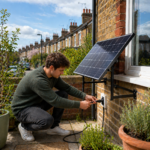
Landlords may now be asked to approve plug-in solar panels at rented homes after the devices became legal across Great Britain this week.
The government says the panels can be used from 27 August and could cut household electricity bills by up to £110 a year.
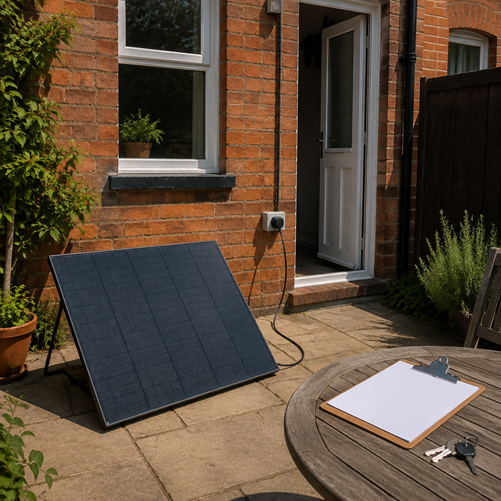
The devices can be placed in outdoor areas or on some balconies and plugged directly into a home.
Depending on the property, landlord, building owner or freeholder approval may be required, along with planning permission or listed building consent.
Energy secretary Miatta Fahnbulleh said: “Plug-in solar is a simple, affordable way for households to take control of their energy bills and start saving straight away.
“From this summer, we’re giving more families the ability power their homes with clean homegrown energy.”
Energy Saving Trust knowledge manager Joanna O’Loan said: “The arrival of plug-in solar panels represents a significant milestone in expanding access to clean energy for households across Great Britain.
She added: “While the savings will vary from home to home, plug-in solar panels will give more people greater control over their energy use and costs.
“As these products become more widely available, access to clear and reliable information is essential to help people make informed choices that are right for their home and budget.”
Each plug-in kit can produce up to 800W, providing as much as 20% of an average home’s electricity use.
When the sun is shining, that could power a fridge, television, Wi-Fi router, laptop, phone charger and an Xbox S at the same time.
The government says the panels require no installation cost and generate electricity without drawing power from the grid.
Their introduction follows independent safety testing covering the main electrical components and compatibility with UK wiring.
Amazon, Argos, Currys and Wickes have committed to stocking plug-in solar panels, while B&Q and Screwfix have also worked with the government on the rollout.
The UK safety specification is more stringent than Germany’s, where about half a million new devices were plugged in last year.
Almost 150,000 certified solar panel installations across the country were recorded during the first half of 2026, up 17% on the previous record set in 2025.
Certified battery installations reached 36,000 during the same period, almost double the number recorded a year earlier.
14 comments on this article
A different perspective could help you spot an issue, avoid a mistake or find a better way forward. Read the comments and add your own views if you wish.
Previous Article
Can plug-in solar panels improve a landlord’s EPC rating?
6 months ago | 10 comments
2 months ago | 16 comments

7 months ago | 6 comments
Member Since February 2024 - Comments: 92
10:26 AM, 28th August 2026, About 2 months ago
The one pictured looks like it would “go missing” too easily. Or get damaged easily. Hope there is some way of fitting them more securely?
We once had a very heavy manhole cover in an enclosed courtyard which very mysteriously went missing!
Member Since April 2018 - Comments: 654
10:32 AM, 28th August 2026, About 2 months ago
Like the the unauthorised satellite dishes that tenants install, that have to removed at the landlord’s expense.Enough of this nonsense. How much do these things weigh?
Member Since January 2015 - Comments: 1623 - Articles: 1
10:40 AM, 28th August 2026, About 2 months ago
If the tenant doesn’t pay for professional installation and amendment to the property’s EICR then why would any landlord agree?
If the tenant installs without professional installation and amendment to the property’s EICR this could be classified as a Hazard under HSSE and Grade 1 hazard fines imposed on the landlord by the Local Authority.
Member Since April 2018 - Comments: 654
11:16 AM, 28th August 2026, About 2 months ago
Reply to the comment left by Judith Wordsworth at 28/08/2026 – 10:40
Great advise, as always.Problem is some tenants will just install and with this anti landlord government/council wanting to fine everybody for the slightest honest mistake I fear this is exactly what could happen.
Member Since October 2020 - Comments: 1393
11:28 AM, 28th August 2026, About 2 months ago
Expect more house fires due to old wiring and letters from the Council about, ahem, unauthorised erections.
Member Since October 2013 - Comments: 1757 - Articles: 3
12:01 PM, 28th August 2026, About 2 months ago
They are a false economy. For the government to say no installation is required is scandalous. The wiring needs to be checked and an outside socket fitted. Where would they be fitted in a flat? On a balcony if available? What if it isn’t secured properly (up to 25kg) and falls off and kills someone? The lease would prohibit it, in any case. They don’t work with batteries, so you can’t store electricity for when you need it throughout the day/nightn(unless you are home all day on benefits). They would need to be serviced to check for damage. How long do they last? Insurance premiums would probably increase….
Why are we committing ourselves to even more Chinese crap?
Member Since February 2022 - Comments: 212
12:40 PM, 28th August 2026, About 2 months ago
Plugging in one 800W to ring is fine but what happens when someone starts plugging in 3 or 4 on the same circuit? Reverse feeding non bidirectional fuse is bad, also overloading the ring especially on older domestic wiring and knowing tenants using extension leads too. And to NewYork point Cheaply made knock offs too.
Member Since August 2024 - Comments: 43
12:56 PM, 28th August 2026, About 2 months ago
So let’s see..government says a saving of £110 a year..then quotes UPTO 20% savings…a guess based on maximum output all year?
Multiply that figure by 5 to get actual electric cost for the household so the average electric bill is £550 per year, really ????
If the panel generates maximum of 800 watts, using the 20% savings figure, then the average housold use per day THROUGH the entire year is 4kw…not happening in winter and very minimal gain anywhere..plus the average cost is 600 quid per unit, so six years just to offset the panels cost…negating the so called 20% maximum saving in electric costs.
Will the landlord be responsible for any hazards created, almost certainly when the Stasi council arrive for an inspection.
It’s just a scam.
Member Since December 2025 - Comments: 3
6:48 PM, 28th August 2026, About 2 months ago
Reply to the comment left by Judith Wordsworth at 28/08/2026 – 10:40
It is s plug in device so will not be part if an EICR as this is for the electrical installation. It may come under PAT testing which the owner will have the expense of doing, so if it is owned by the tenant then they will have to have it PAT tested if the law requires.Landlords responsibility is the property, fixed installation and any equipment or appliances provided and owned by the landlord.
Member Since January 2015 - Comments: 1623 - Articles: 1
9:40 AM, 29th August 2026, About 2 months ago
Reply to the comment left by Stuart Goodwin at 18:48
But requires a waterproof outside socket which then becomes part of the electrical circuit under ECIR? Holes drilled through the outside wall would breach Lease terms if done without the freeholders written permission never mind the landlords.