

HMO planning refusals have doubled – where are tenants supposed to live
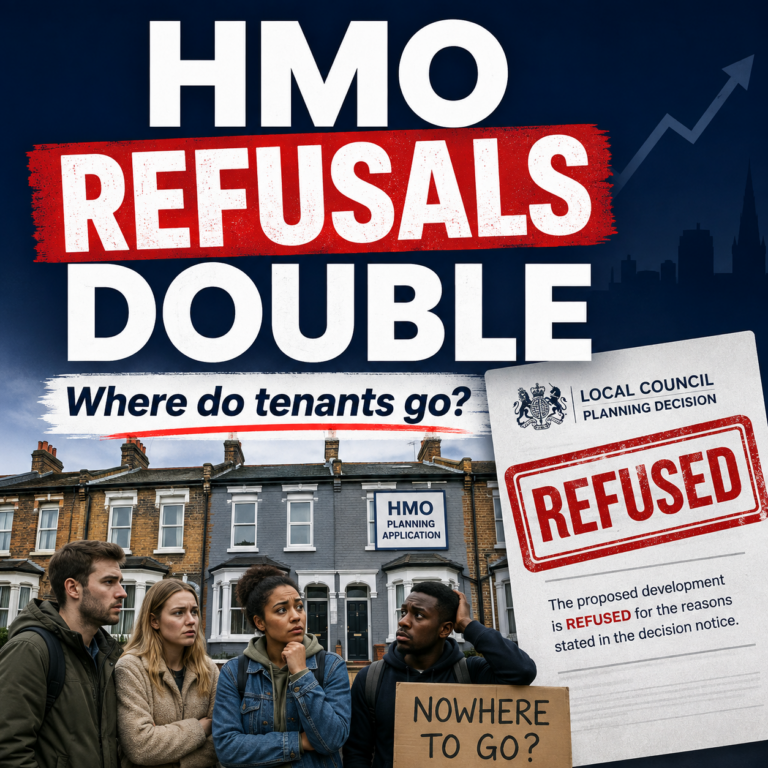

Councils refused 1,203 HMO planning applications in 2025. In 2021, the figure was 590.
There is an important caveat. The number of applications being decided also increased sharply, from 1,848 to 3,454 across the same 144 English councils. Therefore, councils have not suddenly become twice as likely to refuse an HMO application. The approval rate fell from 68.1% to 65.2%.
Even so, the practical result is that 613 more HMO applications were refused in 2025 than four years earlier.
Those refusals did not make the people looking for affordable rooms disappear. They merely prevented more of those rooms from being provided legally.
That is the part of the story councils rarely seem willing to confront.
An HMO is somebody’s home
HMO has become one of those phrases that immediately sets off alarm bells in local council meetings.
We hear about parking, bins, noise, overcrowding and the loss of family homes. Some of those concerns will be perfectly legitimate. Badly designed HMOs should not be approved and badly managed HMOs should not be allowed to continue operating.
However, not every HMO is a cramped house run by a rogue landlord.
A well-designed and properly managed HMO can provide decent accommodation for people who cannot afford, or do not want, an entire flat to themselves. That includes students, young professionals, key workers, people relocating for work, couples separating and those simply trying to get back on their feet.
For many of them, the realistic choice is not between an HMO room and a spacious one-bedroom flat.
It is between an HMO room, an unaffordable flat, a long commute, somebody’s sofa or whatever informal arrangement they can find.
Councils can refuse the planning application, but they cannot regulate that demand out of existence.
Article 4 is changing the commercial calculation
In many parts of England, the conversion of a normal C3 dwelling into a small C4 HMO for three to six unrelated occupiers can take place under permitted development rights.
An Article 4 Direction removes that right within the area covered. The landlord must then make a full planning application and take their chances against the council’s local HMO policies.
That does not amount to an outright ban, at least not on paper.
In practice, some councils impose concentration limits that make it extremely difficult to secure permission once an arbitrary percentage has already been reached within a street or prescribed radius.
Apparently, a well-designed HMO providing six good-quality rooms can be acceptable on one side of an invisible line but unacceptable on the other because a council spreadsheet says there are already too many.
The tenants who might have occupied those rooms still need somewhere to live, of course, but that does not appear to feature prominently in the calculation.
Article 4 Directions were supposed to allow councils to deal with evidenced local problems. Increasingly, we are seeing them applied across very large areas, sometimes covering an entire town or borough.
That may be administratively convenient, but convenience is not the same as good housing policy.
If the problem is concentrated within a handful of streets, target those streets. Do not make the creation of lawful shared housing more difficult everywhere and then express surprise when rents rise or people end up in less suitable accommodation.
Landlords cannot afford to buy first and investigate later
From a landlord’s perspective, this has made planning due diligence a fundamental part of the commercial appraisal.
It is no longer enough to find a large house, calculate the room rents, obtain a refurbishment quotation and assume the numbers work.
Before exchanging contracts, the buyer needs to know whether the property is already within an Article 4 area, whether a new direction has been proposed and what the council’s local HMO policies actually say.
They also need to establish the property’s current lawful planning use.
This is particularly important where a property is being sold as an existing HMO. A licence is not the same as planning permission, and the fact that tenants have occupied the property for several years does not automatically mean the owner can prove its lawful use when challenged.
As I explained in When is an HMO not an HMO?, the issue often emerges when the landlord tries to sell or refinance.
The buyer’s solicitor asks for evidence of lawful HMO use. The lender asks the same question. Suddenly, everybody discovers that the licence, council tax records and old letting adverts do not necessarily provide the certainty they expected.
A landlord who can demonstrate that the property was already being used lawfully as a C4 HMO before an Article 4 Direction took effect may be in a very different position from somebody trying to create a new HMO today.
That distinction can affect the property’s value, mortgageability and saleability.
Restrictions may increase the value of existing lawful HMOs
There is an obvious commercial consequence whenever councils restrict new supply.
Existing lawful HMOs may become more valuable because competitors cannot easily create more of them. Demand for rooms continues, but the planning system limits the number of new rooms that can be brought to market.
That can create scarcity value, but only where the property’s planning and licensing position is clean and capable of being evidenced.
An established HMO with a clear planning history, proper licensing, sensible management records and evidence of continuous use may become an increasingly valuable asset.
An HMO bought on assumptions, with missing records and no certainty over lawful use, could become an expensive problem.
That is why landlords should not regard planning as something for the solicitor to look at shortly before completion. It should be investigated before the purchase price is agreed, because the planning position directly affects what the property can earn and what it may eventually be worth.
Refuse the bad HMOs, not the people who need them
Nobody is suggesting that councils should approve every HMO application.
Conversions that create dangerous layouts, inadequate facilities, unacceptable overcrowding or genuine harm to neighbours should be rejected. Rogue landlords should also face robust enforcement.
However, that is not an argument for treating shared housing itself as the problem.
Britain has a shortage of affordable homes. Self-contained rents are beyond the reach of a growing number of people, social housing waiting lists are enormous and councils are already spending extraordinary sums on temporary accommodation.
Against that background, making professionally managed shared housing more difficult to provide looks less like joined-up policy and more like one department passing the problem to another.
A planning committee can vote against an HMO. It cannot vote away the tenant who would have lived there.
Reject the bad conversions. Prosecute the rogues. But stop pretending that refusing lawful HMO accommodation amounts to solving a housing problem.
The tenants still need somewhere to live.
Where exactly do councils expect them to go?
Are HMO applications being refused in your area despite obvious demand for affordable rooms? Has Article 4 affected the value, purchase or refinancing of one of your properties? Please share your experiences in the comments below.
7 comments on this article
Learn from your peers’ experience
A different perspective could help you spot an issue, avoid a mistake or find a better way forward. Read the comments and add your own views if you wish.
Previous Article
Landlords could face annual property tax under Burnham
Member Since April 2018 - Comments: 669
10:25 AM, 28th August 2026, About 2 months ago
Too much legislation from a Nanny state. If tenants don’t like where they live , move.
Member Since January 2015 - Comments: 1636 - Articles: 1
10:35 AM, 28th August 2026, About 2 months ago
Where are tenants supposed to live?
Maybe back home with their parents until they can afford to pay rent or buy?
Member Since December 2023 - Comments: 1665
4:12 PM, 29th August 2026, About 2 months ago
I would not want an HMO in my street. I bought my house in a nice street and paid good money for it.
The only reason that we need so many HMOs is because of mass migration.
Member Since June 2013 - Comments: 745 - Articles: 1
10:43 PM, 29th August 2026, About 2 months ago
Reply to the comment left by Cider Drinker at 29/08/2026 – 16:12
my HMO tenants are good neighbours. many non hmo neighbours are the pits.
Member Since April 2023 - Comments: 5
7:27 AM, 30th August 2026, About 2 months ago
My HMO is full of decent, hardworking tenants who respect their home and the area.
Member Since October 2013 - Comments: 1767 - Articles: 3
10:51 AM, 30th August 2026, About 2 months ago
The HMO issue is far more nuanced. We must factor in the make up of the elected council and those they represent.
We can’t sweep under the carpet the fact that certain cultures are not too concerned about observing the laws of this land, housing quality, and overcrowding. Large areas of Brentford and Ealing were full of such properties, with people even taking shifts sleeping in garden sheds. Everyone knows it’s happening, and where, but when we know the local councillors appear to ignore what goes on, it must be galling to those who want to provide decent HMOs and find themselves blocked by the same councillors.
Member Since October 2020 - Comments: 1402
11:04 AM, 30th August 2026, About 2 months ago
This isn’t just about Article 4 directives. 7 or more bed HMOs are sui generis and always need planning consent.