
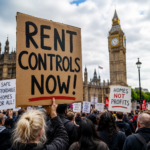
Housing campaigners demand rent controls ahead of new Prime Minister
4 months ago | 4 comments



Rent controls could save the average private tenant in England £2,400 a year, according to a report welcomed by Green Party leader Zack Polanski.
The report, published by the UCL Institute for Innovation and Public Purpose, argues that controlling rents could reduce housing benefit spending while improving affordability for lower-income households.
It was written by Dr Beth Stratford, an honorary research fellow at the institute, and Dr Joe Beswick of the Rosa Luxemburg Foundation.
Researchers calculated that, had rents been frozen in November 2022, the government could have restored housing support to cover the cheapest 30% of local rents and still be spending £2 billion less each year on housing benefit.
Combining the freeze with increased housing support would now be saving the average renting household £2,400 annually, the report claims.
Also, disposable income among renters in the poorest fifth of households would be 22% higher.
Mr Polanski welcomed the findings, saying on social media: “Great to see how well the new report into rent controls has landed!
“It saves renters money and it saves government money.
“And some of that money should be used on building new social housing stock, too!
“Win/win all around!”
He has previously promoted the report by saying it was time to “take back control of rents”.
The Green Party has already called for rent controls as part of its response to the cost-of-living crisis.
During its 2026 local election campaign, it said councils should be given powers to restrict rent increases.
The Wales Green Party proposed a one-year freeze as a longer-term system was developed.
The new analysis also challenges claims that substantial rent reductions would make large numbers of landlords financially unviable.
Using HM Revenue & Customs data, the researchers estimated that a 20% reduction would cut the mean pre-tax profit margin among mortgaged landlords from 70% to 64%.
That margin, they said, would still be 4.5 times the average pre-tax margin recorded by businesses across the economy.
However, the calculation excludes capital gains arising from house price growth.
Unmortgaged landlords, who account for 58% of unincorporated landlords in the report’s analysis, would retain higher margins.
A 10% rent reduction would make an estimated 2.3% of landlords unprofitable.
The authors accept that controls would prompt some landlords to sell, including to councils and housing associations.
Savings generated by a 20% reduction could, within 10 years, support the purchase of at least 48% of the properties made unprofitable by the policy, the report estimates.
Half of those acquired homes could then be converted to social rent.
The proportion that could be purchased would rise to at least 56% with changes to council financing, according to the calculations.
13 comments on this article
A different perspective could help you spot an issue, avoid a mistake or find a better way forward. Read the comments and add your own views if you wish.
Previous Article
Survival of the fittest?
4 months ago | 4 comments

4 months ago | 17 comments
Member Since August 2023 - Comments: 48
10:13 AM, 14th July 2026, About 3 months ago
The greens could just google:-
Rent controls have rarely “worked” as intended to solve housing shortages. While they provide short-term stability for existing tenants, international case studies consistently show that strict rent caps often shrink housing supply, deter new development, and create massive informal “black” markets. Looking at international experiences highlights distinct outcomes across different models:
Sweden (Long waiting lists): Sweden utilizes a system of collective bargaining to keep rents low. While it protects current tenants, it has resulted in a severe shortage of accommodation and waiting lists of up to 10 to 20 years in major cities like Stockholm. This has forced many young people into overcrowded share-housing or illegal subletting markets.
Germany (Pressure zones & loopholes): Germany caps in-tenancy rent increases by an index and utilizes a Mietpreisbremse (rent brake) to limit rent hikes in “pressure zones” to 10% above the local average.
However, studies show this has led landlords to bypass rules by heavily furnishing apartments (exempt from the cap) or selecting higher-income tenants, resulting in ongoing affordability challenges in Berlin and Munich.Berlin,
Germany (Short-lived rent freeze): In 2020, Berlin implemented a hard cap and five-year freeze on rents for roughly 1.5 million apartments. While it initially reduced prices, it caused a steep drop in available rental listings, and the policy was ultimately overturned by the courts as unconstitutional.
Member Since October 2023 - Comments: 27
10:20 AM, 14th July 2026, About 3 months ago
I saw Polanski’s post about the profitability of landlords and commented the following:
I’d be very careful with these claims. Is tenants’ welfare the primary concern, or putting landlords out of business? If it’s the latter, you might find tenants suffer as a corollary.
The 4.5x figure compares profit margins, not profits or returns on investment. Property has low turnover relative to the capital invested, so of course its margin on revenue looks high. Comparing a landlord’s rental margin with the turnover margin of an operating business is economically meaningless. Compare return on capital or equity instead.
There may be another problem. I make no assumption that this is what the report has done, but if its HMRC data treats taxable property profit as actual profit, Section 24 creates a huge distortion because mortgage interest is no longer deducted from taxable profit. Landlords, in effect, pay tax on partial turnover, which means many pay tax on a loss – over 100%.
Take £1,000 rent, £600 mortgage interest (the loan capital is never paid off) and £200 other costs – both conservative estimates. The landlord actually makes £200 before tax. Before Section 24, a 40% taxpayer pays £80 tax and keeps £120. Under Section 24, HMRC taxes £800, producing £320 tax, then gives a £120 basic-rate credit: £200 tax, leaving nothing. Yet the taxable-profit figure is £800 — a supposed 80% “profit margin” on a business actually making £200 before tax and nothing after tax. If that figure has been used as “profit” and compared with ordinary business margins, the 4.5x claim is fundamentally flawed.
Include the actual Section 24 tax bill as a cost and the same illustrative landlord is left with a 0% margin. Against the report’s 14.2% average business margin, the headline reverses completely:
Rather than the landlord making 4.5 times the margin of an average business, the landlord makes no post-tax profit at all, while the average business has a 14.2% margin.
The FT reports 700 landlords a day are listing property for sale, that’s 250,000 a year. They’re not leaving the sector because it’s profitable, they’re leaving because they’re often paid nothing for the service they provide. This sell off puts strong downward pressure on affordable new build, with developers more likely to focus on the luxury market, which is not affected by ex-rentals. As rental stock fails to keep up with demand, the poorest tenants are pushed out of the sector into temporary accommodation or homelessness. I did a recent search over a 40-mile area and there was one 3-bedroom house for rent for under £1,000, and 448 for sale.
What is really needed is more housing, particularly affordable rental property. To get that, you need people who know what they’re doing to invest, buying up empty property – of which there is plenty – employing tradespeople to make it habitable, providing homes for those who need them, and paying tax at every stage from purchase through to rental. Without those willing to do this – landlords – you’re dealing with symptoms, not causes.
Member Since May 2015 - Comments: 2326 - Articles: 2
11:21 AM, 14th July 2026, About 3 months ago
Surely 10 to 20 years wait for property is “proportionate”, just like £40,000 fines?
Member Since May 2015 - Comments: 2326 - Articles: 2
11:23 AM, 14th July 2026, About 3 months ago
Rent controls could save tenants much more than £2,400 a year because sleeping on the street when all the landlords have sold is free of charge.
Member Since May 2018 - Comments: 2588
11:33 AM, 14th July 2026, About 3 months ago
Reply to the comment left by graham mcauley at 14/07/2026 – 10:13
….and in Scotland when the SNP introduced rent controls the effect was to increase rents for all new lets and a surge in rents when the controls were removed.
…and in Scotland Portugal has just had to move to liberalise the rental market and speed up evictions.
https://www.globalbankingandfinance.com/portugal-launches-reform-liberalise-rental-market-speed/
Zack Polanski has no idea of what he’s talking about. The only thing that he is achieving is to discredit the Greens: The Green Party used to be the party of sustainability.
Member Since May 2018 - Comments: 2588
11:45 AM, 14th July 2026, About 3 months ago
Reply to the comment left by Beaver at 14/07/2026 – 11:33
Sorry…that should just have read “…and Portugal has just had to move to liberalise the rental market..”
Scotland removed rent controls:
https://espc.com/news/post/end-of-rent-controls-in-scotland-what-this-means-for-the-market#:~:text=From%20April%202025%2C%20rent%20setting%20will%20return%20to,%28Scotland%29%20Bill%2C%20expected%20to%20take%20effect%20in%202027.
According to this link “It may also help attract property investors back to the market. In Edinburgh, demand for rental properties continues to outstrip supply, and removing financial barriers for landlords—many of whom have been handling rising costs—could improve overall rental stock.”
Even our most extreme left-wing government had to reverse its position on rent controls…just like Portugal.
Although of course the Greens are now more extreme-left-wing than the SNP.
Member Since February 2020 - Comments: 400
12:15 PM, 14th July 2026, About 3 months ago
Put a price on everything then, why single out landlords.
If Polanski wants to cap the price for tenants, why doesn’t he become a landlord and cap his own rent?
Price caps are government overreach.
Member Since May 2018 - Comments: 2588
3:27 PM, 14th July 2026, About 3 months ago
Reply to the comment left by Downsize Government at 14/07/2026 – 12:15
We already have energy price caps because of lack of competition in the energy market. However, because of the effect of war-crazed despots surrounded by yes-men invading other nations, energy prices can go up and energy price caps sometimes have to be lifted. Ofgem recently announced a 13% increase in energy prices from this month:
https://www.ofgem.gov.uk/energy-regulation/domestic-and-non-domestic/energy-pricing-rules/energy-price-cap/energy-price-cap-news-and-insight
But yes, governments who are arrogant, who get seduced by their own inflated perceptions of their power, can overreach themselves and cause collateral damage. Governments have to be careful about interfering in markets and destroying competition. The Labour Renters Rights Act is constraining supply, making some tenants too risky to house, and driving rents up. I would be surprised if the rent increase caused by the introduction of the Labour Renters Rights Act is less than 13%.
Portugal has already had to back track on some of its controls.
Rent controls won’t save tenants £2,400 per year.
Government is driving rents up.
Member Since March 2024 - Comments: 346
4:57 PM, 14th July 2026, About 3 months ago
I have owned a couple of trading businesses and was a portfolio landlord for many years. Polanski is simply beyond hope if, egged on by this clown show of a think tank, he can’t see the problem with the ludicrous figures around ‘margin’ that are claimed. It just illustrates that none of them have ever owned businesses or rental property or even worked in the private sector where salaries are based on the employer turning a profit. Just an endless round of PPE degrees, third sector posts and political positions.
I have just read the history of Jack Cohen and Tesco in the period to 1970, his aim was a complete turnover of the value of a stores’ stock every two weeks – so 26 times a year. Similarly a used car dealer would turn its stock over multiple times a year. A landlord has an illiquid pile of bricks, is not operating a trading business and would be very lucky to get a gross yield in double figures at the end of a year before costs so this apparent treatment of the gross rent being some sort of 100% windfall with costs reducing it to 70 odd percent is just utter nonsense.
Incredible that Polanski’s followers seem to be university educated younger people – just the ones who will be hit hard when even more PRS policy is based on utterly financially illiterate nonsense like this.
Member Since January 2026 - Comments: 12
6:49 PM, 14th July 2026, About 3 months ago
Reply to the comment left by Andrew at 14/07/2026 – 10:20
This is exactly why I sold a couple of years ago. On my mortgaged BTL once mortgage interest relief fully kicked in it was no longer viable.
I took the hit, made a loss, but at least I didn’t have to hand any CGT to the goons in government. Also, wholly relieved to be out of the PRS