
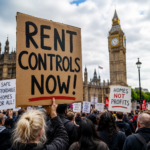
Housing campaigners demand rent controls ahead of new Prime Minister
3 months ago | 4 comments



Rent controls could save the average private tenant in England £2,400 a year, according to a report welcomed by Green Party leader Zack Polanski.
The report, published by the UCL Institute for Innovation and Public Purpose, argues that controlling rents could reduce housing benefit spending while improving affordability for lower-income households.
It was written by Dr Beth Stratford, an honorary research fellow at the institute, and Dr Joe Beswick of the Rosa Luxemburg Foundation.
Researchers calculated that, had rents been frozen in November 2022, the government could have restored housing support to cover the cheapest 30% of local rents and still be spending £2 billion less each year on housing benefit.
Combining the freeze with increased housing support would now be saving the average renting household £2,400 annually, the report claims.
Also, disposable income among renters in the poorest fifth of households would be 22% higher.
Mr Polanski welcomed the findings, saying on social media: “Great to see how well the new report into rent controls has landed!
“It saves renters money and it saves government money.
“And some of that money should be used on building new social housing stock, too!
“Win/win all around!”
He has previously promoted the report by saying it was time to “take back control of rents”.
The Green Party has already called for rent controls as part of its response to the cost-of-living crisis.
During its 2026 local election campaign, it said councils should be given powers to restrict rent increases.
The Wales Green Party proposed a one-year freeze as a longer-term system was developed.
The new analysis also challenges claims that substantial rent reductions would make large numbers of landlords financially unviable.
Using HM Revenue & Customs data, the researchers estimated that a 20% reduction would cut the mean pre-tax profit margin among mortgaged landlords from 70% to 64%.
That margin, they said, would still be 4.5 times the average pre-tax margin recorded by businesses across the economy.
However, the calculation excludes capital gains arising from house price growth.
Unmortgaged landlords, who account for 58% of unincorporated landlords in the report’s analysis, would retain higher margins.
A 10% rent reduction would make an estimated 2.3% of landlords unprofitable.
The authors accept that controls would prompt some landlords to sell, including to councils and housing associations.
Savings generated by a 20% reduction could, within 10 years, support the purchase of at least 48% of the properties made unprofitable by the policy, the report estimates.
Half of those acquired homes could then be converted to social rent.
The proportion that could be purchased would rise to at least 56% with changes to council financing, according to the calculations.
13 comments on this article
A different perspective could help you spot an issue, avoid a mistake or find a better way forward. Read the comments and add your own views if you wish.
Previous Article
Survival of the fittest?
3 months ago | 4 comments

3 months ago | 17 comments
Member Since June 2026 - Comments: 12
10:49 PM, 14th July 2026, About 3 months ago
And this is exactly the sort of thinking that’s just made me tell my tenants that I’ll be selling up, much to their dismay. The rent for the property is good value and has had no increases and they are worried about finding something similar. But I am even more worried about what’s coming. Now that Andy Burnham is in place, it’s time to move fast and try to beat the CGT increase that’s definitely coming as well as any other stupid “cost of living “ help he wants to give his voters while clobbering the evil landlords. Anyone else worried?
Member Since May 2018 - Comments: 2550
5:37 PM, 15th July 2026, About 3 months ago
Reply to the comment left by Ana at 14/07/2026 – 22:49
I think that most landlords are likely to be worried. And they have every right to be worried: Labour refused to publish the results of its justice impact test on the courts:
https://www.property118.com/government-refuses-to-reveal-renters-rights-bill-court-impact-assessment/
Last summer the NRLA warned that court backlogs were increasing:
https://www.nrla.org.uk/news/court-wait-times-up-despite-number-of-claims-falling
In April the Telegraph reported that court backlogs are increasing and it is taking 341 days to get properties back:
https://www.telegraph.co.uk/money/property/buy-to-let/creaking-court-system-landlords-battle-evict-rogue-tenants/?msockid=0b8a4155c7db6ba1058955b1c6196a07
Labour have SAID that they WILL fix the courts….but there is no evidence today that they HAVE fixed them. The truth is that labour also SAID that its first priority was to grow the economy and yet it is pursuing policies that punish employment and will cause the economy to stagnate. Labour has SAID that it will build 1.5 million new homes, but the truth is that labour is pursuing policies that punish investors from investing in housing. And so against this backdrop of saying one thing but doing something else, and no evidence as yet to say that court backlogs are dropping, we have no reason to suppose that labour will achieve the goal of ‘fixing the courts’.
Against this background landlords’ options in response to the increased risk from the Labour Renters Rights Act are mostly limited to selling, screening out the high-risk tenants and raising the rent to market rent to recover the additional costs imposed by the Labour Renters Rights Act thereby decreasing their risk of continuing to invest. In some cases it will be less risky to withdraw properties from the market rather than continuing to let them.
There are things that the government could do to decrease the risk for landlords but so far I can’t see any evidence that they are doing any of these things or have any appetite to consider them.
Member Since June 2017 - Comments: 145
4:35 PM, 23rd July 2026, About 3 months ago
Profits? Their word, not mine.
Does the term used in the article take into account the new roof I just had to put on a leaky house? Or the fact that I’m having spend money on a new hot water system in another? Or that the new EPC rules will mean I’ll have to spend £10k per property getting them to a C rating, or at least trying to? Or the money I have to find for court cases to evict people that are told to stay put by local councils, despite not having paid rent for months? Or any of the plethora of other items of expenditure that only a landlord would know about?
No, of course it doesn’t.
Maybe a tax hike in donations to political parties would be a more sensible option. I see nothing wrong with donations being taxed at the same level as income to landlords. Sounds fair to me. After all, what are the political parties not in power or opposition contributing to the British economy just now? Not a lot I would wager.
Fair treatment for all I say. If politicians want to bash landlords, they should be expected to have the pendulum swing back with equal force.