
UK rents rise 3.5% as house prices stall – ONS
4 months ago


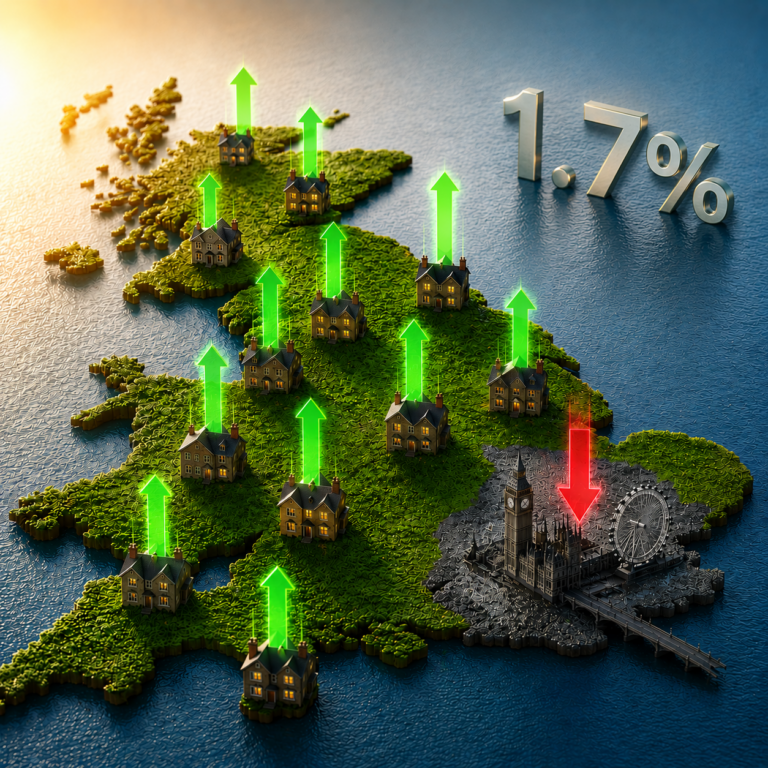
House prices are rising in most parts of Britain, but the latest figures show London moving in the opposite direction.
The e.surv House Price Index for April puts the average house price at £327,800, up 1.7% year on year.
Prices rose by 0.2% over the month and 0.3% over the quarter, with the strongest annual growth recorded in lower-priced regions.
Scotland led the table, with prices up 4.4% to £228,300.
The chartered surveyors firm says: “This points to a market that is still moving forward, but without strong momentum.
“The headline GB figure masks a wide range of regional positions.
“Most regions are still recording annual price growth, but London is moving in the opposite direction.”
It goes on: “The small monthly and quarterly gains show there is still support for prices, but the pace remains steady rather than strong.
“Without a clearer improvement in affordability and mortgage rates, national growth is likely to remain modest.”
The North West saw annual growth of 3.7%, taking average prices to £248,600, while Yorkshire and the Humber rose 3.2% to £234,400.
Wales recorded a 3% annual increase, with the East Midlands up 2.8% and the West Midlands up 2.7%.
The South recorded weaker growth as prices rose 1.4% in the South West, 1% in the East of England and 0.4% in the South East.
London was the only region in negative territory, with average values down 3.6% year on year despite remaining the most expensive market, at £586,871.
The capital also recorded a quarterly fall of 0.1%.
The figures show a sharp divide inside London itself with inner London prices falling 8.7% year on year, compared with a 2.6% fall in outer London.
The average inner London price stood at £687,415, while outer London averaged £518,655, leaving a gap of almost £169,000.
Inner London flats have been hit harder still, and prices are 11.2% below their April 2020 level.
Outer London flats were weaker than their recent peak, but still 4.1% above April 2020.
The firm also says that higher mortgage rates have reduced buying power in the most expensive markets, particularly for first-time buyers and mortgaged investors.
Higher service charges and running costs have also made some flats less attractive compared with houses or lower-density homes.
Tax changes are also affecting the top end of the capital’s market.
The end of Help to Buy removed a source of demand for new-build flats, while parts of inner London continue to work through a larger supply of apartment stock.
2 comments on this article
A different perspective could help you spot an issue, avoid a mistake or find a better way forward. Read the comments and add your own views if you wish.
4 months ago
4 months ago | 5 comments

Member Since January 2017 - Comments: 135
10:10 AM, 27th May 2026, About 4 months ago
Rubbish!
Just look at the number of reductions on Rightmove listing.
Also speak to estate agents, they will tell you, there are buyers out there “if you price realistically”, another words lower than properties in the area sold for last year and the year before.
Member Since April 2018 - Comments: 614
11:25 AM, 27th May 2026, About 4 months ago
Massively overpriced