



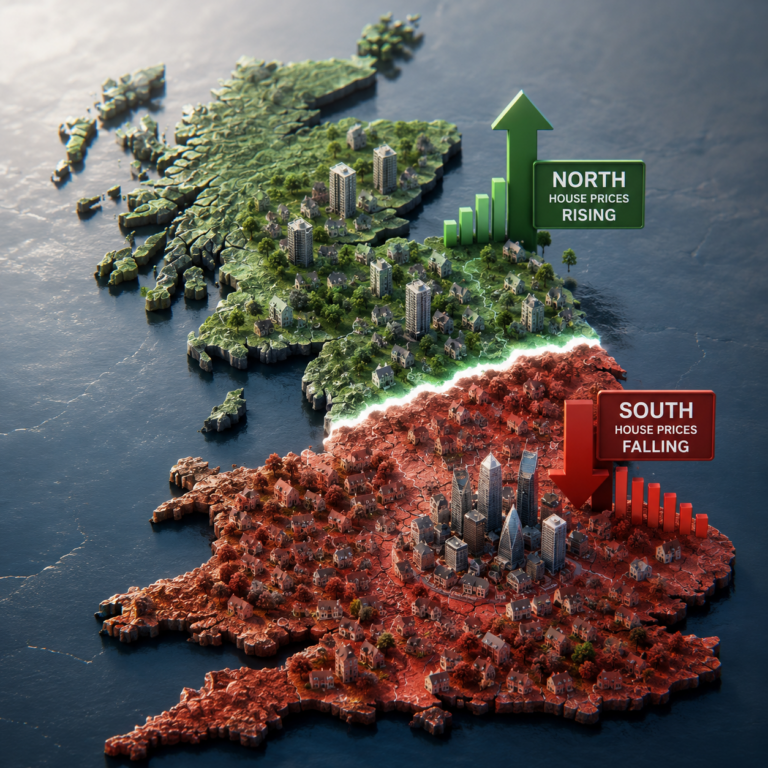
North-South house price divide widens as stock surges
12:01 AM, 19th May 2026, 5 months ago
Categories:
Rising capital gains in northern regions are contrasting with house price corrections across southern areas as new property listing values reach a monthly average of £378,304.
Rightmove’s figures show this 1.2% increase in May outpaces the 1% 10-year seasonal average, despite a broader annual decline of 0.3% since May 2025.
House prices rose by 2.7% in the North East and 2.6% in the North West year on year, while prices fell by 2.4% in London and 1.6% in the South East.
This divergence comes as buyer choice hits its highest level for this time of year since 2015.
Dynamic housing activity
The platform’s property expert, Colleen Babcock, said: “What’s encouraging is how resilient activity has remained, even among first time buyers, despite the ongoing pressures of higher living costs and mortgage rates.
“The number of sales agreed in the first-time buyer sector is performing better than expected and is broadly tracking the wider market.
“Prices in the typical first-time-buyer sector are lower than a year ago, helping to support affordability.”
She added: “It’s a healthy dynamic that activity is continuing not because buyers are overstretching, but because prices are adjusting to levels that some would-be buyers can realistically afford.”
House prices reduced
Rightmove also warns that 32% of existing homes for sale have undergone a price reduction, and the time taken to find a buyer is lengthening for those who over-price.
Properties that require a reduction stay on the market for an average of 127 days, while those priced correctly from the start sell in 36 days.
Current sales agreed volumes are 4% below last year but have risen 2% compared to the same period in 2024.
For first-time buyers, sales are also down 4% on 2025 levels with average prices dipping 0.7% annually, which compares to a 0.3% fall for the wider national market.
Mortgage costs have seen a marginal reduction as the average two-year fixed rate has fallen to 5.18% from 5.42% last month.
Property sector reaction to Rightmove House price data
Adam French, the head of consumer finance at Moneyfactscompare.co.uk, said: “Higher mortgage rates are exposing big regional affordability imbalances.
“Based on current Moneyfacts average mortgage rates and the latest Rightmove house price data, for the same amount of borrowing a typical new mortgage in London is likely to cost around £348 more per month than before the Iran conflict spike in rates, compared to an increase of roughly £104 per month in the North East.”
“The growing gap between the north and south underscores how higher rates will put greater affordability pressure on borrowers in already stretched and more expensive housing markets, while relatively lower house prices in other regions can help absorb some of that shock – at least for now.”
Tom Bill, the head of UK residential research at Knight Frank, said: “The recent spike in borrowing costs will only have a gradual impact on demand, as more favourable mortgage offers that predate the Middle East conflict lapse over coming months.
“A Labour leadership contest this summer will add to the mood of uncertainty and keep downwards pressure on prices and, to a lesser extent, transaction numbers.
“Speculation over the content of this autumn’s Budget and the ideological stance of any new Chancellor could also keep a lid on activity, especially if bond markets are unsure about their policy agenda and borrowing costs stay high.”
Louise Apollonio, the sales and distribution director for retail mortgages at Shawbrook, said: “While month-on-month prices are up by 1.2%, the steady start to the year is fading as house prices react to waning buyer demand.
“Rising costs and global uncertainty could also be deterring buyers, who may be holding out until there’s more clarity.
“While demand is low, now is a good opportunity for buyers to seek better deals, particularly as affordability remains an issue.”
Jeremy Leaf, a north London estate agent and a former RICS residential chairman, said: “Uncertainty over indeterminate interest rate and inflation rises is prompting more protracted decision making and transactions, exacerbated by the significant amount of available property, especially flats.
“However, in our offices very few sales are falling through although buyers are negotiating and re-negotiating hard to ensure, as far as possible, that mortgage payments will be affordable today as well as tomorrow.
“Although the Rightmove survey always provides an interesting snapshot of market confidence, sellers’ asking prices are part of marketing so determine if genuine buyers are attracted in such price-sensitive times.”
Tags:
landlord investment UK, Mortgage rates, North-South divide, property market May 2026, Rightmove House Price Index, UK House Prices
Be the first to comment
Your experience could help the next reader
Have you dealt with something similar? Share what you learned, raise a question or offer a perspective your peers may find useful.
Previous Article
Rents rose before Renters' Rights Act took effectNext Article
Making Tax Digital not for Partnerships?Related Articles

Home sales now take 104 days to exchange
5 months ago

House prices fall again in April – Halifax
5 months ago
Not a member yet? Join In Seconds
Login with