

Book your Property118 consultation
1 year ago


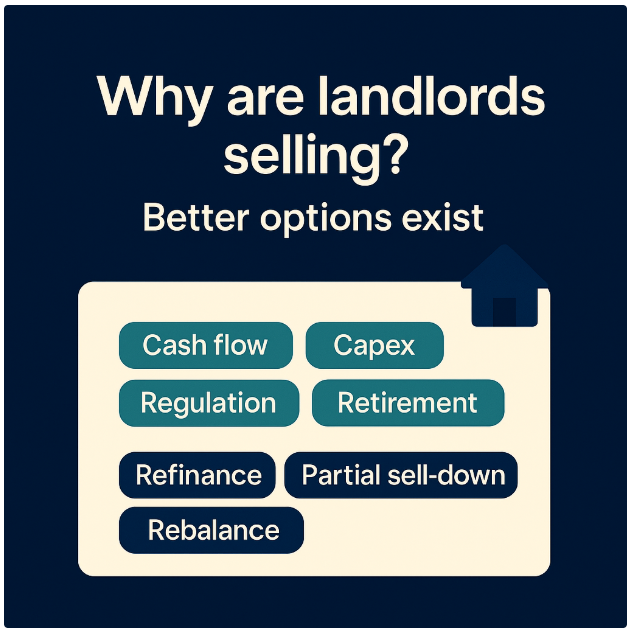
There is nothing wrong with selling. The key is to sell with your eyes open. Many landlords are weighing exits for good reasons — cash flow pressure, big repair bills, regulation fatigue or simply the desire for a quieter life. This piece groups the real reasons we hear and sets out better options you can consider before you list, including partial sell-down and refinancing to a resilient target LTV.
Use these alongside this article to run the numbers and sense-check decisions:
Exit, Refinance or Rebalance? A Decision Framework for Landlords
Net Proceeds Calculator: How Much Will You Really Have After Selling?
When Refinancing Beats Selling (And When It Doesn’t)
Partial Sell-Down and Debt Re-basing
Each reason below includes quick signals to confirm if it applies and better options to consider before committing to a sale.
Signals: rent barely covers interest and realistic maintenance; sleepless nights at each rate change.
Better options: de-gear toward a ~40% target LTV; refinance the most expensive debt; sell one weaker unit to retire debt across the rest; reset rents at renewal while maintaining standards. Model interest saved vs income lost before you sell a strong asset.
Signals: roof, heating or fabric works with weak payback; EPC/legal upgrades needed soon.
Better options: partial sell-down to fund works and debt reduction; prioritise “keeper” assets where capex improves rent and value; avoid blanket exits that destroy long-term income.
Signals: back-to-back refis, ERC traps, or maturities bunched in one year.
Better options: smooth maturities over 3–5 years; time disposals with ERC step-downs; use AVMs to build a lender-friendly pack and test appetite early.
Signals: constant rule changes, licensing complexity, or heavy HMO admin without scale.
Better options: simplify the portfolio (fewer, better assets); consider moving from complex HMOs to vanilla units with stable tenants; document governance so lenders and agents see order rather than risk.
Signals: you want fewer phone calls, steadier income and time back.
Better options: partial sell-down of the most time-consuming units; refinance the keepers to a calm LTV with a one-year liquidity buffer; hand day-to-day to a managing agent with a clear brief and KPIs.
Signals: over-exposed to a single micro-market, employer or building type.
Better options: sell selectively to reduce concentration; redeploy into diversified sub-markets (or simply de-gear and hold if replacement risk is high).
Signals: messy director loan accounts, historic guarantees, or cross-collateralised security slowing decisions.
Better options: use a sell-down to clear the worst frictions, then refinance cleanly; minute each tidy-up so the audit trail reassures lenders.
Signals: agent says “strong interest at £x”.
Better options: run the true net proceeds after fees, redemption and CGT; compare it to the interest saved by repaying debt elsewhere plus the income you would lose if you sell. Surprise: the “great price” often becomes modest cash in hand.
A) Cash flow squeeze, good assets
Sell one weaker unit, retire the priciest debt, refinance the rest. Portfolio moves from 65% to 45% LTV, interest cover improves, and calls to the plumber drop because you kept the best stock.
B) Retirement glide path
Two-year plan: sell high-friction units across two tax years, use proceeds to de-gear and fund a 12-month buffer, appoint a managing agent, and diarise a light annual review. Income steadier, life simpler.
C) Capex cliff
A block needs costly works with weak payback. Exit the block, use net proceeds to pay down debt on solid houses nearby, and refinance to smoother maturities. Less risk, calmer cash flow.
Our consultation service covers de-leveraging, retirement planning, business continuity and legacy planning for landlords. The process is written, structured and client-led. It is not a phone call. We base our recommendations on a conditional-logic Fact Find followed by focused email exchanges. Your inputs drive the analysis and the priorities. Our role is to organise the options, test commercial feasibility, and document an implementation plan that your own accountant, solicitor and regulated adviser can execute.
Scope of topics we cover
How it works
What you receive
This article is for information only. Calculations are illustrative and based on your inputs. Please ask your accountant to verify CGT and your solicitor to confirm legal steps before you proceed with a sale or refinance.
Property118 does not provide formally regulated or insured advice on law, tax, or financial services, including life insurance, mortgages, pensions, or investment products.
Our role is to present researched planning recommendations based on our interpretation of current legislation, HMRC guidance, established case law, and our extensive experience supporting UK landlords.
While our bespoke recommendations are always based on detailed research, we strongly recommend that you share them with appropriately regulated professional advisers, such as your solicitor, accountant, or financial adviser, and ask them to review and confirm the correct legal and tax treatment before proceeding.
Specific regulated responsibilities include:
Property118 is happy to work with your existing advisers or introduce you to trusted professionals. Our planning is designed to support you in making commercially led decisions that can then be implemented through appropriate regulated channels.
Be the first to comment
Have you dealt with something similar? Share what you learned, raise a question or offer a perspective your peers may find useful.

1 year ago
Not a member yet? Join In Seconds
Login with