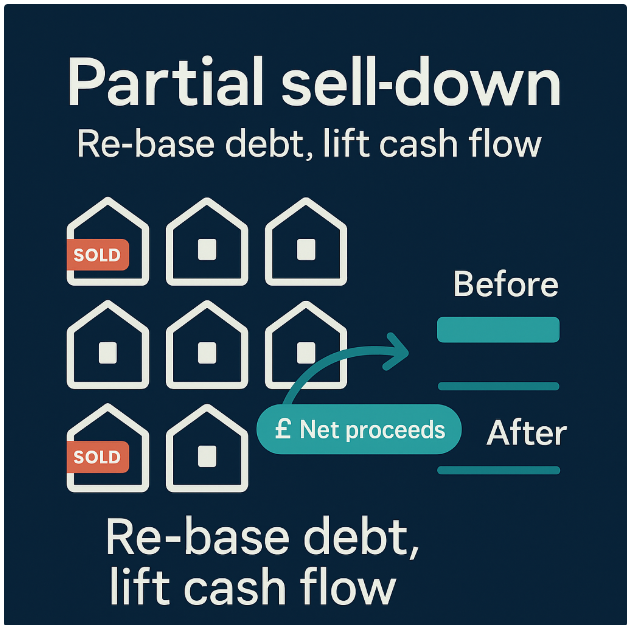
Selling everything is rarely necessary. A partial sell-down uses the sale of one or two weaker units to retire expensive debt on the keepers. Debt re-basing then sets a resilient portfolio LTV and smoother maturities so cash flow is stronger and life is simpler. This article shows how to pick what to sell, how much debt to retire, and how to avoid the common traps.
Companion guides
Use these alongside this article to run the numbers and sense-check decisions:
What “partial sell-down” and “debt re-basing” mean
Partial sell-down: sell selected properties to generate true net cash (after fees, redemption and CGT) to pay down debt.
Debt re-basing: use those proceeds (and any refinance) to move the whole portfolio to a target LTV and a cleaner maturity profile.
When this strategy shines
You have a handful of underperformers or high future capex units dragging the rest down.
Your current LTV is elevated, but the keepers are strong and worth holding long term.
Net proceeds from one or two sales can retire the most expensive debt and lift free cash flow materially.
You want to simplify operations without dismantling the best assets.
How to choose which units to sell
Yield vs capex: low net yield and high near-term works are prime sell candidates.
Void and management friction: chronic arrears, frequent turnover, HMOs without scale, awkward leasehold issues.
Market view: sub-markets you no longer back; concentration risk you wish to reduce.
Replacement difficulty: think twice before selling top-quartile assets that would be costly to replace.
Set your target and size the debt reduction
Pick a resilient target portfolio LTV (many landlords settle around ~40% for lender comfort through stress tests) and a one-year liquidity buffer for calm decision-making.
Quick sizing: Debt reduction required = Current debt − (Target LTV × Current value).
Worked example (portfolio)
Illustrative only, not advice.
Today: Portfolio value (AVMs) £4,000,000; Debt £2,800,000 → LTV 70%.
Target: LTV 45% initially (stepping to ~40% in 18 months); Liquidity buffer £120,000 (c. 12 months of interest/works).
Debt to repay now: 45% × £4,000,000 = £1,800,000 → reduction needed £1,000,000 to hit 45%.
Candidate disposals:
Property A: AVM £350,000 → Net after fees, ERC, CGT ≈ £95,000
Property B: AVM £325,000 → net ≈ £88,000
Property C (weaker): AVM £300,000 → net ≈ £75,000
Property D (weaker): AVM £275,000 → net ≈ £68,000
Subtotal net proceeds (A–D): ≈ £326,000
Plan: sell C and D now (≈ £143,000 net) and refinance to retire a further £757,000 of expensive debt; schedule A or B for next tax year if needed, or skip if rents reset well.
After actions: New debt ≈ £2,800,000 − £900,000 = £1,900,000 → Portfolio LTV ≈ 47.5% today; step to 45% after minor disposals/refis complete; liquidity buffer funded at £120,000.
Cash-flow effect: interest saved on £900,000 at, say, 6% ≈ £54,000/yr before any rent resets or maintenance savings.
Sequencing for better outcomes
Tax years: stage exchanges across 5 April where practical to use allowances twice and manage bands.
ERC timing: align sales with step-downs to avoid unnecessary redemption costs.
Maturities: smooth fixed-rate expiries over 3–5 years to avoid a single cliff.
What to do with the proceeds
Pay down the most expensive debt first (highest rate or weakest covenant).
Fund the liquidity buffer (6–12 months of interest and essential works) before any discretionary spend.
Document the plan in minutes and a short lender/broker note so underwriters understand the strategy.
Common pitfalls to avoid
Selling a top performer because it is easy, not because it is right.
Overestimating proceeds by ignoring ERCs or CGT bands and allowances.
Skipping the maintenance reserve in cash-flow modelling.
Letting cross-collateralisation or partial releases delay completion — engage the lender early.
Spending proceeds before the buffer and debt reduction are fully funded.
Numbers and documents to prepare
AVM snapshot for each property and a portfolio total
Debt schedule with balances, rates, maturities, ERCs and security
Per-property net proceeds estimate using the steps in the Calculator article
Target LTV (e.g. 45% stepping to ~40%) and the liquidity buffer you will maintain
A one-page note for brokers and lenders explaining the sequence and uses of proceeds
How we help
Our consultation service covers de-leveraging, retirement planning, business continuity and legacy planning for landlords. The process is written, structured and client-led. It is not a phone call. We base our recommendations on a conditional-logic Fact Find followed by focused email exchanges. Your inputs drive the analysis and the priorities. Our role is to organise the options, test commercial feasibility, and document an implementation plan that your own accountant, solicitor and regulated adviser can execute.
Scope of topics we cover
Business continuity and lender management, including target LTV setting and liquidity buffers
Succession and legacy planning that keeps control tidy, including equalising between children without selling core assets
Structuring options such as LLP governance, company housekeeping and Family Investment Company considerations, with clear signposting to legal drafting where needed
Life insurance trust and loan-back mechanics, including trustee duties, loan terms and security options
Refinancing pathways, broker briefing notes, and the documents underwriters expect to see
Valuations approach using AVMs for portfolio snapshots and when to commission a full valuation
Director loan accounts and intra-group balances, with tidy-up options before, during and after an owner’s death
Insurance strategy at a commercial level, including whole of life sizing logic and ownership routes, with referral to a regulated adviser for product selection
Governance pack items such as shareholders’ agreements, members’ agreements, Wills and LPAs, flagged for your solicitor to draft or update
How it works
You complete our conditional-logic Fact Find and property schedule
We follow up by email to clarify objectives and any missing data
We prepare a tailored 30+ page written report setting out your options, worked examples, risks, and recommended next steps
What you receive
A 30+ page personalised report with numbered recommendations and a clear sequence of actions
This article is for information only. Calculations are illustrative and based on your inputs. Please ask your accountant to verify CGT and your solicitor to confirm legal steps before you proceed with a sale or refinance.
Property118 does not provide formally regulated or insured advice on law, tax, or financial services, including life insurance, mortgages, pensions, or investment products.
Our role is to present researched planning recommendations based on our interpretation of current legislation, HMRC guidance, established case law, and our extensive experience supporting UK landlords.
While our bespoke recommendations are always based on detailed research, we strongly recommend that you share them with appropriately regulated professional advisers, such as your solicitor, accountant, or financial adviser, and ask them to review and confirm the correct legal and tax treatment before proceeding.
Specific regulated responsibilities include:
Tax calculations and filings – Your accountant
Stamp Duty Land Tax and equivalents – Your solicitor
Company structuring – Your accountant
Legal drafting – Your solicitor or Barrister
Trust, wills, and succession planning – A STEP-qualified solicitor or trust specialist
Life cover, pensions, and other financial services – An FCA-regulated financial adviser
Property118 is happy to work with your existing advisers or introduce you to trusted professionals. Our planning is designed to support you in making commercially led decisions that can then be implemented through appropriate regulated channels.
Members can reply to discussions, connect with experienced landlords, and access full member profiles showing years of expertise. Don't stay on the sidelines - join the UK's most active landlord community today.
Some cookies are needed to make the site work, and we always set those. We would also
like to use analytics and advertising cookies to understand how the site is used —
but only if you say yes. You can change your mind at any time in our
cookie policy.





Not a member yet? Join In Seconds
Login with