

London boroughs’ EPC rankings revealed
6 months ago


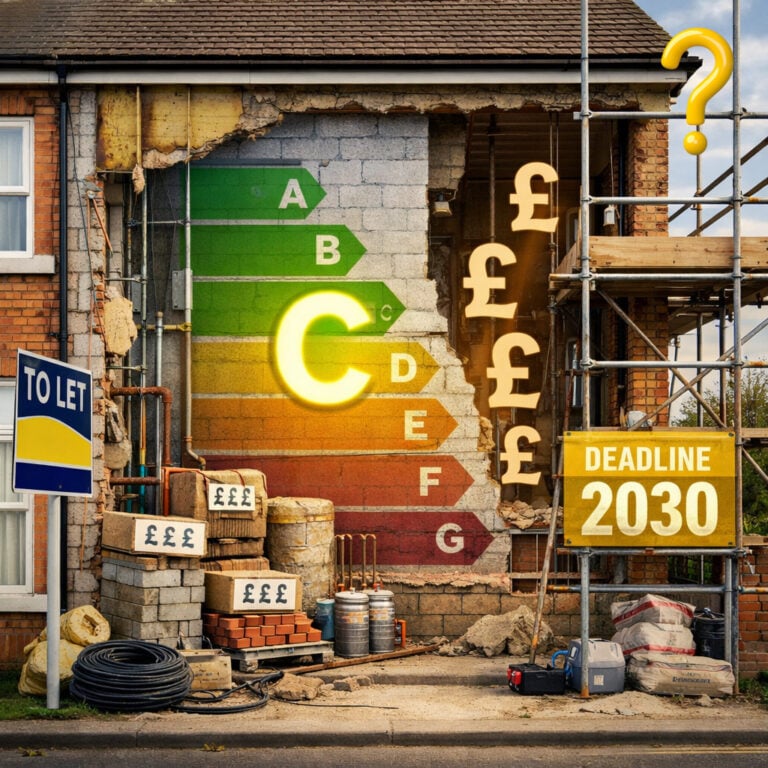
I’ve been digging into the EPC open data register to work out what the EPC C 2030 deadline actually means in practice for a typical small portfolio. Not the headline figures from government consultations, the actual numbers from real EPC certificates in real postcodes.
Thought it might be useful to share what I found, because the picture is more nuanced than “it’ll cost you £6,000-7,000” that keeps getting quoted.
The government publishes every EPC certificate through their open data portal (epc.opendatacommunities.org). It’s free to access. Each certificate includes the current rating, the potential rating after improvements, and a list of specific recommended upgrades with estimated cost ranges.
I pulled every domestic EPC in my local authority area and filtered for properties currently rated D, E, F, or G , the ones that need upgrading.
The spread of upgrade costs is enormous. A D-rated mid-terrace from the 1930s with reasonable loft insulation and double glazing might only need a boiler upgrade and cavity wall insulation to hit C, potentially £2,500-4,000 total. A solid-wall Victorian end-terrace rated E with single-glazed sash windows and no loft insulation could easily exceed the £10,000 cost cap.
The single biggest factor in whether your upgrade is affordable is wall type. Cavity wall insulation costs £350-500 and can shift your rating by 5-10 points. Solid wall insulation (internal or external) costs £5,000-15,000 and many landlords on Property118 have rightly pointed out it can cause damp issues in older properties.
The second factor is your current heating system. If you’ve got a modern condensing gas boiler rated A, you’ve already banked those points. If you’re still on an old non-condensing boiler, the swap alone (£2,000-3,000) can add 10-15 points to your score.
Properties that achieve EPC C under the current assessment method (EER) before October 2029 will be deemed compliant until their EPC expires, which is 10 years. That means if you get assessed at C under the current system before the new Home Energy Model kicks in, you’re potentially covered until 2039.
The new HEM system requires you to meet two criteria: fabric performance AND either smart readiness (solar panels, battery storage) OR heating system performance (heat pumps). This is likely to be harder and more expensive to pass. Several people on webinars have confirmed this interpretation.
So there’s a genuine argument for getting your properties assessed sooner rather than later under the current system, even if your EPCs aren’t due for renewal.
What I’d actually want to know per property after going through this exercise, I realised what would actually help me (and I suspect many landlords) is a simple per-property view.
The specific upgrades recommended for THIS property (not generic advice)
What I’d actually want to know per property:
I’m curious, how many of you have actually looked up your properties on the EPC register and gone through the specific recommendations?
And for those who’ve already started upgrading, did the recommended improvements actually move the needle the way the certificate predicted, or was the reality different?
Interested to hear real experiences. The government estimates feel very average-based and I suspect the property-by-property variation is huge.
Thanks,
Kshitig
68 comments on this article
A different perspective could help you spot an issue, avoid a mistake or find a better way forward. Read the comments and add your own views if you wish.
Previous Article
Rents tick up as Renters’ Rights Act deadline approaches
6 months ago
6 months ago | 1 comments

7 months ago | 1 comments
Member Since April 2026 - Comments: 6
12:36 PM, 13th April 2026, About 6 months ago
The government’s £6-7k average is basically useless as a planning figure – it varies wildly by property type. The one thing I keep telling people: get EPCs done now on anything that might just reach a C, because anything assessed before October 2029 is grandfathered for 10 years under the current methodology. Also worth knowing the 2027 Home Energy Model will likely require smart readiness or high-performance heating.
Member Since May 2018 - Comments: 2550
1:58 PM, 13th April 2026, About 6 months ago
Reply to the comment left by Mark Regan at 13/04/2026 – 12:36
That’s an interesting perspective. That could mean that it would make sense to make EPC improvements not now, but in early 2029. Do you have a link to the information confirming “…anything assessed before October 2029 is grandfathered..” or a reference for that?
Member Since May 2014 - Comments: 101
3:03 PM, 13th April 2026, About 6 months ago
Reply to the comment left by Beaver at 13/04/2026 – 13:58
I think he means EPCs last 10 years so if they’re dated 2029 – just before the changes come in – you’re safe for another 10 years till 2039.
Personally, all mine that are C or above will be redone in 2029, regardless of how long they have left till they expire. That way no capital outlay for another 9 years…at which point I’ll have to do solar or ASHP…if the ridiculous rules haven’t changed by then.
Member Since May 2018 - Comments: 2550
3:40 PM, 13th April 2026, About 6 months ago
Reply to the comment left by Neil P at 13/04/2026 – 15:03
Again, that’s an interesting perspective. If you were a long way off getting from D to C, i.e. you faced significant capital expenditure, then it appears to me you are better off not doing anything until you know what you have to do, and if it is overly onerous then just get rid of the tenant to do what you need to do when you need to do it. You may otherwise spend a lot of money on things that don’t make any difference to your EPC rating, won’t count towards your expenditure cap if they move the goalposts as they have done in the past, or may never be recoverable.
However, I had always assumed that if you were very close to band C then it might make business sense to do easy upgrades now in order to push the rent up as a band C property. My understanding is that it costs £80-110 per month more for a tenant to rent out a band C property rather than a band D. So if it only cost you say £1,500 to move the EPC band because you were already close to it you could recover that in raised rent, although you’d need to be charging far more in additional rent as a small portfolio, non-incorporated landlord to recover the additional tax being levied on you by HMRC.
But what you and Mark Regan seem to be implying is that you are better off re-doing your EPCs in 2029 anyway because they then last 10 years. I.e. it doesn’t make sense to redo them now.
Member Since May 2018 - Comments: 2550
3:59 PM, 13th April 2026, About 6 months ago
Reply to the comment left by Beaver at 13/04/2026 – 15:40
PS: Under the current system, if an EPC rating expires during an existing tenancy, landlords are not required to obtain a new EPC rating until the tenancy ends. So even if your EPC expires in 2026-2029 with a tenant in situ it is hard to see how you would benefit from renewing it until 2029. If the tenant leaves it’s easier (and in my experience cheaper) to do work with the tenant out of the property anyway.
Member Since January 2023 - Comments: 173
6:15 PM, 13th April 2026, About 6 months ago
Reply to the comment left by Mark Regan at 13/04/2026 – 12:36
We have been adding PV to houses . Each 2.5kw of PV supposedly adds about six points
Member Since May 2018 - Comments: 2550
10:43 AM, 14th April 2026, About 6 months ago
Reply to the comment left by Contango at 13/04/2026 – 18:15
Wickes seems to think that adding PV panels to your property could add up to 15 points and even more if your systems includes battery storage:
https://www.wickes.co.uk/wickes-solar/solar-panel-advice/epc-ratings-and-solar#:~:text=Your%20EPC%20rating%20will%20improve,higher%20category%2C%20saving%20you%20money.
Member Since January 2023 - Comments: 15
4:33 PM, 15th April 2026, About 6 months ago
Reply to the comment left by Beaver at 02/04/2026 – 10:53
Totally agree. There are a 1001 reasons why a property with a cavity should not be insulated ; narrow or irregular cavities especially pre 1925 properties , pre 1981 galvanised ties, poor external pointing or poor quality mortar, properties with any existing damp problems, properties wihere there is a high risk of water penetration i.e. wet west facing walls, etc etc.
Member Since May 2018 - Comments: 2550
5:13 PM, 15th April 2026, About 6 months ago
Reply to the comment left by Maureen Treadwell at 15/04/2026 – 16:33
Plus floors, floor joists, ceilings and roof timbers that all rot if they aren’t ventilated, even if there isn’t a high risk of water penetration. Just living in a house creates moisture which has to get out somewhere. Moisture doesn’t just enter a cavity from the external skin, it also enters from the internal skin. And it also climbs up if the property doesn’t have a modern damp proof course. Some people already qualify for government compensation for poorly fitted cavity wall insulation installed through government schemes. And yet it just seems to be a blanket recommendation from EPC assessors, regardless of whether it’s appropriate to the structure.
Member Since April 2026 - Comments: 6
10:27 AM, 27th April 2026, About 6 months ago
I’ve been budgeting for this across the portfolio and the numbers really do vary — anywhere from £2k on a newer flat to £15k+ on a draughty pre-1919 terrace once you factor in IWI, glazing and heating upgrades. What’s made the biggest difference for me is being able to expense the work properly through a limited company, which softens the blow quite a lot compared to how it lands on personal tax. I’d also say get your EPCs reassessed before you commit — I had two properties jump a band just from an updated assessor visit, no work done. Worth modelling the spend against whether the property still stacks up afterwards rather than throwing money at it blindly.