

London boroughs’ EPC rankings revealed
6 months ago


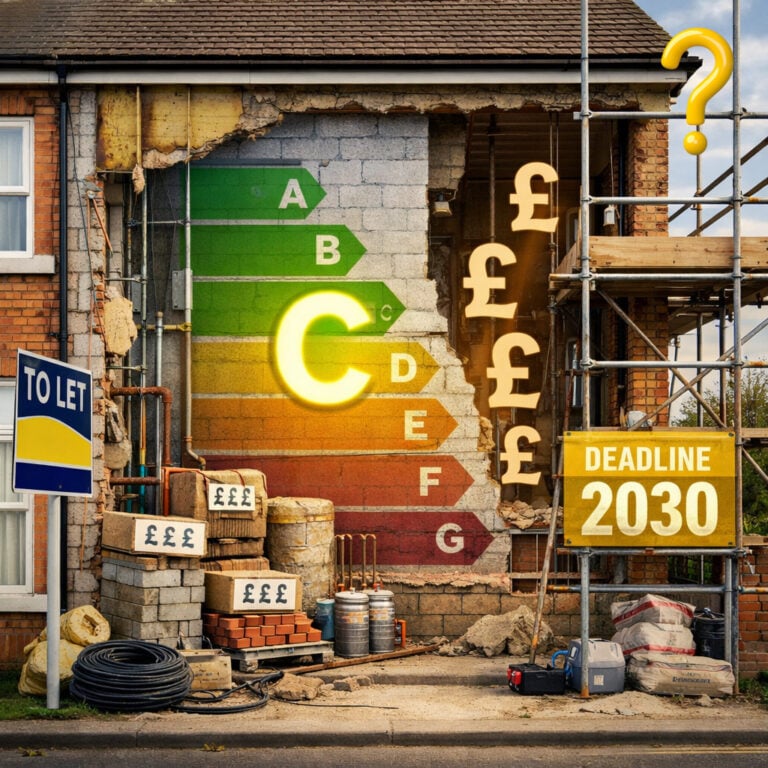
I’ve been digging into the EPC open data register to work out what the EPC C 2030 deadline actually means in practice for a typical small portfolio. Not the headline figures from government consultations, the actual numbers from real EPC certificates in real postcodes.
Thought it might be useful to share what I found, because the picture is more nuanced than “it’ll cost you £6,000-7,000” that keeps getting quoted.
The government publishes every EPC certificate through their open data portal (epc.opendatacommunities.org). It’s free to access. Each certificate includes the current rating, the potential rating after improvements, and a list of specific recommended upgrades with estimated cost ranges.
I pulled every domestic EPC in my local authority area and filtered for properties currently rated D, E, F, or G , the ones that need upgrading.
The spread of upgrade costs is enormous. A D-rated mid-terrace from the 1930s with reasonable loft insulation and double glazing might only need a boiler upgrade and cavity wall insulation to hit C, potentially £2,500-4,000 total. A solid-wall Victorian end-terrace rated E with single-glazed sash windows and no loft insulation could easily exceed the £10,000 cost cap.
The single biggest factor in whether your upgrade is affordable is wall type. Cavity wall insulation costs £350-500 and can shift your rating by 5-10 points. Solid wall insulation (internal or external) costs £5,000-15,000 and many landlords on Property118 have rightly pointed out it can cause damp issues in older properties.
The second factor is your current heating system. If you’ve got a modern condensing gas boiler rated A, you’ve already banked those points. If you’re still on an old non-condensing boiler, the swap alone (£2,000-3,000) can add 10-15 points to your score.
Properties that achieve EPC C under the current assessment method (EER) before October 2029 will be deemed compliant until their EPC expires, which is 10 years. That means if you get assessed at C under the current system before the new Home Energy Model kicks in, you’re potentially covered until 2039.
The new HEM system requires you to meet two criteria: fabric performance AND either smart readiness (solar panels, battery storage) OR heating system performance (heat pumps). This is likely to be harder and more expensive to pass. Several people on webinars have confirmed this interpretation.
So there’s a genuine argument for getting your properties assessed sooner rather than later under the current system, even if your EPCs aren’t due for renewal.
What I’d actually want to know per property after going through this exercise, I realised what would actually help me (and I suspect many landlords) is a simple per-property view.
The specific upgrades recommended for THIS property (not generic advice)
What I’d actually want to know per property:
I’m curious, how many of you have actually looked up your properties on the EPC register and gone through the specific recommendations?
And for those who’ve already started upgrading, did the recommended improvements actually move the needle the way the certificate predicted, or was the reality different?
Interested to hear real experiences. The government estimates feel very average-based and I suspect the property-by-property variation is huge.
Thanks,
Kshitig
68 comments on this article
A different perspective could help you spot an issue, avoid a mistake or find a better way forward. Read the comments and add your own views if you wish.
Previous Article
Rents tick up as Renters’ Rights Act deadline approaches
6 months ago
6 months ago | 1 comments

7 months ago | 1 comments
Member Since May 2018 - Comments: 2550
11:25 AM, 27th April 2026, About 6 months ago
Reply to the comment left by Mark Regan at 27/04/2026 – 10:27
There is indeed a massive difference between the case for doing it if you are in a limited company, vs. the situation for the majority of landlords who hold 1-3 properties outside a limited company, are already penalised by the tax system, and are further penalised by the tax system for raising additional capital. If you factor in ripping out floors or ceilings to insulate them along with internal wall insulation, possibly photovoltaics with storage and upgrading the electrics to compensate for the additional power generation and storage, then it can easily be far more than £15K.
If it’s only £2K to squeak your premises from band D to C and you can raise the rent a bit to cover that it’s an easy decision, especially if you are in the minority that hold property in a limited company. The TRUE cost for most landlords of upgrading from Band D to Band C is much higher than the government says that it is. The physics and the technology presently available to make domestic energy usage more sustainable enable you to do lots of things. What stops you is the tax system, capital availability and impact of the tax system on cash flow.
The point really is that the TRUE cost of EPC upgrades is the cost after tax.
And any government, or any party aspiring to get into government on a sustainability ticket that is COMPETENT, should understand that.
Member Since August 2026 - Comments: 2
1:51 PM, 25th August 2026, About 2 months ago
Kshitig, on the grants part of your question specifically — the two schemes people conflate most are ECO4 and the Boiler Upgrade Scheme, and they’re testing completely different things, which is why the “what applies to me” answer varies so much property to property.
ECO4 tests the tenant’s circumstances (benefits, or the property falling in certain low-income indicators via LA Flex) — the landlord’s own financial position is irrelevant, but if the tenant doesn’t qualify, the property doesn’t either, regardless of EPC band.
The Boiler Upgrade Scheme tests neither the landlord’s nor the tenant’s income, but it’s routinely misunderstood: it does not fund a straight gas boiler swap at all. It funds heat pumps (and now air-to-air/heat batteries per the scheme’s 2025 expansion) — up to £7,500 off, or £9,000 for off-grid rural properties. A lot of people search “boiler grant” expecting it to cover exactly what it doesn’t.
Then there’s Warm Homes: Local Grant, which is council-administered and has its own claim-order quirk that catches out portfolio landlords specifically — the first property in a claim gets funded up to 100%, but subsequent properties in the same portfolio drop to a 50% contribution, and there’s a £315,000 lifetime ceiling per landlord across the whole portfolio. Claiming your properties in the wrong order can cost £3,000–£7,500 in lost funding for no reason other than sequencing.
None of this is a substitute for an actual EPC-register pull the way you’ve done here — but it’s the layer on top of “what does my EPC say I need” that decides whether a given upgrade is actually going to be funded, partly funded, or not funded at all for a specific property/tenant combination.
Member Since May 2018 - Comments: 2550
1:55 PM, 25th August 2026, About 2 months ago
Reply to the comment left by [email protected] at 25/08/2026 – 13:51
This is interesting: Do you have any more detail on what it funds in terms of photovoltaics and storage, i.e. batteries?
Member Since August 2026 - Comments: 2
2:01 PM, 25th August 2026, About 2 months ago
Reply to the comment left by Beaver at 25/08/2026 – 13:55
Beaver — worth separating two different things here, because they get conflated a lot.
BUS doesn’t fund solar panels (photovoltaics) at all, in this expansion or any previous one — that’s never been in scope for the scheme.
For batteries, there are actually two different things both called a “battery” that BUS treats completely differently. A home battery (paired with solar, storing electricity) isn’t funded by BUS — there’s a separate £2,500 battery-storage grant under the wider Warm Homes Plan for that, unrelated to BUS. A heat battery (a heating appliance like a Sunamp or Tepeo unit — stores heat, not electricity, and replaces your boiler rather than sitting alongside solar) is genuinely a new BUS-eligible category at £2,500, but applications aren’t actually open yet — gov.uk’s own guidance has that landing winter 2026/27, not live today.
So if you’re weighing PV+battery against a heat pump for the cost cap, the PV/battery side gets no help from BUS specifically — that’d need to come from elsewhere in the sums.
Member Since May 2018 - Comments: 2550
2:17 PM, 25th August 2026, About 2 months ago
Reply to the comment left by [email protected] at 25/08/2026 – 14:01
OK thank you. So I’m guessing that the PV/battery side gets no help and remains capital expenditure.
Member Since January 2023 - Comments: 173
2:19 PM, 25th August 2026, About 2 months ago
Reply to the comment left by Beaver at 25/08/2026 – 14:17
correct the batteries and solar are capital expense, the only helpo at the moment is that there is no VAT.
Member Since May 2018 - Comments: 2550
2:21 PM, 25th August 2026, About 2 months ago
Reply to the comment left by Contango at 25/08/2026 – 14:19
And the last time I looked there were no capital allowances for the photovoltaics and solar batteries. Is this still correct?
Member Since January 2023 - Comments: 173
2:23 PM, 25th August 2026, About 2 months ago
Reply to the comment left by Beaver at 25/08/2026 – 14:21
correct