

Angela Rayner – Will rent controls and tax rises for landlords be on the agenda?
3 years ago | 13 comments


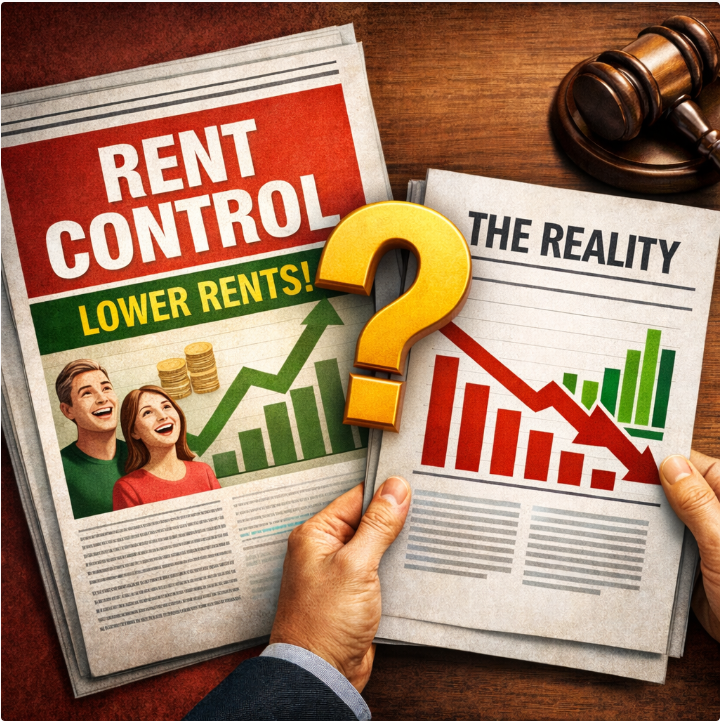
Rent control has an obvious political appeal. If rents are rising faster than wages, the solution can appear straightforward. Limit how much landlords are allowed to charge and tenants will immediately benefit.
Campaign groups often present the idea in exactly those terms. Cap rents and affordability will improve.
Yet the international evidence tells a far more complicated story.
One of the most widely cited studies of rent control, conducted by economists at Stanford University, found that an expansion of rent control in San Francisco ultimately reduced the city’s rental housing supply by around 15%.
In other words, a policy designed to make housing more affordable ended up shrinking the number of homes available to rent.
That tension between intention and outcome lies at the heart of the rent control debate.
The San Francisco study is one of the most influential pieces of modern research on rent regulation.
Economists Rebecca Diamond, Tim McQuade and Franklin Qian analysed the long-term impact of the city’s 1994 rent control expansion. Their work followed thousands of housing units over many years to observe how landlords responded to the policy.
The findings were striking.
While existing tenants in regulated homes benefited from lower rents in the short term, landlords responded by changing how properties were used. Some converted rental units into owner-occupied housing. Others redeveloped buildings into higher-value accommodation that fell outside the rent control system.
Over time, these responses reduced the city’s rental housing supply by around 15%. That contraction in supply contributed to rising rents across the wider market.
The study illustrates a key economic principle. When the return from renting property is constrained, the supply of rental housing can fall.
A more recent example emerged in Berlin.
In 2020 the city introduced a strict rent freeze known as the Mietendeckel, which capped rents across much of the housing market.
Initially the policy appeared to deliver the outcome supporters hoped for. Regulated rents fell and tenants welcomed the relief.
However, the wider housing market began to react in unexpected ways.
Rental listings declined sharply. Some landlords moved properties into the sales market rather than continuing to let them under the new restrictions. Others delayed new investment in rental housing.
In 2021 Germany’s constitutional court struck down the policy, ruling that the regional government did not have the authority to impose it.
By that point the Berlin experiment had already demonstrated how quickly rent controls can influence housing supply.
Sweden offers another long-running example of how rent regulation can reshape housing markets.
Stockholm operates a heavily regulated rental system where rents are negotiated collectively rather than determined freely by supply and demand.
This system has kept rents relatively stable for existing tenants, but it has also created one of the most unusual housing markets in Europe.
In central Stockholm, waiting lists for regulated rental apartments can stretch for many years, sometimes more than a decade.
For those fortunate enough to secure a regulated tenancy the system can work well. For newcomers attempting to enter the rental market it can be extraordinarily difficult.
The policy protects existing tenants but creates barriers for future ones.
The central concern raised by economists is not the immediate effect on rents; it’s what happens to housing supply over time.
If rent controls reduce the financial return from renting property, some landlords may choose to sell. Others may convert homes into different uses. New investors may decide not to enter the market at all.
When supply falls while demand continues to grow, the result can be the very outcome rent control was intended to prevent. Rents for unregulated properties rise as the pool of available housing shrinks.
This dynamic explains why many economists approach rent control with caution, even when they recognise the political appeal of the policy.
None of this means rent control has no benefits. For tenants already living in regulated properties the policy can provide stability and protection from sudden rent increases. In cities with volatile housing markets that stability can be highly valued. The challenge is that housing markets are dynamic. Policies that protect current tenants can sometimes make it harder for future tenants to find homes. That trade-off sits at the centre of the rent control debate.
Housing affordability is a genuine challenge in many cities. Rising rents place real pressure on households and it is understandable that policymakers search for solutions that appear decisive and immediate. Yet decades of international evidence suggest that rent control rarely produces the simple outcomes its advocates promise. Housing shortages are ultimately driven by the relationship between supply and demand. Policies that alter that balance can produce consequences that only become visible years later.
The global experience with rent regulation suggests that straightforward answers to complex housing problems often carry hidden trade-offs.
Rent control is frequently presented as an obvious solution to rising rents. Yet the international evidence paints a far more complicated picture.
If strict rent controls consistently reduced rents without wider consequences, cities around the world would be adopting them enthusiastically.
Instead, the policy remains one of the most contested ideas in housing economics.
So what do you think explains that gap between the promise of rent control and the evidence from real-world housing markets?
Support Property118 and keep the platform independent
If you value evidence-led reporting like this, you can support the work here.
Monthly support helps fund independent reporting, research, and the free landlord forum.
11 comments on this article
A different perspective could help you spot an issue, avoid a mistake or find a better way forward. Read the comments and add your own views if you wish.
3 years ago | 13 comments

8 months ago | 6 comments

2 years ago | 14 comments
Member Since May 2018 - Comments: 2579
10:43 AM, 6th March 2026, About 8 months ago
These aren’t the only ‘rent control experiments’ out there and there are other ‘experiments’ closer to home.
In Scotland the SNP’s rent controls lead to significant rises in rents. Average rent for a one-bedroom property rose by just over 31% in the 12 years from 2010 to 2022. Then rents rose by 22.4% in the two years following the SNP’s rent cap. For two bedroom properties there was a rise of nearly 33% in the 12 year period before the SNP rent cap. And then there was a 27% rise in the two years after the SNP rent cap.
The SNP loves to blame all of its failures on the Westminster government…it’s their get-out-of-jail-free card. If there have to be cut backs or spending rises it’s always the fault of Westminster, always because Westminster didn’t give them enough money. But in this case the SNP’s problem was that they didn’t understand the economics of housing or learn the lessons of history. The consequences of this were that higher rents were inflicted upon Scotland’s citizens although they’ll probably never admit that because their failures always have to be somebody else’s fault.
This doesn’t just affect Scotland. This week I watched a number of Youtube videosfrom an agent who manages a large number of rental properties outlining what to expect from the Renters Rights Act, which reached its final shape under the influence of a labour government with a significant majority and as a consequence also contains rent controls. I use an agent and the advice from my agent as little as ten years ago was to hold rents down a bit to minimise the risk of void periods. However, these online videos from a very large and well established agent now recommend that because a landlord can no longer accept more than the advertised rent, all advertised rents must be ‘premium priced’. And so as a consequence of the Renters Rights Act there is presently another big ‘rent control experiment’ going on across England which is resulting in rents being ‘premium priced’. What a great shame that during the final discussions over the RRA the labour government didn’t listen to the voices of moderation warning about the real effect of left-wing policies would really have on people renting anywhere in England.
Member Since May 2014 - Comments: 7
12:25 PM, 6th March 2026, About 8 months ago
Basic economic theories explain what would happen if rents are held down – supply would diminish, then after that, rents would rise because of the lower supply. More people chasing fewer properties encourages higher offers to be made for said properties. Enforced lower rents make property owners find other ways to get an income from their assets. Laws of supply and demand. I was taught that at college at 16! Do politicians know nothing?
Member Since May 2023 - Comments: 240
1:30 PM, 6th March 2026, About 8 months ago
The problem is that policies are decided by people with no qualifications or experience in property who are gullible enough to believe that activists who house nobody have the answers.
This is a fundamental flaw with democracy that enables voters to elect representatives who aren’t qualified. The Select Committee mechanism should enable selection of qualified people and production of reports subject to proper review before providing policy recommendations.
The politics of envy is a lame and unsustainable basis for government.
Member Since May 2018 - Comments: 2579
1:36 PM, 6th March 2026, About 8 months ago
Reply to the comment left by Diana Seymour at 06/03/2026 – 12:25
This is of course true. And at the same time it is more than just supply and demand. When the SNP introduced rent controls in Scotland effectively limiting rent increases to a certain percentage over the previous rent the effect of that was that landlords had to increase rents for all new lets just in case they couldn’t do it later. The effect of a policy in the Renters Rights Act saying that a landlord cannot take more than the advertised rents are (a) that all tenancies needed to be advertised at a premium (b) that agents change their advice from holding rents down to putting them up (c) that advertised rents are pushed up (d) that market rents (being influenced by advertised rents) are also pushed up.
The concurrent effect of landlords being unable to offset their finance costs against rents (if not incorporated, i.e. the majority) is that (a) they have to push rents up to minimise their losses, or in some cases to avoid a cash loss after extra tax at 40% or above (b) in many cases tenants will be forced to pay extra cash to fund the additional tax bill that the landlord now faces at 40% or above: Tenants pay more tax indirectly.
And so the rent control demon has both direct and indirect negative effects on tenants: That doesn’t matter for a genuinely left-wing government as for a left-wing government market failure is success; the answer from the left-wing is always “well that just proves that we need more socialism.” But the people who get hurt by that are the small people, the citizens who increasingly suffer from lack of choice, lack of freedom, less ability to choose where they live or work. less money to spend on the nice-to-have non-essentials in life…or even just better food.
As for the question of whether politicians know this, a lot of labour MPs are both landlords and higher rate tax payers: So they must know. And yet, they do what they do anyway and dress up what they do as for the public benefit. And labour MPS who are landlords who will certainly know what the negative outcomes of these policies are for tenants don’t seem to be able to survive long in government.
https://en.wikipedia.org/wiki/The_Emperor%27s_New_Clothes
As a small portfolio landlord my agent used to advise me to hold rent down. Now my agent advises me to put rents up. And that’s not just my own personal experience…that’s the response to the Renters Rights Act that I can see from a large agent publicising itself on Youtube.
Member Since June 2014 - Comments: 1574
3:24 PM, 6th March 2026, About 8 months ago
I don’t think they are good intentions.
They want to drive out private landlords for ideological reasons and to hell with the consequences for tenants.
Member Since May 2018 - Comments: 2579
3:37 PM, 6th March 2026, About 8 months ago
Reply to the comment left by PAUL BARTLETT at 06/03/2026 – 13:30
My understanding is that only 2 out of 9 of the current labour government front-bench have ever worked in businesses outside of politics, public affairs or law. And no member of the labour cabinet has ever run a successful private enterprise. So I do think that it is true to say that when it comes to the economics of business, they aren’t qualified.
However, when it comes to being a landlord, lots of labour MPs are landlords and therefore they must know what the tax effects of their policies are because they will be experiencing them, even though they may not have considered the disastrous effects of their policies on housing supply and rent inflation. Therefore I think that Monty Bodkin is closer to the truth; they are doing what they are doing for ideological reasons, and they are ignoring the real effect not just on tenants….people who already have some kind of roof over their heads…but also on people who don’t have a home.
Saying that they are going to build 1.5 million new homes is just a lie.
Member Since October 2022 - Comments: 277
10:48 PM, 6th March 2026, About 8 months ago
Reply to the comment left by PAUL BARTLETT at 13:30
We don’t really live in a democracy any more. It’s more like a “pressurocracy” than anything else. Whoever shouts the loudest and longest gets what they want, like little children.
In this case so-called consumer advocacy groups are essentially dictating terms to suppliers. Fine when there’s more supply than demand, but not the other way round.
My guess is that one unexpected consequence of the new legislation is that those landlords still around in 5 years’ time will have more power, not less. The days of not paying the rent, getting a section 21 and then getting a council house off the back of it are well and truly over. It will be “Pay up, or I take you to court and no decent landlord will ever house you again. And good luck ever getting social housing either”.
Member Since October 2020 - Comments: 1384
12:23 PM, 7th March 2026, About 8 months ago
The Government have already introduced rent controls as part of the Renters Rights Act:
– the right to challenge the rent at the tribunal as soon as the tenant moves in
– the right to challenge rent increases in the same way with the rent staying unchanged until after the tribunal makes the decision, (likely to be many months once RRA comes in)
– the tribunal not allowed to impose an upward rent review
– landlords not allowed to change the advertised rent before the tenancy commences
– landlords not allowed to accept rent until the agreement is signed or require more than 1 months rent in advance
Member Since May 2015 - Comments: 2326 - Articles: 2
2:05 PM, 7th March 2026, About 8 months ago
Reply to the comment left by Peter Merrick at 06/03/2026 – 22:48
I believe we are already there, my tenants rarely move and surprisingly often come back after moving.
BUT I have a rule, leave with even a penny owing in rent, and you will never get one of my properties again. It’s surprising how many tenants do not appreciate this unwritten rule.
Member Since January 2011 - Comments: 12261 - Articles: 1489
11:53 AM, 10th March 2026, About 7 months ago
Reader question:
“I agree with most of the article, and so do most economists. However it feels a little one-sided. It doesn’t mention examples like Austria, which is often cited as a relative success story for rent control. The article paints a grim picture where rent controls are doomed everywhere, which is not strictly true if you look at what happened in Vienna.”
Response:
That is a fair observation, and Vienna is frequently raised in discussions about rent control.
The key point, though, is that Vienna’s housing model is often misunderstood. Its relative stability is not the result of rent caps alone. It is the result of an entirely different housing ecosystem built over more than a century.
Around 60% of Vienna’s population lives in some form of social or subsidised housing. The city itself owns roughly 220,000 homes, and a large additional share of housing is delivered through regulated non-profit housing associations. That means a very large proportion of the housing market operates outside the typical private landlord model.
This matters because Vienna did not simply impose rent controls and expect the market to absorb the consequences. It simultaneously maintained a massive programme of public and subsidised housing construction, supported by public land, long-term financing and consistent policy stretching back to the 1920s.
In effect, the city created a large “public option” for housing which competes with the private market and helps stabilise rents.
Most rent control policies elsewhere attempt something very different. They cap rents within an existing private market without simultaneously expanding housing supply. That is the scenario where economists typically warn about reduced investment, declining supply and poorer housing quality over time.
Vienna avoids many of those outcomes because supply has been actively maintained through large-scale public involvement in housing development.
This is why many housing researchers describe Vienna not as a simple rent control policy, but as a comprehensive housing system.
The challenge for policymakers is that replicating such a system would require decades of consistent policy, substantial public investment and political agreement to maintain a very large social housing sector.
In that sense, Vienna does not really contradict the broader economic evidence discussed in the article. Instead, it highlights a different point: rent caps alone rarely solve housing shortages, but sustained investment in housing supply can help stabilise markets.
That distinction is an important one in the wider debate about housing policy.