

Fires from disposable vapes could impact landlord insurance claims
1 year ago | 4 comments


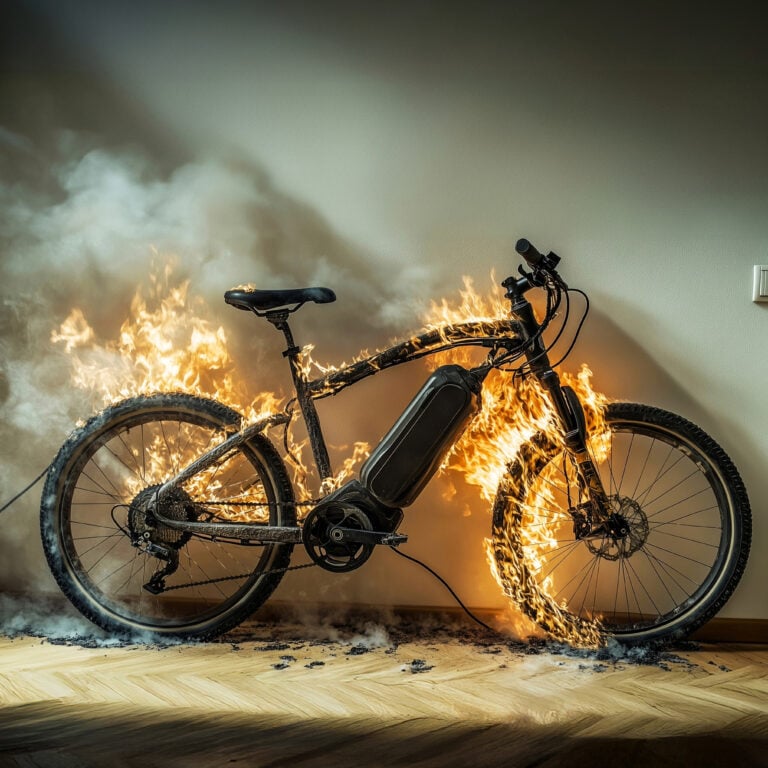
Firefighters in London are attending an e-bike or e-scooter fire every other day, as the London Fire Brigade calls on landlords to raise awareness of its campaign and store e-bikes safely.
The London Fire Brigade has launched its #ChargeSafe campaign to raise awareness to landlords, housing associations and councils about the risks associated with owning a poorly built e-bike or e-scooter lithium-ion battery.
E-bikes and e-scooters are becoming more common in rental properties and according to The Times there are now estimated to be more than one million private e-scooters in the UK.
According to data from the London Fire Brigade, firefighters attended 206 e-bike and e-scooter fires in 2025, an average of 17 incidents per month. Around 83% of these incidents involved an e-bike, accounting for 171 fires.
The Brigade says lithium-ion battery failures, conversion kits and chargers are frequently responsible for these blazes.
It warns that products bought online that fail to meet UK safety standards, whether new or second-hand, are particularly at risk of catching fire.
Last year, the Product Regulation and Metrology (PRAM) Act received Royal Assent. The Act is designed to strengthen and modernise rules around product safety, standards, and measurement accuracy.
The London Fire Brigade is now urging the government to bring forward its consultation on the Act’s secondary legislation as soon as possible.
Spencer Sutcliff, deputy commissioner and operational director for prevention, protection and policy, said: “Firefighters are currently attending an e-bike or e-scooter fire every other day, on average. Already in 2026, we have seen several fires involving lithium-ion batteries. These fires can be explosive and have devastating consequences.
“We’ve been calling for regulation to improve product safety and are thankful for the work already done by the government to help tackle this issue. We look forward to working with the government on its consultation for secondary legislation, when it is introduced, to help tackle this issue head-on.
“We hope this is done as soon as possible to reduce the number of customers being exposed to dangerous products available for purchase online, and ultimately drive down the number of fires.”
The London Fire Brigade is urging landlords to promote its #ChargeSafe campaign and is encouraging them to take practical steps to reduce the risk of fires, such as providing safe storage areas and appropriate charging facilities for e-bikes and e-scooters.
As previously reported on Property118, property expert Julie Ford says it’s all about communication to mitigate the risks of e-bike fires.
She told Property118: “If you’re a landlord with a designated charging area, make sure it’s clearly communicated to the tenant.
“It’s important to understand the laws in place to protect you. In many cases, if a tenant is charging an e-bike on the property, it can raise insurance concerns.
“If the e-bike’s battery explodes, it cannot be extinguished easily, even the fire brigade can’t put it out, as the battery needs to burn out on its own.”
Julie adds: “What you need to make clear to the tenant is that if you find an e-bike being charged in the property without permission, you have the legal right to confiscate it. Many landlords are unaware of this, but under the Interference with Goods Act 1977, this is allowed.
“The landlord can take the e-bike away legally but they must store it safely. Landlords are going to have to adapt as more and more people have e-bikes and e-scooters and charging them at the property.”
4 comments on this article
A different perspective could help you spot an issue, avoid a mistake or find a better way forward. Read the comments and add your own views if you wish.
Previous Article
Councils struggle with damp and mould targets under Awaab’s Law
1 year ago | 4 comments

2 years ago | 11 comments

3 years ago | 9 comments
Member Since June 2013 - Comments: 242 - Articles: 49
9:26 AM, 24th February 2026, About 8 months ago
I wrote a post about this here https://www.landlordlawblog.co.uk/2023/07/30/landlord-warning-your-tenants-e-bike-batteries-can-cause-serious-fires/ a couple of months ago, which has further guidance.
Our Landlord Law tenancy agreements include a clause prohibiting ebikes and escooters without consent and we have draft letters for landlords to use when granting permission.https://landlordlaw.co.uk/new-content-dealing-with-the-dangers-of-exploding-e-bike-and-e-scooter-batteries/
Member Since June 2019 - Comments: 973
11:51 AM, 24th February 2026, About 8 months ago
I suspect that tenants hardly ever ask for permission and for leasehold flats it is not possible for the landlord to grant any external storage and a freeholder is unlikely to help out (if they do help out it instantly becomes their liability in case of a fire).
PS these AI images are terrible, the battery is not on fire. Just the metal frame!
Member Since July 2013 - Comments: 2066 - Articles: 21
11:03 AM, 19th March 2026, About 7 months ago
Reply to the comment left by Tessa Shepperson at 24/02/2026 – 09:26
Tessa, why would you not have a blanket prohibition? Offering “consent not to be unreasonably withheld” will inevitably put the landlord under pressure to agree. Whatever safety conditions you tell the tenant to observe, it is almost impossible to police them. If a fire is caused, whether or not because of the tenant’s act or omission, it is very hard to extinguish and tens or hundreds of thousands of pounds of damage may occur. People may die if they cannot escape the blaze. The HSE will investigate the landlord.
Landlords will have to notify their insurers and the premiums may rise and/or onerous conditions may be imposed such as weekly or fortnightly inspections that could lead to a claim being rejected. The increase in premiums may continue long after the tenant has left. There is very little benefit for a landlord permitting e-bikes, certainly not inside a building where people sleep.
Member Since June 2013 - Comments: 242 - Articles: 49
11:08 AM, 19th March 2026, About 7 months ago
Clauses in consumer contracts which give a blanket prohibition are likely to be unenforceable under the unfair terms rules in the Consumer Rights Act 2015.
All tenancy agreements (other than company lets) are classed as consumer contracts.