

Landlords face paying National Insurance on rental income
7 months ago | 116 comments



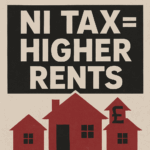
Labour’s plan to impose National Insurance (NI) contributions on rental income could see UK landlords paying £885 per property each year, research from Inventory Base reveals.
The study of the policy under consideration by Chancellor Rachel Reeves for the upcoming Autumn Budget estimates the impact of a proposed 8% NI rate.
The average UK landlord, typically an employed individual, could face an annual NI charge of £722 per property – but this rises to £885 in London.
This figure is derived from an 8% NI contributions applied to the average gross rental income of £10,621, after subtracting typical property maintenance costs of £1,593 per year.
The firm’s operations director, Sián Hemming-Metcalfe, said: “Landlords are already trying to guesstimate and juggle any potential financial fallout of the Renters’ Rights Bill, so slapping an NI charge on rental income feels less like policy and more like punishment.
“The private rented sector thrives on stability – tenants need secure homes, landlords need predictable returns.
“Add another layer of tax and all you create is uncertainty, and uncertainty drives good landlords out of the market.
“That doesn’t protect tenants, it weakens an already fragile system.”
She added: “If the Government is serious about raising standards, it should be focusing on ways of maintaining the protections and standards that tenants are being promised and backing landlords to deliver, not taxing them into retreat.”
However, the impact of the NI levy on rental income varies with London landlords expected to bear the heaviest burden.
In the capital, landlords face an estimated NI bill of £885 per property, based on a post-maintenance rental income of £11,060.
In the East of England, the average bill would be £802 and in the South East it’s £792.
Landlords in the South West face a £750 bill, in the North East it would be £684, in the East Midlands is £680 and in the West Midlands it would be £677.
In the North West the NI contribution would be £646, Wales it is £608, and Yorkshire and the Humber it’s £606.
Every day, landlords who want to influence policy and share real-world experience add their voice here. Your perspective helps keep the debate balanced.
Not a member yet? Join In Seconds
Login with
7 months ago | 116 comments

7 months ago | 11 comments
7 months ago | 20 comments
Sorry. You must be logged in to view this form.
Member Since August 2014 - Comments: 336
11:03 AM, 6th September 2025, About 7 months ago
Reply to the comment left by Abhishek Swarup at 04/09/2025 – 06:34
There are plenty of prospective tenants who can afford to pay substantially higher rent. Every time I put a house up for rent, I push the rent up to the most I think I can reasonably achieve, and every time I am inundated with offers of full asking price.
And before anyone criticises me for maximising my rent, it’s purely because of Section 24, the doubling of interest rates, and the RRB which proposes to limit our rent increases. My profits have halved in the last year, and the prospect of paying NI is yet another reason to maximise rent. Although in my position, the government won’t make a penny as I am so close to retirement age, and what they take in they will have to pay me back by way of an increased state pension since I don’t quite have enough qualifying years.
Member Since August 2014 - Comments: 336
11:17 AM, 6th September 2025, About 7 months ago
Reply to the comment left by Simon Lever – Chartered Accountant helping clients get the best returns from their properties at 05/09/2025 – 11:53
You say that “No tenant is going to accept a 15% rent increase”, well I disagree. Every property that is new to the market, or becomes free when a tenant leaves, will be advertised 15% higher than otherwise it might have been. My own experience is that when I advertise vacant properties at what I think is the most rent I can achieve I am still inundated with offers at full asking price. I have a pick of which tenant to chose. And this inflationary pressure will allow other landlords to raise their rents accordingly, albeit maybe over 2 or 3 years, as the average rent increases for an area are now an ONS published figure, which enables any landlord to raise their rent by this same amount, without fear of challenge under the proposed RRB.
Member Since May 2018 - Comments: 1996
2:02 PM, 6th September 2025, About 7 months ago
Reply to the comment left by Jessie Jones at 06/09/2025 – 11:17
I think that in the areas where there is the greatest pressure on housing, this is correct. And the proposal in the RRB to stop landlords accepting offers from prospective tenants at above the advertised rent will drive up advertised rents and therefore market rents. It will be a vicious circle.
Faced with the RRB, NI and being unable to offset their finance costs, every landlord that can do it will drive up rents because they will HAVE to.
But it is the GOVERNMENT that is driving up rents by interfering with the workings of the market and being dishonest about the real effects of their proposals to raise taxes. Historically most landlords have wanted to keep good long term tenants and many kept rents down to do it…it was government that interfered with a business model that worked.
Member Since February 2018 - Comments: 627
4:26 PM, 6th September 2025, About 7 months ago
Reply to the comment left by Jessie Jones at 06/09/2025 – 11:03
You are asssuming that NI will continue not to be paid by retirees, I wouldn’t put anything passed this thoroughly mendacious apology of a government nor, for that matter, any ‘front’ of the global power under which all operate.
Member Since July 2013 - Comments: 463
8:15 PM, 6th September 2025, About 7 months ago
Reply to the comment left by moneymanager at 06/09/2025 – 16:26
Well, I think charging retirees NICs make sense, IF in exchange they are enrolled into a national insurance scheme with a significantly wider scope than the current one. Retirees would pay insurance contributions, but in return would be protected for the first time against the risk of needing long-term social care – typically because incapacity after stroke or injury, or they fall prey to a debilitating illness like dementia.
The cost of such private insurance is ludicrously high and so very few people take it out. However if the whole retired population were required to contribute to the cost of needing to go into a care home or nursing care, or equivalent care packages at home, the cost per person would be vastly smaller, and would relieve of old people of a massive worry as they age and lose their faculties.
They will then be able to worry about inheritance tax instead (feeble joke).
Of course people on very low incomes would be protected by a threshold, as working people are already with regular NICs. And the average retiree already has a larger income than the average working person who does have to pay NICs, so it’s not as if they can’t afford to pay , all in exchange for a wonderful protection against the risk of losing most of their wealth to pay for a care home charging £50-70,000 a year.
Member Since September 2018 - Comments: 3507 - Articles: 5
9:24 AM, 8th September 2025, About 7 months ago
Reply to the comment left by AnthonyJames at 06/09/2025 – 20:15
the money raised wont go to funding actual services. Just like the NIC’s charged from oversees workers on a visa (healthcare/social sector), all it does is go towards the ever spiralling debt payments.
IMF incoming….?
Member Since May 2018 - Comments: 1996
9:24 AM, 8th September 2025, About 7 months ago
Reply to the comment left by AnthonyJames at 06/09/2025 – 20:15
It’s an interesting theory. But if the care was provided by unionised, state-run social care providers, in practice the state would take the money and provide sub-standard care.
Member Since February 2018 - Comments: 627
9:34 AM, 8th September 2025, About 7 months ago
Reply to the comment left by AnthonyJames at 06/09/2025 – 20:15
If the state really became the near universal ‘haven’ for the old and frail, you would see elective deaths go off the chart, although more complex, much of current policy is being driven by eugenescist Fabianists, if it weren’t for the anti Hitler attrocity propaganda, the mass eugenics programme of the 1920s would now be much further down the track, Bill Gates’ father was a eugenescist and I don’t think the apple fell far from the tree.
Member Since May 2018 - Comments: 1996
10:51 AM, 8th September 2025, About 7 months ago
Reply to the comment left by moneymanager at 08/09/2025 – 09:34
Whether this is true or not I don’t know…but we already have a national health service that is a bottomless pit because it is largely run by unionised public sector workers and has limited exposure to market forces that would result in the efficiencies in the service being exposed.
When you already have one bottomless pit it hardly seems likely that digging a second bottomless pit will result in solving any problem, other than keeping union officials and socialist politicians in power.
Member Since July 2013 - Comments: 463
10:53 AM, 8th September 2025, About 7 months ago
Reply to the comment left by Beaver at 08/09/2025 – 09:24
I don’t see why a Government would be dumb enough to think it could replace the entire private care home system with a unionised, state-run one. They’d either have to nationalise the whole industry, or build a fresh set of care homes and train and recruit a fresh set of staff. Either approach would be ludicrously expensive and time-consuming.
This approach is about insurance, not who delivers the actual care services, or who determines what level of service, sub-standard or not, is appropriate. Of course there would need to continue to be quality validation and inspection of care homes through the CQC, but there needn’t be a new national system of cost-checking and constant pressure to deliver a basic service at the lowest possible price.
Look at the approach taken with private critical illness or income protection insurance. You pay a certain annual fee to get a certain level of cover, with higher costs if you want inflation-protection, a longer period of cover, etc. No one pretends that the insurance is going to cover *all* of your costs or fulfilling your Bucket List, or that it will continue to be paid for ever if you are incapacitated.
I suggest we’d adapt this approach for a new National Care Service. If would be different from the “free at the point of use” model of the NHS, and be much closer to the state-subsidised insurance based models used in France, Germany etc. The private care and nursing homes would continue to provide their services, but National Care Insurance funded by NICs paid by retirees, would fund a core building block of care costs, which would be updated over time. Care packages would be structured financially to encourage care at home by family members and NHS, private and voluntary sector organisations; the aim would be to reduce as much as possible the need for the ultra-expensive hotel-level costs of a care home, and people tend to prefer care at home anyway. But if care in a residential home does become essential, as assessed by medical professionals, social services, the family, Occupational Health, the individuals themselves if they have capacity etc, then the person would move into a home and would be entitled to a core level of financial support from the national care insurance scheme. They or their family could choose to top this up and pay for a higher level of care support or higher-quality home if they wish, so the care home system would still be allowed to offer a variety of levels of support.
To an extent this system is already in place via the NHS, social services and councils, but it is chronically underfunded and leaves an unfortunate number of people forced to spend virtually all of their wealth on care home fees before they become entitled to state support. There’s also a much larger number of people who choose to put up with inadequate levels of care at home because they are afraid of losing all their money and impoverishing their descendants. No one thinks the current system is fair, efficient, or providing adequate levels of care, and it is creating massive strains on the NHS because of issues like “revolving-door” patients and bed-blocking in hospitals. A National Insurance scheme, funded by relatively small NIC charges across the whole retired population, would enable dramatic improvements in the care system and change the methods of funding and delivery. For example, local councils could be removed from the system entirely, and the structure and service orientations of the NHS would be helped and encouraged to shift to more home-based preventative and continuing care, as opposed to the current crisis-driven model used in expensive hospitals.