

Landlords face paying National Insurance on rental income
1 year ago | 116 comments



Labour’s plan to impose National Insurance (NI) contributions on rental income could see UK landlords paying £885 per property each year, research from Inventory Base reveals.
The study of the policy under consideration by Chancellor Rachel Reeves for the upcoming Autumn Budget estimates the impact of a proposed 8% NI rate.
The average UK landlord, typically an employed individual, could face an annual NI charge of £722 per property – but this rises to £885 in London.
This figure is derived from an 8% NI contributions applied to the average gross rental income of £10,621, after subtracting typical property maintenance costs of £1,593 per year.
The firm’s operations director, Sián Hemming-Metcalfe, said: “Landlords are already trying to guesstimate and juggle any potential financial fallout of the Renters’ Rights Bill, so slapping an NI charge on rental income feels less like policy and more like punishment.
“The private rented sector thrives on stability – tenants need secure homes, landlords need predictable returns.
“Add another layer of tax and all you create is uncertainty, and uncertainty drives good landlords out of the market.
“That doesn’t protect tenants, it weakens an already fragile system.”
She added: “If the Government is serious about raising standards, it should be focusing on ways of maintaining the protections and standards that tenants are being promised and backing landlords to deliver, not taxing them into retreat.”
However, the impact of the NI levy on rental income varies with London landlords expected to bear the heaviest burden.
In the capital, landlords face an estimated NI bill of £885 per property, based on a post-maintenance rental income of £11,060.
In the East of England, the average bill would be £802 and in the South East it’s £792.
Landlords in the South West face a £750 bill, in the North East it would be £684, in the East Midlands is £680 and in the West Midlands it would be £677.
In the North West the NI contribution would be £646, Wales it is £608, and Yorkshire and the Humber it’s £606.
42 comments on this article
A different perspective could help you spot an issue, avoid a mistake or find a better way forward. Read the comments and add your own views if you wish.
1 year ago | 116 comments

1 year ago | 11 comments
1 year ago | 20 comments
Member Since November 2017 - Comments: 266
12:15 PM, 4th September 2025, About 1 year ago
Reply to the comment left by Cider Drinker at 03/09/2025 – 17:37
They will find a way to apply 98% tax to the money you received, for selling the properties, that caused the crash, in their perverted version of the truth, you bad, bad, bad, wicked landlord!
Member Since May 2018 - Comments: 2550
12:36 PM, 4th September 2025, About 1 year ago
Reply to the comment left by Gromit at 04/09/2025 – 11:00
It is certainly true that the biggest chunk of income the government receives comes from income tax. And when you add VAT to that (which is paid by consumers) and National Insurance (which is just another tax) then yes, the biggest slices of the tax pie are swallowed by ordinary working people in order to pay for ‘public services’. Although some of these ‘public services’ are self-serving.
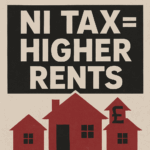
And any national insurance levied on landlords will be paid by tenants in the form of higher rents. Just as the higher income tax burden imposed upon non-incorporated landlords unable to offset their finance costs against rents is passed on to tenants as rent because landlords have no other choice.
The policy of not allowing non-incorporated landlords to offset finance costs is regressive and inflationary: And any NI levy imposed on non-incorporated landlords will be the same. Landlords don’t have any choice but to pass it on as higher rent.
Member Since August 2014 - Comments: 179
7:14 PM, 4th September 2025, About 1 year ago
Reply to the comment left by Steve Ticket at 03/09/2025 – 18:19
The plan is the Govt wants independent landlords to leave the PRS so their homeless tenants have to turn to the corporate BTR landlords. Then wealth management companies such as BlackRock can market the UK corporate landlords as an investment sector,
Everyone then wins.
UK Govt ministers get their corporate bribes, sorry I meant fees for “speaking engagements”.
BTR builders, such as Grainger, Lloyds Bank etc get to sell and/or manage their housing developments.
BlackRock and Vanguard etc get to make fees selling the UK rental sector as an “investment”.
The losers of course will be the independent landlords and the desperate tenants of the corporate landlords.
Do you see how it all neatly fits together?
What could possibly go wrong?
Member Since January 2016 - Comments: 300 - Articles: 1
8:28 PM, 4th September 2025, About 1 year ago
when tenants have an
issue they can ring Manila
where they will be in a que!
Member Since July 2013 - Comments: 463
8:31 PM, 4th September 2025, About 1 year ago
Those who say a new NIC tax on landlords can simply be passed on to tenants may well be disappointed. A point comes when most tenants simply cannot afford to pay more, and landlords trying to charge higher rent cannot find any takers. They will have priced themselves out of a market where most buyers have finite ability to pay..
Since when were NICs charged on investment income? Or if it’s charged on landlords now seen as self-employed, then we are running businesses and should get full cost deductibility, and S24 dies. If NICs are applied to property income, then so it must also be applied to cash savings interest, share dividends, bond yields and pension incomes.
The Government is causing havoc and panic in the property market with all these tax proposals from think tanks and the usual special interest groups, which it refuses to deny. It is the height of irresponsibility and utterly disgraceful. Unfortunately this has come to be seen as normal behaviour by a bunch of amateurs and class warriors who seem to think it’s clever to wreck people’s pension plans and wreck inheritance planning for family businesses and farms, as they did in the last Budget
Member Since August 2014 - Comments: 179
8:44 PM, 4th September 2025, About 1 year ago
Reply to the comment left by AnthonyJames at 04/09/2025 – 20:31
Agreed there is an upper limit to what rent tenants are prepared, and able, to pay due to the generally low average pay in the UK.
Agreed about UK Govt, it is very hard to tell which is greater, their corruption or their incompetence, it’s really a toss up.
Member Since May 2018 - Comments: 2550
11:07 AM, 5th September 2025, About 1 year ago
Reply to the comment left by AnthonyJames at 04/09/2025 – 20:31
I think this will depend upon where the landlord is in the country. A lot of landlords are finding that either they or their agents have a queue for properties. Less than ten years ago my agent used to advise me to hold rents down a bit to encourage long-term tenancies. I know lots of other small portfolio landlords who did the same. Now, agents are advising rent increases and small portfolio landlords are raising rents when they can just in case they can’t do it later.
In some areas of the country demand may have slumped and private landlords may be better off renting their houses to Serco, or one of the other companies housing asylum seekers. Not something that I can do but it looks to be a much less risky option than housing social housing tenants under the proposals of the Rental Reform Bill.
So I still think that in the areas where there is the greatest pressure on housing that if there is NI on rental income then this will be passed on UNLESS the government back-tracks on George Osborne and the conservatives’ policy to stop non-incorporated landlords from being able to offset their finance costs. If NI was payable at the same rate as the rate for self employment on net income after all REAL business costs, INCLUDING FINANCE COSTS, then application of NI to rents would not have the same effect and would not create the same pressure on rents.
I’m not seeing much evidence of competence in the government yet: Certainly there is no evidence of competence from the current housing minister. But what if out there somewhere there was a politician who had the ability to learn the lessons of history and get rid of policy that doesn’t work? From any party?
What if there was a politician out there who understood that the only solution to the country’s woes is market growth? Including growth in the PRS. The country can’t solve it’s housing crisis without growth in BOTH social housing AND private rental accommodation. And you can’t get that by attacking investors, as labour, conservative and SNP have all done.
What if there was a politician out there who understood that if you allow companies selling cavity wall insulation and external cladding to be the gatekeepers for grants, then this is a recipe for corruption and malpractice?
What if there was a politician out there who understood that if you allowed landlords to offset their finance costs for all properties at EPC band C and above, and made it clear either via capital allowances or via clear guidance from HMRC, that investment in local energy generation and storage could be offset against revenues, that this would at least incentivise the boom in energy-efficient housing that we actually need.
Member Since June 2015 - Comments: 201
11:53 AM, 5th September 2025, About 1 year ago
Talking about 8% NI on rents will mean that the actual increase in rents will have to be around 11% to just stay at the same level of income. Here are some simplistic calculations:
Assume that the current rent is £10,000 per annum on the property
Assume a basic rate (20%) taxpayer
Assume all personal allowances covered by other income (salary, pensions, existing rental income)
Assume NI levied at 8% on all gross rents. Controversial, I know, but otherwise expenses could be created to reduce profits.
Assume a 11% rent increase just to cover the additional NI – £1,100 extra rent.
Tax on additional rent @20% – £220
NI on new rent – £11,000 @8% – £888
Total additional payment to government – £1,108.
If tax is paid at 40% then increase becomes around 15% – £1,500 increase
Tax on additional rent @40% – £600
NI on new rent – £11,500 @8% – £960
Total additional payment to government – £1,560.
No tenant is going to accept a 15% rent increase no matter what the landlord says about not making any additional profit. Especially if properties in limited companies do not have a similar increase. The rental market would just be skewed.
If this does happen then I foresee a massive shift to incorporating, even with the cost of stamp duty.
A possible scenario is for RR to bring back a tax from the distant past – the 60s and 70s – an investment income surcharge. This was just an additional tax on non-earned income such as interest, dividends, rent etc. It could just be targeted at rent but if she is re-introducing it why not add in all other non-earned income. It would bring in enough tax to cover the massive hole she has created in government spending.
Even more controversial would be to scrap employee NI (8%) and increase basic rate income tax (20%) to 25%. Would seem to be a win for the taxpayer but anyone not paying NI at the moment (pensioners) would see a 25% increase in the tax that they pay.
I really cannot see NI on rents being introduced as there are too many other items to be brought into consideration.
Member Since May 2018 - Comments: 2550
12:11 PM, 5th September 2025, About 1 year ago
Reply to the comment left by Simon Lever – Chartered Accountant helping clients get the best returns from their properties at 05/09/2025 – 11:53
I think that we are already seeing a short, medium and long-term shift to incorporation. The market is already being skewed and not in a way that benefits tenants, the environment, or energy security.
However, whether e.g. 8% NI drives pressure on rents or not depends upon whether non-incorporated landlords will be allowed to offset their finance costs going forward. For a landlord who is at break-even after finance costs and investing for the long-term in energy-efficient property, 8% of 0 is 0 and the NI per se doesn’t necessarily create pressure on rents.
But yes, if there is no change in the policy of non-incorporated landlords being unable to offset their finance costs whilst limited companies still can, then we will see the shift to incorporation accelerate.
Member Since May 2020 - Comments: 17
10:45 AM, 6th September 2025, About 1 year ago
Rents up £75 per property then