

£42,500 landlord fine: when tenants create squalor, who is really responsible?
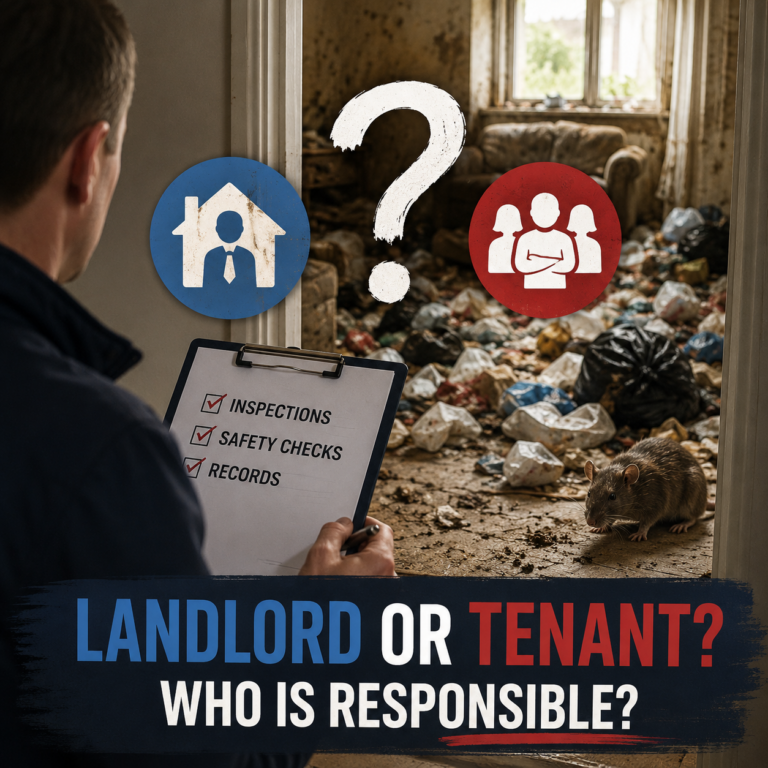

A press release landed in my inbox suggesting that a £42,500 prosecution in County Durham demonstrated why landlords should check their properties regularly for signs of pests. That may be one lesson from the case, but it overlooks a much more uncomfortable question for landlords and letting agents. When adult tenants create or choose to tolerate appalling living conditions inside their home, at what point does their behaviour become the landlord’s responsibility?
Carter Property Services, a County Durham company reported to be responsible for around 300 rental properties, was prosecuted after Durham County Council identified 13 breaches of selective licence conditions across eight homes. The company was fined £40,000, ordered to pay £500 in costs and charged a £2,000 victim surcharge, bringing the total to £42,500.
The most shocking evidence concerned a property in Peterlee, where paramedics reportedly found three adults sleeping on the floor among accumulated waste, dead rats and mice. The house was said to be caked in faeces and urine and to have a strong smell of ammonia. According to the council’s account, the property had not been inspected for two years and its gas safety certificate was almost four years overdue. At another property, a tenant said no inspection had taken place during the four years they had lived there, while the company was also said to have failed to provide valid gas safety certificates for four of the eight homes.
Those reported failures are serious. An annual gas safety check is a fundamental legal obligation, not an optional administrative exercise, and a landlord accepting a selective licence must comply with the conditions attached to it. If Durham’s evidence gives the full picture, no responsible landlord or agent should seek to defend gas safety records being allowed to fall years out of date or required inspections simply not taking place.
The fine was not, though, imposed because the landlord put rubbish into the property, deposited human waste on the floor or caused three adults to sleep among dead rodents. The prosecution concerned failures to comply with licensing conditions. That distinction matters because the language used by the council risks leaving the public with a very different impression.
Did the landlord really “allow” this to happen?
Tony Hanson, Durham County Council’s corporate director for regeneration, economy and growth, described the case as one in which the landlord had failed in its duty by “allowing” tenants to live in poor and unsafe conditions.
The word “allowing” carries a great deal of weight. It suggests knowledge, consent and control. It gives the impression that the landlord was aware of the conditions and made a conscious decision to leave the occupants living among rubbish, faeces and dead rodents.
The publicly available account does not appear to establish that.
We are told that three adults were living at the Peterlee property. We are not told who accumulated the waste, how quickly the conditions developed, whether the occupants reported the problem, whether they prevented anyone from entering or whether they had vulnerabilities that affected their ability to look after themselves and the property. Those facts could alter any fair assessment of responsibility, but they are missing from the council’s version of events.
Tenants do not lose all personal responsibility when they rent a home. Government guidance says tenants should give landlords reasonable access for inspections and repairs, take good care of the property and repair or pay for damage caused by themselves, their family or their visitors.
A landlord is responsible for the structure, installations, statutory safety checks and necessary repairs. A landlord can also be expected to inspect at reasonable intervals, respond to warning signs and take appropriate action when a tenant is damaging a property or living in conditions that create a danger.
That does not mean a landlord can control every decision made by adults behind their own front door. The landlord does not decide what the occupants bring into the property, how often they clean it, whether they dispose of their rubbish or whether they report a developing problem.
Landlords cannot simply force their way inside
The practical difficulty is that a landlord’s responsibility to inspect does not give them an unrestricted right to enter an occupied home whenever they choose. Tenants are entitled to live in the property undisturbed, and landlords are normally expected to give at least 24 hours’ notice and visit at a reasonable time.
Even where a statutory gas safety check is overdue, the Health and Safety Executive says landlords must not use force to enter. Where a tenant prevents access, landlords are expected to make repeated attempts, leave notices, write to the tenant and retain evidence of their efforts. The HSE says inspectors will generally look for at least three attempts, although whether the steps taken were reasonable will depend on the circumstances and may ultimately be decided by a court.
We do not presently know whether access was refused in this case. The fact that inspection and gas safety failures were identified across eight properties may indicate a broader management failure rather than one particularly difficult tenancy. If the company simply failed to arrange the inspections, the responsibility for that failure sits squarely with the company.
The position would be very different if appointments had repeatedly been offered and refused, letters had gone unanswered and the occupants had deliberately concealed the condition of the property. A landlord facing that situation would still need to escalate matters, potentially through legal proceedings, but it would be grossly unfair to describe them as having voluntarily “allowed” the conditions to develop.
The council’s public statement does not tell us whether Carter Property Services offered any explanation, whether evidence of attempted access was produced or what the company said in its defence. The court may have heard evidence that entirely justified the conclusions reached, but that evidence has not been included in the council’s publicity.
Responsibility should follow conduct
There appears to be a growing assumption that almost anything found inside a rented home must be the landlord’s fault. Damp is blamed on the landlord without considering heating and ventilation. Damage is presented as disrepair without asking who caused it. Waste and pest infestations are treated as property-management failures without examining how the waste accumulated or whether the problem was reported.
Landlords should not use tenant behaviour as a convenient excuse for neglecting their own duties. Equally, councils should not erase tenant responsibility because blaming the property owner produces an easier headline.
A fair assessment should separate the issues.
The landlord or agent should be accountable for carrying out required inspections, keeping gas and electrical safety records up to date, maintaining the parts of the property for which they are legally responsible and acting promptly when a problem becomes known.
Tenants should be accountable for taking reasonable care of their home, disposing of household waste, reporting hazards, avoiding damage and permitting reasonable access for inspections and safety work.
Where occupants are vulnerable and unable to care for themselves, the situation may also require support from social services, health professionals or other agencies. It should not automatically become a criminal or moral failing by the landlord simply because the people concerned happen to live in rented accommodation.
The practical warning for landlords and agents
Whatever the unanswered questions surrounding this prosecution, the practical warning is clear. An inspection that was arranged but refused is very different from an inspection that was forgotten. The difference will often be determined by the landlord’s records.
Every inspection appointment, access request, unanswered email, text message, letter and attempted visit should be recorded. When access is refused repeatedly, the matter should not be allowed to drift for years. The tenant should be warned formally, the reasons for the inspection should be explained and legal advice should be obtained where necessary.
Gas safety checks require particular attention. Systems should flag renewal dates well in advance, giving the landlord or agent enough time to deal with missed appointments or access difficulties before the certificate expires.
None of this answers the wider question raised by the way Durham County Council has presented the case. The reported inspection and gas safety failures appear substantial, but it does not follow that the landlord created or knowingly approved the squalor found inside the Peterlee property.
Responsibility should follow what each party did, what each party knew and what each party could reasonably control. On the information published so far, there appears to have been more than one responsible party in that house, even though only the landlord has been publicly named, prosecuted and blamed.
6 comments on this article
Learn from your peers’ experience
A different perspective could help you spot an issue, avoid a mistake or find a better way forward. Read the comments and add your own views if you wish.
Previous Article
Government defends Breathing Space scheme amid landlord concernsNext Article
Cash in the bank without evicting your tenant
Member Since December 2023 - Comments: 1665
6:16 PM, 24th July 2026, About 3 months ago
If their HMO license says that they must inspect the property every six months and they simply don’t bother, they deserve the fine. Neighbours of HMOs deserve HMOs to be properly regulated.
Member Since June 2019 - Comments: 976
11:49 AM, 25th July 2026, About 3 months ago
Reply to the comment left by Cider Drinker at 24/07/2026 – 18:16
…… but if they insist on living in squalor, how exactly can we remove them post RRA.
Member Since October 2020 - Comments: 1378
11:56 AM, 25th July 2026, About 3 months ago
Reply to the comment left by Cider Drinker at 24/07/2026 – 18:16
The article says it was selective licence conditions, so they’re not HMOs.
Member Since December 2023 - Comments: 1665
8:22 AM, 26th July 2026, About 3 months ago
Reply to the comment left by Paul Essex at 25/07/2026 – 11:49
Maybe they wouldn’t need removing. A report to the social services might be enough to get the tenants the help that they need. We cannot allow poor areas, that are deemed to require selective licensing, turning into ghettos.
Landlords could rely ground 12 or 13 and possibly one of the antisocial behaviour grounds.
Facing the problem head-on is better than not complying with their license.
Member Since September 2018 - Comments: 3751 - Articles: 5
9:57 AM, 27th July 2026, About 3 months ago
The LL checks every 6 months. T lives like a pig. LL says you need to clear up. T says ok. Another check a month later and still the same.
LL informs the council. Council responds its down to the LL to sort out….
LL now turns into a social worker because its going to take time and money to evict.
LL should report tenant to Enviro Health. Keep all correspondence etc then contact council again (housing Dept) to say that if they evict this person will be back on their books so are they going to help?
Get reply and then S8 Ground 12/13
Member Since October 2020 - Comments: 209
3:01 PM, 27th July 2026, About 3 months ago
Great article. Absolutely on point. Council took quite a chance and lazily so on prosecuting the landlord for breach of a licence condition that was most likely imposed unlawfully – rather than a breach directly of applicable statutory requirement(s) in which the tenant would have had some culpability too. Councils do not have a lawful basis for imposing the same suite of licence conditions on all houses subject to licencing. The Upper Tribunal determined that recently in Fletcher v Portsmouth City Council [2026] UKUT 234 (LC). So there was a good defense available if the landlord/agent had had specialist legal advice.