

Landlords face £40,000 fines for misuse of possession grounds
4 months ago | 7 comments


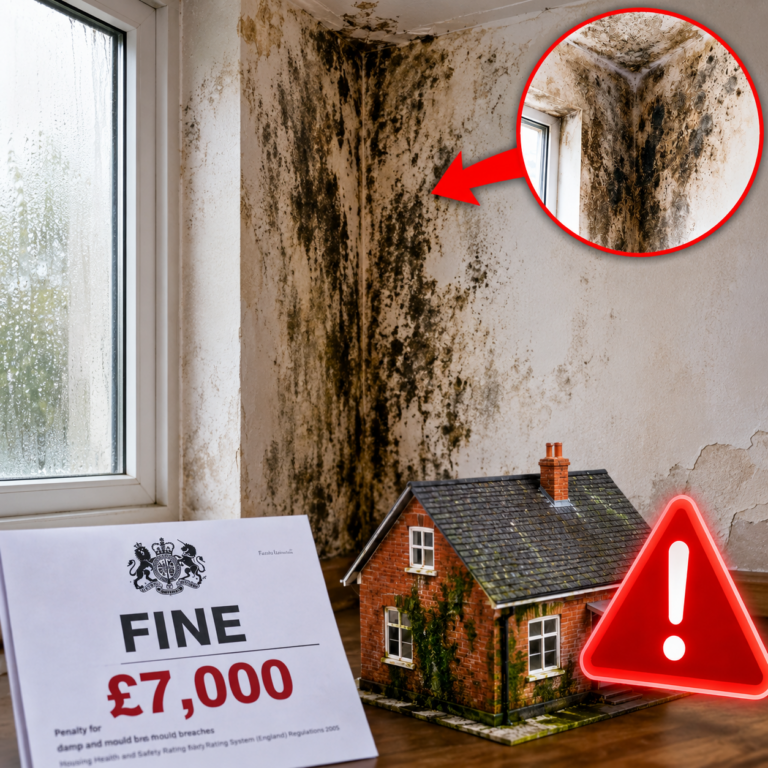
The government has announced landlords will face on-the-spot fines of £7,000 for severe damp and mould, as well as for broken-down boilers during freezing temperatures.
Housing Secretary Steve Reed has written to England’s councils calling on them to use the powers at their disposal to tackle poor conditions in the private rented sector and protect tenants.
The new rules come into force under the Renters’ Rights Act starting this week (Monday 22nd June).
Housing Secretary Steve Reed said: “Renters deserve a safe, secure place to call home, and our landmark Renters’ Rights Act gives councils more options to take swift action against rogue landlords.
“These include the new power to issue a £7,000 penalty to a landlord when there is a hazard such as severe damp or mould in a privately rented home, a situation that no family should have to live with.”
The fine will apply to 21 types of serious hazards, classified as the most dangerous level. These include freezing conditions, faulty electrics, fire risks, structural issues and unsafe layouts.
The government says severe damp and mould are also included on the list, along with broken-down boilers in freezing temperatures.
The new penalty sits alongside existing powers councils can use to tackle unsafe homes that put tenants at risk.
These include forcing repairs, carrying out emergency works and recovering costs from landlords who fail to act.
Tenant groups have welcomed the government’s crackdown on landlords.
Ben Twomey, chief executive of Generation Rent, said: “Homes are the foundations of our lives, and no renter should have to live alongside mould, dampness and other risks to our health.
“The council being given the power to fine landlords up to £7,000 if they ignore repairs is an essential step towards raising the quality of rented homes. For renters to feel the benefit, though, councils must seek out and take action against those landlords who ignore unsafe conditions and profit from misery.”
Clara Collingwood, director at the Renters’ Reform Coalition, said: “Homes are the foundation of our lives, but for far too long, hundreds of thousands of renters have been living in substandard homes that undermine our health and cause serious harm to children and vulnerable adults.
“It’s great that authorities have new powers to tackle this, and they must start using them immediately to crack down on landlords who profit from unhealthy homes.
“And now that we have new rights as renters, we need to use them. Any tenant living with serious disrepair or damp and mould should know they don’t have to put up with it any longer.
“With new rights and protections, and Section 21 evictions scrapped, we can’t be evicted for complaining and shouldn’t be afraid to report dodgy landlords to the council.”
As previously reported by Property118, the government has also announced changes to the Housing Health and Safety Rating System (HHSRS).
The government claims updating the rules will support quicker enforcement, helping to ensure hazards such as damp, fire risks and unsafe electrics are addressed more effectively.
12 comments on this article
A different perspective could help you spot an issue, avoid a mistake or find a better way forward. Read the comments and add your own views if you wish.
4 months ago | 7 comments

4 months ago | 1 comments

5 months ago | 5 comments
Member Since September 2022 - Comments: 217
11:22 AM, 22nd June 2026, About 4 months ago
So the 16th Housing Minister in 16 years wants to encourage Councils to Fine landlords for not providing Safe, Warm and Mould free Homes
I wonder how long he will be in the job ?
Can’t be bothered to remember his name as they might be gone next week !
Meanwhile in the real world More and More Landlords are selling up.
Please Check Roghtmove and other house selling websites if you think its not happening
London as always leading the charge
Member Since July 2013 - Comments: 2079 - Articles: 21
12:14 PM, 22nd June 2026, About 4 months ago
So, an on the spot fine if there is damp and mould!
What about due process and justice? What about investigating if the tenant is responsible for the damp and mould? Has the tenant reported it in a timely fashion and taken steps recommended by the landlord such as using fungicide, ventilating the property and heating it properly? I think we need some test cases as I think judges will not be impressed by a claim that this is a matter of strict liability.
A question for the politicians: If there is mould in an owner/occupier’s home, whose fault is that?
Member Since October 2025 - Comments: 14
12:28 PM, 22nd June 2026, About 4 months ago
I had a tenant who had a mould issue caused by her placing her chest of drawers next to a radiator and right up against an outside wall, thus restricting air flow. It caused a relatively tiny amount of mould spores, but she became convinced it was affecting herself and her child. So I got the minor treatment done and she was happy, but still kept putting the chest against the wall. I don’t think council inspectors would care about the truth but lick their lips at the thought of the draconian power they have to punish us.
Member Since May 2017 - Comments: 844
12:41 PM, 22nd June 2026, About 4 months ago
Woops, I misread the 2nd paragraph:
‘Housing Secretary Steve Reed has written to England’s councils calling on them to use the powers at their disposal to tackle poor conditions in the private rented sector and protect tenants’
I thought he was asking councils to eliminate poor conditions from their properties.
Member Since March 2017 - Comments: 14
2:25 PM, 22nd June 2026, About 4 months ago
If they seriously want safe and good conditions instead of fining they could authorise the repairs and the landlord has to pay. No fine but problem rectified.
Member Since January 2025 - Comments: 132
2:34 PM, 22nd June 2026, About 4 months ago
I am sorry to use gritty language, but are some of these so-called property voices completely brain dead, or have they just arrived from the planet Zog?
Property is only owned in this country because the state says it is owned. That ownership is not floating around in some romantic, untouchable, private-law bubble. It is tethered to HM Land Registry, and every registered title is therefore capable of being identified, charged, restricted, controlled, taxed, regulated, penalised and, ultimately, sold.
That is the point too many of the so-called property representatives still do not seem to grasp.
A landlord can huff and puff about not paying a fine, but unpaid statutory penalties do not just disappear because somebody is cross on the internet. They can be turned into enforceable debt. That debt can be pursued. It can be secured. It can sit against the property like unpaid council tax, with interest and costs added until somebody pays it, refinances it, sells to clear it, or is forced into a worse outcome.
The notice will arrive in calm administrative language. It will not say, “We are dismantling your property business.” It will say, in effect:
“You have been issued with a penalty. You have the statutory period stated in the notice to make representations or appeal. If you do not pay, further enforcement action may follow.”
And in many cases, unless there is a real factual, procedural or proportionality argument, there will be no meaningful ground of appeal. It will not be a debate about whether the landlord likes the policy. It will be a statutory penalty imposed under a statutory scheme by a public authority exercising statutory powers.
That is the machinery.
The council does not need to run around with a pitchfork. It does not need to nationalise anything in one dramatic parliamentary announcement. It simply needs to issue notices, impose penalties, enforce debts, recover costs and, where necessary, secure those debts against the one thing landlords cannot hide: the property.
Then comes the collection machine. Councils can outsource recovery to the growing industry of private law firms, enforcement agents and debt-recovery operators plugged into local authority systems and procedures. The debt can be pursued through the courts. The property can be charged. If the registered proprietor is an individual, bankruptcy is a possible route. If the property is held in a company, winding-up is a possible route. If the charge remains unpaid, the eventual destination can be sale.
That is not fantasy. That is not conspiracy. That is how the system works.
Instead of poring over carefully constructed, performative statements — to use the latest political expression — designed mainly to keep members paying fees of questionable value, these property voices should spend a week in the library of property and political history. They might discover that much of this has happened before, probably before many of the current operators of these landlord “voices” were even born.
This is confiscatory property history on steroids.
It destroyed the property industry before, and it will destroy it again unless the supposed representatives of landlords acquire some knowledge, some wisdom, and, above all, a backbone. Their job is not to pander to government. Their job is to fight for the people who pay them to understand the threat before it is too late.
This is not really about economics. It is an ideological shift, delivered partly through tax, but more stealthily through regulation. The object is to transfer wealth away from asset holders while avoiding the political ugliness of saying so directly.
Property owners are the low-hanging fruit because property cannot run away. It cannot be moved abroad. It cannot be put in a suitcase. It exists because the state records it, recognises it and controls the machinery around it. That is why property is so easy to tax, so easy to regulate and so easy to penalise.
Regulation has effectively turned many registered proprietors into bare trustees of their own properties. The beneficial claimants are now government, councils and renters, with the former landlord reduced to a sort of unpaid housing officer, left to discover how much of the income, capital and control the state is still prepared to leave in his hands.
The country is financially exhausted. Government cannot generate meaningful growth, so it must look for capital that already exists. That means redistribution, not by one grand confiscatory act, but by a steady chain of tax, compliance, penalty, enforcement and forced adjustment.
As one Labour MP was said to have observed:
“It is only property returning to the state.”
That may have been said quietly, but the policy direction is shouting it.
Member Since January 2025 - Comments: 132
2:43 PM, 22nd June 2026, About 4 months ago
P.S. The Telegraph recently published an excellent exposé showing how councils are handing up to 90% of regulatory fines to private enforcement companies. It is a bonanza for them and for the councils. As the system beds in, councils will no doubt demand a larger share, but one thing is certain: landlords will still be expected to pay 100%, plus costs and interest, to whoever has been empowered to do the collecting.
Member Since December 2023 - Comments: 1665
6:58 PM, 22nd June 2026, About 4 months ago
It is absolutely right that rogue landlords are taken out of the industry.
However, many homes are damp because of poor installation of government-inspired EPC improvements.
Member Since June 2025 - Comments: 6
8:10 AM, 23rd June 2026, About 4 months ago
People living in council and housing association homes suffer from damp and mould just as much as those renting privately. It seems unfair that private landlords can face fines of up to £7,000 per hazard while social landlords are subject to a different regime. Tenants’ health is affected in exactly the same way regardless of who owns the property. The focus should be on equal protection and equal accountability for all landlords, whether private, housing association, or council-run.
Member Since September 2018 - Comments: 3765 - Articles: 5
9:25 AM, 23rd June 2026, About 4 months ago
Reply to the comment left by Person Of The People at 22/06/2026 – 14:43
so then the council can be challenged on the basis that 100% of the proceeds from enforcement fines clearly do NOT go directly back to either ‘running the system’ nor ‘raising standards’ in the PRS then. If taxpayers are funding money to give to councils (from general taxation) then surely this is misuse of public funds if they simply pay more to subcontract out that they ever receive back?