

Damp and Mould Issues in Terraced Property

I became a member today and, although I have read many articles, this is my first post. Can I say, in opening, what a valuable resource this is.
I have one BTL property near Barnsley which is an old (1885) terrace. I bought the property in November 2013 with tenants already in situ. The Home Buyers report said no damp was found.
On a visit just before Christmas I was told of a small damp patch in the corner on the floor of the upstairs bedroom. We agreed to monitor the situation and they would get in touch if it became a problem.
Having now read some articles I realise it was always going to ‘become a problem’!
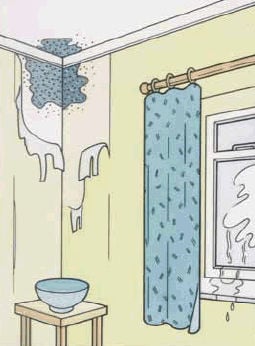
However, I heard nothing from my tenants on this issue so when I visited again last Monday I was shocked to hear of their experience – there is black mould in the upstairs bedroom in the corner and under the window, mould under the downstairs window at the front (NW facing), peeling paint on an internal wall and the chimney breast had been damp to touch. The bathroom has also got mould – there is no extractor in there so I have asked an electrician for a quote to fit an Humidistat fan.
The tenants reported that they have been wiping the mould off and repainting or wallpapering over the affected areas. I know this is not the way to deal with it.
My question is what is the best way to tackle this issue?
Do I purchase a DIY eradication kit or does it need a proper investigation to find the cause?
If so, how do I find a reputable damp specialist working in the South Yorkshire area?
I am very keen to resolve this issue for my tenants as soon as possible.
Many thanks in anticipation.
Lynne
33 comments on this article
Learn from your peers’ experience
A different perspective could help you spot an issue, avoid a mistake or find a better way forward. Read the comments and add your own views if you wish.
Previous Article
Change of use for flat belowNext Article
Taking deposit and first months rent
Member Since June 2013 - Comments: 726 - Articles: 1
5:42 PM, 10th July 2014, About 12 years ago
Reply to the comment left by “Mark Alexander” at “10/07/2014 – 17:38“:
the most effective solution is surely important. and it can be implemented by working with the tenant.
Member Since June 2013 - Comments: 12
5:59 PM, 10th July 2014, About 12 years ago
Reply to the comment left by “Joe Bloggs” at “10/07/2014 – 17:22“:
So…you are agreeing with me…:)
Glad we cleared that up.
Comments: 16
12:53 PM, 11th July 2014, About 12 years ago
Reply to the comment left by “Mark Alexander” at “10/07/2014 – 08:17“:
I have been a specialist damp consultant for over 25 years and condensation is an increasing problem in the UK – especially in tenanted properties. I have been advising landlords and letting agents about these issues in South Devon and hope to set up seminars on the subject soon. My company has supplied hundreds of Nuaire Drimaster PIVs which we find are the best value for money on the market.
I consider dryhomes.net to be the most comprehensive and informative website you are likely to find. If you want good advice from experts look no further.
Best wishes
Stephen Linley-Shaw (Dryhomes).
Comments: 16
12:58 PM, 11th July 2014, About 12 years ago
Reply to the comment left by “Ian Ringrose” at “10/07/2014 – 09:33“:
The Drimaster 3S is rated for 3 storey buildings.
See Dryhomes.net
Member Since July 2013 - Comments: 199
1:49 PM, 11th July 2014, About 12 years ago
Reply to the comment left by “Adrian Matthews” at “10/07/2014 – 12:05“:
I always hand my tenant a leaflet which guides them on how to live in the property without creating condensation.
I find that you cant change the way the tenant behaves that easily .Drying clothes on radiators is a big problem and not always in the winter either as some are so lazy they wont venture up the garden to the washing line. They very often dont open windows or doors either. Its usually lifestyle . The same property can be immaculate depending on who is renting the property .
Once all the extractor fans etc are at the property for the tenant to use I then ask the inventory clerk to make regular inspections on the properties after the initial inventory has been done. This works for me as the clerk will speak to them at inspection and guide them if any signs of condensation can be seen .
Regular checks to keep on top of it all .
Comments: 16
2:02 PM, 11th July 2014, About 12 years ago
Could not agree more with Jan Martin
Here’s our dryhomes list
Lifestyle changes that can help cure condensation problems:
General
Don’t dry clothes inside you home – our top tip… but we know it can be difficult to follow
Tumble drier / Washing machine – use a condensing type – otherwise it must be vented outside
Don’t use butane or paraffin – they produce more water than the liquid fuel they burn!
Consider reducing the number/size of plants – water a plant and it gives off vapour
Don’t put furniture against cold outside walls – mould grows on the back
Consider fitting trickle vents in the window frames
Remove aquariums which evaporate lots of vapour
Maintaining background heating at low level is better than rapid rises and falls
Leave doors of remote rooms, cupboards and wardrobes ajar to let air and heat circulate
Open windows and doors – on a warm, breezy day it’s a great way to dry a soggy home
Kitchen
Use lids when boiling vegetables
Consider using a pressure cooker – you get energy savings as well
Mop up any water so it doesn’t evaporate into the home: drain sinks and bowls to stop evaporation
If a cooker hood is used run it on afterwards for 20 minutes – this only works if the hood vents outside!
Open window for half an hour and keep the kitchen door closed during cooking
Bathroom
Shower less often and/or for a shorter time
Bathroom fan – leave the light on to keep it running for 20 minutes after a shower
Bathroom window – leave ajar for half an hour and keep the bathroom door closed after use
Benefits of Self Help Approach
It’s free or quite cheap
Each change reduces condensation
Sadly it needs the co-operation of all dwellers for this to be successful.
Steve
Member Since February 2011 - Comments: 3462 - Articles: 286
2:29 PM, 11th July 2014, About 12 years ago
Reply to the comment left by “Stephen Linley-Shaw” at “11/07/2014 – 14:02“:
Hi Stephen,
Welcome to Property118. It is great to have someone of your experience here.
Your first post made us chuckle as I am sure we all think our own websites are the best lol 🙂
Please see the following linked page regarding our house rules for promotional articles and comments see >> https://www.property118.com/business-sponsorship/
Member Since June 2013 - Comments: 726 - Articles: 1
5:07 PM, 11th July 2014, About 12 years ago
Reply to the comment left by “Stephen Linley-Shaw” at “11/07/2014 – 14:02“:
good list. the importance of reducing unnecessary (lifestyle) moisture sources was the apparently ‘semantic’ point i was making above. i would add heating all rooms (rad valves are often turned off in rooms not used).
Member Since January 2011 - Comments: 12256 - Articles: 1481
5:14 PM, 11th July 2014, About 12 years ago
Reply to the comment left by “Joe Bloggs” at “11/07/2014 – 17:07“:
Hi Joe
My comment regarding semantics was merely in relation to you bashing a particular point which you and another commenter clearly agreed on all along but you seemed to continue to think he was disagreeing with you.
Sementics is the branch of linguistics and logic concerned with meaning. The two main areas are logical semantics, concerned with matters such as sense and reference and presupposition and implication, and lexical semantics, concerned with the analysis of word meanings and relations between them.
.
Member Since June 2013 - Comments: 726 - Articles: 1
5:37 PM, 11th July 2014, About 12 years ago
Reply to the comment left by “Mark Alexander” at “11/07/2014 – 17:14“:
hi mark,
we didnt agree!
simon holloway’s asked what he had said wrong and i explained again.
his last comment about me agreeing with him was clearly tongue in cheek.