

Andy Burnham warns LHA freeze is driving up temporary accommodation costs
2 months ago | 1 comments


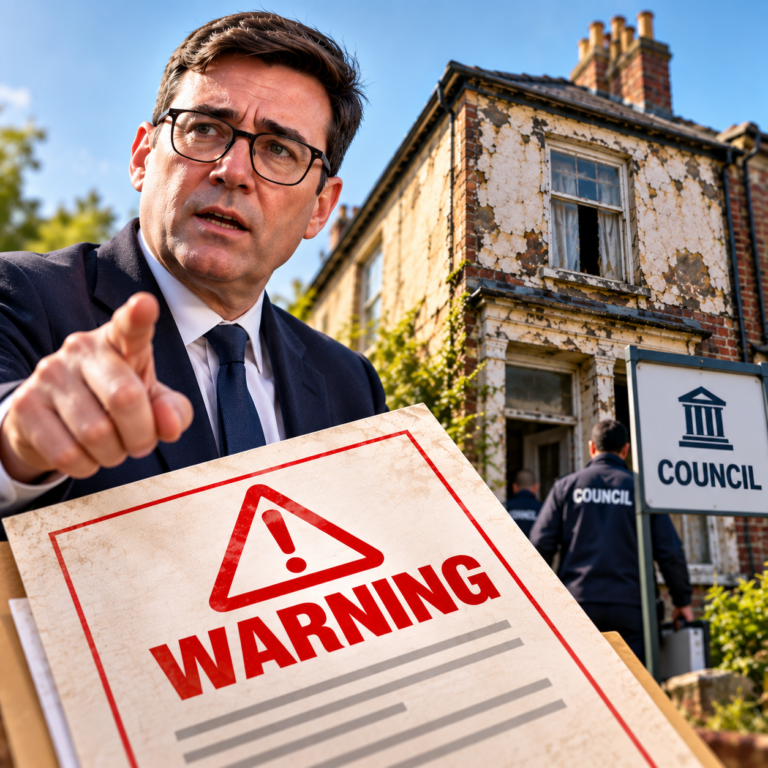
The Prime Minister has warned landlords who rent out the “worst-quality homes” will be given warnings and could ultimately face having their properties taken over by councils.
Speaking at the Labour Party conference, Andy Burnham also said he would reform Right to Buy and tackle the empty homes crisis.
The comments come as the government announces plans to strengthen leaseholders’ rights, including tighter regulation of property agents and a cap on fees.
Mr Burnham claimed that too many homes in the private rented sector are in a poor state of repair.
Addressing the Labour Party conference, Mr Burnham said: “You will find rented homes in a poor state of repair on so many British streets. Homes which harm the health of the people living inside them and drag down the streets around them.
“The worst of it is often owned by absent landlords, who are paid through the benefits system but refuse to reinvest in the upkeep of their properties.
“It is time to call an end to this. Landlords who rent out the worst-quality homes will be given warnings to improve them. If they refuse, we will make it much easier for councils to acquire those homes, and we will legislate if necessary.”
Mr Burnham added: “We don’t let people sell food that damages people’s health, so why should we allow it with homes? From now on, we won’t. This is what I mean by taking back control with our communities.”
Mr Burnham added that the government would reform Right to Buy and launch a council housebuilding revolution.
He said: “I am specific about council homes because we need to restore stronger democratic control over our housing stock.
“We will help councils build again and make it affordable by building on unused public land. We will reform Right to Buy, not taking the right away from anyone in an existing home, but removing it from the new homes we build, so they are there for generations to come.”
The news comes as the government have announced councils in England will be able to take control of homes left empty for six months under government plans to cut the current two-year threshold.
Councils will also no longer need to provide evidence relating to anti-social behaviour or community support when seeking an order through the Residential Property Tribunal.
Timothy Douglas, head of policy and campaigns at Propertymark, said further clarity is needed on how the proposals would work in practice.
He said: “Addressing poorly maintained properties should remain a key concern, with local authorities across England working closely with residents, landlords and property agents to understand why properties may fall below the required standard.
“Every case will have different circumstances, so any proposals must be proportionate and recognise the individual circumstances of the property and those living in it.
“Further clarity is needed on how the proposals would work in practice, including carrying out remedial work with a tenant in situ, the responsibilities of different parties, and how properties would be managed if they passed into local authority control or ownership.
“With the new ‘Register Your Rental Property Service’ being implemented for landlords from December, councils will have greater access to information to support targeted, intelligence-led enforcement. The focus should be on making better use of existing tools rather than simply adding another layer of legislation and potentially damaging relationships between good landlords and government.
“Any new proposals should deliver a fair, proportionate and tailored approach that achieves sustainable, long-term outcomes.”
43 comments on this article
A different perspective could help you spot an issue, avoid a mistake or find a better way forward. Read the comments and add your own views if you wish.
Previous Article
Property sales fall as house price growth slows
2 months ago | 1 comments

2 months ago | 11 comments

2 months ago | 22 comments
Member Since September 2018 - Comments: 3766 - Articles: 5
9:22 AM, 1st October 2026, About 3 weeks ago
Reply to the comment left by David100 at 30/09/2026 – 19:32
you can only do this once. If they honestly believe every single ex LL house will be bought by a FTB then they are not only deluded but will have cut their own throat in the process.
There are many LL’s that will simply offer up the property rent free to their kids who cannot get on the property ladder. The property therefore is not empty, will not pay void CT charges, and it will sit outside the RRA (the LL simply charges £50 or less a year for rent). The son/daughter can then let a room to a lodger, the income being tax free (then pass it back to the property owner in cash).
Member Since December 2023 - Comments: 32
9:39 AM, 1st October 2026, About 3 weeks ago
Reply to the comment left by Stella at 30/09/2026 – 12:23
The chief executive of a social housing provider can earn around £200,000 a year, while the actual financial risk is borne by the organisation rather than personally by the chief executive. By contrast, a small private landlord may invest hundreds of thousands of pounds of their own money in providing homes for the community and would be delighted to achieve even a quarter of that amount as net annual income.
There also appears to be a serious imbalance in the way responsibility and enforcement are perceived. Consider Grenfell Tower in North Kensington. Seventy-two people lost their lives in the 2017 fire in the 24-storey building. The tragedy exposed catastrophic failures surrounding building and fire safety, including the external cladding and insulation.
Nine years later, the Metropolitan Police have submitted evidence concerning 54 individuals and 20 companies or organisations to the Crown Prosecution Service, with possible offences including corporate manslaughter, gross negligence manslaughter, health and safety offences and fraud. Charging decisions are still awaited.
Meanwhile, small landlords can face very substantial financial penalties for regulatory breaches, even though they have invested their own capital in providing housing.
Nobody should argue for lower safety standards. The real question is whether regulation, enforcement and accountability are being applied fairly and proportionately to everyone providing housing, from the smallest private landlord to the largest housing organisations.
Member Since April 2021 - Comments: 48
11:23 AM, 1st October 2026, About 3 weeks ago
Reply to the comment left by Ryan Stevens at 19:05
Actually it already has been. VAT on gas is not changed so 5% on increased gas prices probably outweighs this electric reduction. Then in rural areas, like myself, we have no option for gas, only fuel oil, which has double in price over the last 2 months. Around 65p per litre to over 112p. So 5% on that means the revenue is doing very well. The petrol diesel charge at 20% vat, so with the increase in diesel from 165 to 197 and beyond the revenue is making a fortune. Plus the frozen fuel duty at 53p ends this month so unless extended it will go up by 5p which is 9.5%. No, they can more than afford to loose VAT on electricity. In fact I bet the budget has some minor give aways too. Burnham trying to look like a nice guy. Not working!
Member Since April 2018 - Comments: 654
12:49 PM, 1st October 2026, About 3 weeks ago
Reply to the comment left by Jesus Diaz at 01/10/2026 – 09:39
Yes and even after Grenfell I am still chasing a property manager to carry out PAT tests on electrical equipment provided to residents. Either he can’t be bothered to pick up the phone to his in house electrician , or so overworked by the greedy company he has put it in his pending tray. But if the block goes up in flames it probably won’t be him who ends up in court
Member Since May 2018 - Comments: 2588
6:23 PM, 9th October 2026, About 2 weeks ago
Reply to the comment left by David100 at 30/09/2026 – 11:05
Labour might have blurred the lines but the Green party has leapt right over them. What has being for or against Zionism got to do with having sustainable policies to increase the energy efficiency of properties, increase energy security, decrease the dependence on fossil fuels, restore biodiversity or improve soil health? If you want to do ‘green’ things then surely you have to work out how you make these things affordable for the average landlord, average principle private residence, average small business. If Andy Burnham is now looking at rental homes in the private sector that’s probably an attempt to distract people from the fact that since labour came to power, less than 4% of houses built have been council houses. And building council houses is Andy Burnham’s Holy Grail isn’t it?
When the Monty Python team made Monty Python and the Holy Grail the film had a weird ending about the point at which they discovered the Holy Hand Grenade of Antioch….they just called the police in and created chaos. But I heard someone say once that the reason the film had this weird ending is that they’d run out of money to keep filming and they just had to come up with something a bit whacky to wind it all up. Labour governments also, always run out of other people’s money because they penalise small businesses and cause the economy to stagnate……their stories have always had dodgy endings when the electorate finally realises their sons and daughters can’t get a job or find somewhere to live because their government has been too busy pursuing their 1947 Holy Grails and have run out of both ideas and cash.
Labour never did have enough money to build council houses…the money markets know it…anybody with any experience of life or business can see it. Only a liar or an idiot would carry on pretending that they were going to solve the housing crisis by building council houses. When you are in a position like that you need a scapegoat for your failings don’t you?
So when he realises during this autumn’s budget that the ending of his story is all a bit f****d up, Brave Sir Andy is going to need to either find a scapegoat or b****r off….that scapegoat is going to be landlords isn’t it?
Member Since April 2018 - Comments: 654
8:59 PM, 9th October 2026, About 2 weeks ago
Dare I comment about Burnham risking £55 million of tax payer’s money with foreign businessmen, which is why Woking council went bust .Indeed they built houses in Manchester but how come in 2021 the UK company collecting the rent only paid £4k corporation tax on £1 million rent collected. Just the PM we want and will his cronies be monitoring this company.
Just
Member Since May 2018 - Comments: 2588
4:10 PM, 10th October 2026, About 2 weeks ago
Reply to the comment left by David at 09/10/2026 – 20:59
What that tells me is that during his time in Manchester, Mr. Burnham realised that the citizens of Manchester depend for their housing and the growth of their economy upon investment. So why would you now penalise employers for employing people? Or penalise small landlords for investing in housing?
But I don’t know anything about Mr. Burnham’s investments…all I can see is a debacle unfolding that looks as ridiculous as a Monty Python sketch. Do you have any more detail on Mr. Burnham’s investments, or maybe a link to them?
Member Since April 2018 - Comments: 654
8:38 PM, 10th October 2026, About 2 weeks ago
Reply to the comment left by Beaver at 10/10/2026 – 16:10
I don’t have a link but this story was reported by the Telegraph and can easily be found on Google “Burnham oversaw £55 million taxpayer funded loan to UAE businessmen”.
Member Since May 2018 - Comments: 2588
1:17 PM, 11th October 2026, About 2 weeks ago
Reply to the comment left by David at 10/10/2026 – 20:38
I see….so if I understand the situation correctly as the mayor of Manchester Andy Burnham facilitated a TAXPAYER-FUNDED loan TO UAE businessmen in order to invest in Manchester?
Member Since April 2018 - Comments: 654
8:20 PM, 11th October 2026, About 2 weeks ago
Reply to the comment left by Beaver at 11/10/2026 – 13:17
A high risk strategy, although perhaps no UK business men were interested so it went to the UAE. Seems though UAE has a lot of clout threatening now to pull billions unless man City FC is cleared by Burnham of financial misconduct. All sound fishy to me.