

London boroughs’ EPC rankings revealed
1 week ago


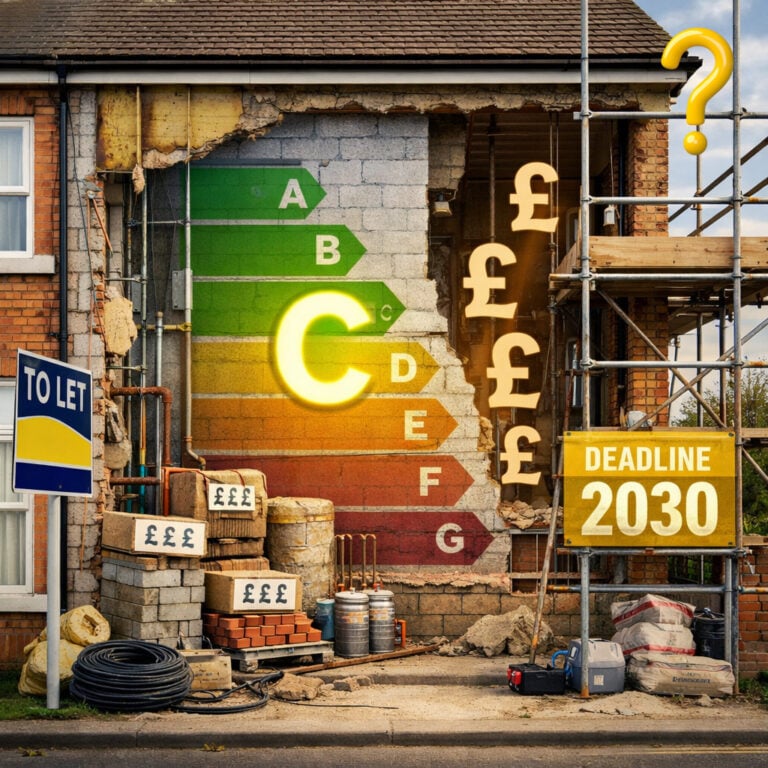
I’ve been digging into the EPC open data register to work out what the EPC C 2030 deadline actually means in practice for a typical small portfolio. Not the headline figures from government consultations, the actual numbers from real EPC certificates in real postcodes.
Thought it might be useful to share what I found, because the picture is more nuanced than “it’ll cost you £6,000-7,000” that keeps getting quoted.
The government publishes every EPC certificate through their open data portal (epc.opendatacommunities.org). It’s free to access. Each certificate includes the current rating, the potential rating after improvements, and a list of specific recommended upgrades with estimated cost ranges.
I pulled every domestic EPC in my local authority area and filtered for properties currently rated D, E, F, or G , the ones that need upgrading.
The spread of upgrade costs is enormous. A D-rated mid-terrace from the 1930s with reasonable loft insulation and double glazing might only need a boiler upgrade and cavity wall insulation to hit C, potentially £2,500-4,000 total. A solid-wall Victorian end-terrace rated E with single-glazed sash windows and no loft insulation could easily exceed the £10,000 cost cap.
The single biggest factor in whether your upgrade is affordable is wall type. Cavity wall insulation costs £350-500 and can shift your rating by 5-10 points. Solid wall insulation (internal or external) costs £5,000-15,000 and many landlords on Property118 have rightly pointed out it can cause damp issues in older properties.
The second factor is your current heating system. If you’ve got a modern condensing gas boiler rated A, you’ve already banked those points. If you’re still on an old non-condensing boiler, the swap alone (£2,000-3,000) can add 10-15 points to your score.
Properties that achieve EPC C under the current assessment method (EER) before October 2029 will be deemed compliant until their EPC expires, which is 10 years. That means if you get assessed at C under the current system before the new Home Energy Model kicks in, you’re potentially covered until 2039.
The new HEM system requires you to meet two criteria: fabric performance AND either smart readiness (solar panels, battery storage) OR heating system performance (heat pumps). This is likely to be harder and more expensive to pass. Several people on webinars have confirmed this interpretation.
So there’s a genuine argument for getting your properties assessed sooner rather than later under the current system, even if your EPCs aren’t due for renewal.
What I’d actually want to know per property after going through this exercise, I realised what would actually help me (and I suspect many landlords) is a simple per-property view.
The specific upgrades recommended for THIS property (not generic advice)
What I’d actually want to know per property:
I’m curious, how many of you have actually looked up your properties on the EPC register and gone through the specific recommendations?
And for those who’ve already started upgrading, did the recommended improvements actually move the needle the way the certificate predicted, or was the reality different?
Interested to hear real experiences. The government estimates feel very average-based and I suspect the property-by-property variation is huge.
Thanks,
Kshitig
Every day, landlords who want to influence policy and share real-world experience add their voice here. Your perspective helps keep the debate balanced.
Not a member yet? Join In Seconds
Login with
Previous Article
Rents tick up as Renters’ Rights Act deadline approaches
1 week ago
1 week ago | 1 comments

2 weeks ago | 1 comments
Sorry. You must be logged in to view this form.
Member Since January 2020 - Comments: 93
9:27 AM, 8th April 2026, About 1 day ago
Reply to the comment left by Beaver at 07/04/2026 – 11:44
Beaver, £4600 was cost of installation including inverter and scaffolding. 450w panels. SEG Export is going to Tenant and being passed on.
Member Since May 2018 - Comments: 1999
11:06 AM, 8th April 2026, About 1 day ago
Reply to the comment left by Pete England – PaTMa Property Management at 08/04/2026 – 09:27
I see, thank you. So the SEG payment is being paid to the tenant and that payment is then being passed on by the tenant to you as the landlord?
Member Since January 2020 - Comments: 93
1:39 PM, 8th April 2026, About 1 day ago
Reply to the comment left by Beaver at 08/04/2026 – 11:06
Yes. I created a separate agreement document.
Member Since May 2018 - Comments: 1999
2:40 PM, 8th April 2026, About 1 day ago
I see, thanks for clarifying, that’s interesting. So how many KWH do they generate in total per annum and what % of that gets sent back to the grid, rather than being used by the tenant?
Member Since January 2020 - Comments: 93
4:09 PM, 8th April 2026, About 1 day ago
Reply to the comment left by Beaver at 08/04/2026 – 14:40
Hopefully my roof, will generate about 3600kwh a year and I’m guessing 90% will go back to grid. I don’t have a battery.
Member Since May 2018 - Comments: 1999
4:52 PM, 8th April 2026, About 1 day ago
Reply to the comment left by Pete England – PaTMa Property Management at 08/04/2026 – 16:09
That’s interesting, thanks for sharing: I would estimate the typical electricity consumption of a 3 bed semi to be about 3000 kwh per annum, especially if the tenant knows the energy is free. So I’d guess that about 1/6 or less of generation would go back to grid, unless the tenant is still connected to the gas network.
Member Since May 2018 - Comments: 1999
2:51 PM, 9th April 2026, About 6 hours ago
Reply to the comment left by Peter Rowley at 04/04/2026 – 18:48
I was prompted to have a few further thoughts on this as a consequence of an email I just received offering me some gilts to invest in. This is because the article at the top of this thread is about the true cost of getting properties to EPC Band C by 2030, four years hence. And the point to understand is that the REAL cost of getting a property to EPC Band C is the after-tax cost, and any benefit is the after-tax benefit, allowing for investment costs and the opportunity cost of that investment.
Another consideration is that a number of commentators have made the point that it is absolutely impossible for the government to reach its target of building 1.5 million new homes, including this one:
https://www.homebuilding.co.uk/planning/absolutely-no-way-governments-1-5m-homes-pledge-can-be-met
On past experience the government won’t be able to stop people renting band D homes in 2030 because they just won’t have enough homes. Furthermore, considering the experience of these proposals in the past, any expenditure that you make before you have to make it will not necessarily count towards any investment ‘cap’ that you might have to meet in order to move your property up a band, by the time they’ve moved the goal posts again (because they have to), or make any difference to the EPC rating.
If you already hold your property portfolio in a limited company and therefore aren’t currently being penalised by the tax system it makes sense to invest in your property to improve the EPC rating IF you can move the rating easily, and IF you can charge more rent for a band C, B or A property. But if you are one of the majority, small landlords with 1.2 properties outside a limited company you have to question this as you are penalised by HMRC for raising capital.
So here are a few thoughts. As a non-incorporated small portfolio landlord you might be considering investing £4.5K in solar panels to squeak your property over the line from band D to band C (this is probably Capex if you aren’t replacing the gas boiler), or maybe investing £10-£30K to fully embrace renewables such as heat pumps and cover all the on-costs including making good. (probably also Capex). If instead you DO NOTHING (other than what you must, i.e. annual gas boiler check, EICR etc) but invest your £4.5K-£30K in either a stocks and shares ISA, possibly in passive funds, or maybe invest in gilts outside an ISA (gilts are free of CGT), then you could sit on your money and let it grow tax-free until the time when the government confirms that you can no longer rent your band D property out. At this point you can get rid of the tenant to put family members in, sell the property, or develop the property. If you haven’t increased the value of the property by upgrading the EPC and need to get it into a limited company then the lower EPC rating should help you get a lower valuation to reduce your CGT bill and you can lend the money from your ISA to your company to upgrade it, if you wish to. Or you can just sell to an owner occupier and just keep your tax-free ISA or gilt money.
As a small portfolio landlord holding property outside a limited company structure, tell my why I’m wrong?
Member Since May 2018 - Comments: 1999
3:34 PM, 9th April 2026, About 5 hours ago
Reply to the comment left by Beaver at 09/04/2026 – 14:51
Or if nobody wants to tell me why I’m wrong. If I’m a small portfolio landlord and my tenant wants me to invest in £4.5K worth of solar panels, allowing for the cost of extra capital, annual service costs, cleaning costs, professional maintenance, depreciation (including both the panels themselves and the inverter), plus the extra tax bill on the capital because I can’t offset my finance costs against rents, how much do I have to put the monthly rent up to cover the costs including both the capital and the extra tax at 40% that HMRC levies on me as a non-incorporated landlord?
Would it be say £200-300 per month?
Member Since April 2026 - Comments: 2
4:20 PM, 9th April 2026, About 4 hours ago
Reply to the comment left by Beaver at 09/04/2026 – 14:51
There are probably many financial instruments you could use to offset the costs to a future date. I understand the trajectory of thought. But, here’s the thing : if you leave things to the last minute , you may find it difficult getting tradesmen to do the work. You know what it’s like at the best of times. Wouldn’t that leave you non- compliant and unable to rent out ? Remember: Archimedes warned against doing his calculations on shifting sand !
Member Since May 2018 - Comments: 1999
4:28 PM, 9th April 2026, About 4 hours ago
Reply to the comment left by Steve Williams at 09/04/2026 – 16:20
I understand that a typical residential solar panel installation takes 1–3 days on-site, but the full process from initial enquiry to commissioning usually spans 4–12 weeks.