

Tell your Mum your brain needed a wash”: What my first mentor, Bob Patmore, taught me
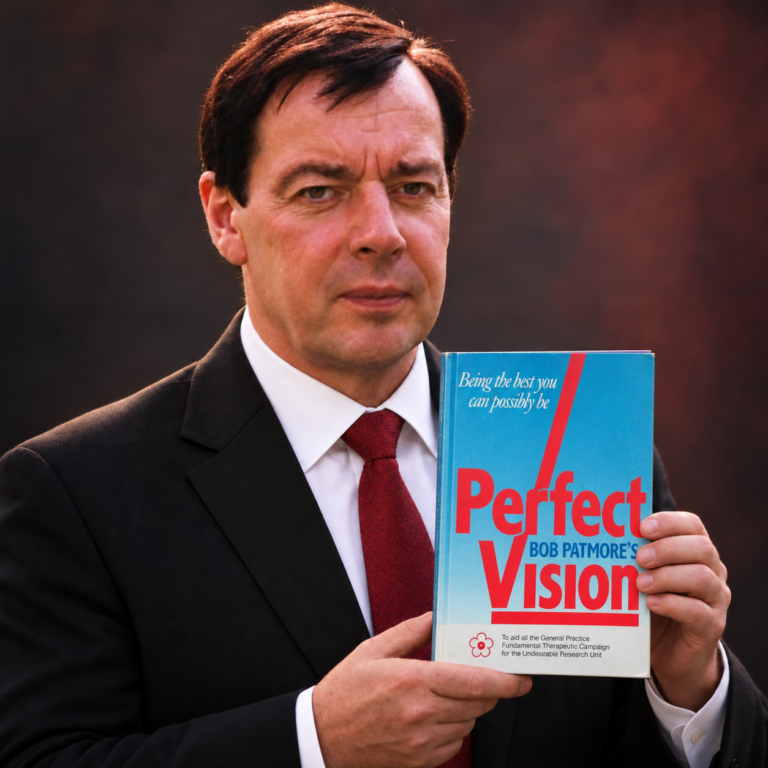

Long before Property118, and before The Money Centre, a former footballer turned financial-services leader taught me how to think bigger, ask better questions and turn ambition into a programme. He also belongs to the story of two friendships that have lasted for most of my adult life.
One evening in the late 1980s, I came home from one of Bob Patmore’s training sessions absolutely buzzing. I told my mum everything he had been teaching me and why I suddenly saw so many possibilities that I had not seen before. Mum listened and then delivered her verdict: “That man is brainwashing you.”
At the next training session, I told Bob exactly what she had said. He did not hesitate for a second.
“Tell your mum your brain needed a wash.”
That was Bob: quick, funny, supremely confident and incapable of allowing somebody else’s scepticism to put a ceiling on another person’s ambition. His answer has stayed with me for nearly four decades because, in an important sense, he was right. My brain did need washing. It needed clearing of the low expectations, excuses and inherited assumptions that persuade so many young people to accept a smaller life than the one they might create for themselves.
To understand why his words landed so powerfully, you need to understand the stage of life I was at. I was 19 and had recently moved to Norfolk with my parents. My days were an unusual mixture of working split shifts in a factory, breakdancing professionally, boxing and practising tae kwon do, while also training to become a financial adviser. I had plenty of energy and ambition, but no system for turning either of them into a result.
Bob supplied that system. He was my first real mentor and, although neither of us could possibly have known it at the time, much of what he taught me would remain relevant through every business I went on to build.
Bob was also the king of the quotable one-liner. In Perfect Vision in Management, he summed up unrealised potential with a sentence I can still hear him delivering:
“I would like to buy you for what you think you’re worth and sell you for what you’re really worth.”
It was funny, but the challenge beneath it was serious. Most people value themselves by what they have already done; Bob looked at what disciplined development might enable them to do next.
The footballer who treated success as training
Bob was not a conventional corporate trainer. Before financial services, he had spent part of the 1960s in the youth ranks at Tottenham Hotspur. A 1993 Financial Times profile described him as a former star of Tottenham’s youth team, while later biographies also associate him with Watford. That distinction is worth making: I have found no record of a competitive first-team appearance for either club, but Bob had experienced the discipline and standards of professional football from the inside.
Looking back, it is easy to see the footballer in the way Bob trained people. You did not become good at something by wishing, waiting for inspiration or relying on natural charm. You decided what result you wanted, broke it down into its component parts, practised those parts and then ran the programme with discipline. When something failed, you reviewed it and worked on the solution. You did not spend the next six months admiring the problem.
Bob had no patience with “nearly”. As he put it in Perfect Vision:
“If you nearly achieve something you have not achieved it.”
Failure could teach you something, but it was not to be disguised as the result you had set out to achieve. You acknowledged the gap, learnt from it and adjusted your next attempt.
By the time I came into financial services in the late 1980s, Bob had spent years developing that approach. This was the period in which FPS Management became General Portfolio Financial Planning Services; Companies House records the formal name change on 16 August 1988. Bob became General Portfolio’s national sales director, responsible for helping young and often inexperienced people acquire the confidence, structure and communication skills needed to make their way in a very grown-up industry. He later worked at Inter-Alliance, where Companies House records directorships from 1997 to 2001.
Bob understood that scale created responsibility as well as reward. In 7 Steps to Perfect Vision, he wrote:
“You double the size of your sales force and you quadruple your problems.”
His point was not to avoid growth. It was that growth without enough capable managers, sound systems and developed people stores up trouble. That remains as relevant to a modern business as it was to a national sales organisation in the 1980s.
The scale of Bob’s own achievements mattered to a room full of young recruits. He was not teaching theory borrowed from a textbook. He had applied the disciplines himself, first in sport and then in business, and he made success appear learnable rather than reserved for people with the right accent, the right family or an impressive collection of qualifications. That message carried extra weight because Bob himself had left school without formal qualifications, yet went on to succeed in a remarkable range of fields.
One question in 7 Steps to Perfect Vision captures his impatience with passive ambition: “Are you a goal setter or a goal getter?” Bob did not object to dreaming; he objected to mistaking the declaration of a goal for the work required to achieve it.
What Bob taught young people about selling
The most important lesson I remember was that selling was a skill, not an accident and not a gift bestowed on a lucky few. Skills can be observed, broken down, practised and improved. What I remember Bob teaching us was process: prepare properly, know the purpose of the conversation, ask purposeful questions, listen to the answers, explain things clearly, deal with the real concern rather than the superficial objection, and never leave the next step to chance.
One demonstration remembered by financial-services author Brian Peters involved Bob placing a playing card face down and using a carefully ordered series of questions to lead a trainee from 52 possibilities to the chosen card. Peters, another person who regards Bob as a formative mentor, has described how that exercise taught him to become a skilled asker rather than merely a teller. The apparent magic was not luck. It was the structure of the questions.
That lesson has matured in my own mind over the years. There is an important difference between asking purposeful questions and steering somebody towards an answer chosen for them in advance. Proper advice must remain client-led. The client owns the objectives, the facts and ultimately the decision; the professional’s job is to help them think clearly, understand the consequences of each option and validate their chosen route. What I carried forward from Bob was respect for preparation and for the power of the right question at the right time, not the idea that an adviser should hijack somebody else’s decision.
I also remember Bob teaching us to seek introductions and referrals, to be specific about our goals, to measure activity rather than merely hope for results, and to accept personal responsibility for what happened next. The version of the referral lesson I carried forward was never to treat an introduction as a substitute for creating value. If you helped somebody properly and earned their trust, it was entirely reasonable to ask who else might benefit from the same help. If the outcome was not good enough, the first question was not “Who can I blame?” but “What do I need to change?”
Another of Bob’s lines in Perfect Vision was:
“The major barriers to our success are those we erect ourselves.”
That did not mean external obstacles were imaginary. It meant that excuses, fear, poor habits and lack of preparation were the barriers over which we had the greatest control. For somebody of 19, that was a liberating lesson. If part of the problem was mine, then part of the solution could be mine too.
This was not motivational speaking in the modern sense of creating a temporary emotional high. Bob’s message was more demanding than that. Decide what you genuinely want, get yourself into the right mental and physical condition, devise a programme and follow it. The ideas he taught were subsequently codified in his books, beginning with Bob Patmore’s Perfect Vision in 1991, followed by Perfect Vision in Management: Starting with the End in Mind and Bob Patmore’s 7 Steps to Perfect Vision.
The programme was built around four memorable verbs:
“THINK – BELIEVE – ACT – BECOME”
The point was practical: picture the destination, build the conviction that it can be reached, take the necessary action and develop into the person capable of sustaining the result. I have always regarded belief and action as inseparable. Belief without action is merely wishful thinking; action without a clear destination can become a great deal of motion with very little progress.
A later account of one of Bob’s public talks captured another lesson I recognise: once you have understood the problem, stop endlessly rehearsing it and devote your energy to the solution. The same account describes his emphasis on attitude, discipline, desire, clear goals and overcoming obstacles. That is a fairly good summary of what made his teaching so powerful to young people who had not yet acquired either a track record or much confidence of their own.
Even in a much more recent radio interview, his language had barely changed. Two of the phrases Bob used were “Try, fail, adjust” and “You can only improve by working with better people”. The first turns failure into information rather than humiliation. The second requires enough confidence to seek out people who know more than you do, and enough humility to listen when you find them.
The industry changed, but the valuable lessons survived
It would be dishonest to pretend that financial services in the late 1980s and early 1990s operated as it does today. A 2001 report described company-level mis-selling and compensation over complaint failures; it named no managers. That history should not be airbrushed. I am not writing this to defend every product, sales script or corporate practice used by every business in which any of us worked.
Nor, however, should we throw away every valuable discipline because the regulatory and cultural setting changed. I am describing the lessons I took from Bob: set a clear destination, work backwards, build a repeatable process, ask better questions, practise, take responsibility and concentrate on solutions. I have always believed that their proper use is to help clients make informed decisions that solve genuine commercial and personal problems, not to push them into somebody else’s preferred answer.
Tony Taylor, Jason Howard and friendships lasting nearly four decades
Bob’s influence on my life cannot be separated from Tony Taylor and Jason Howard, two of my closest and longest-standing friends. All three of us were trained by Bob, but in sequence rather than together: I was first, Tony followed and Jason came next. During that period, Tony and I also reported to Terry Vincent. What united the three of us was the same formative experience of Bob’s teaching—and friendships that have now lasted for the best part of four decades.
We eventually followed our own paths. Tony built Your Mortgage Solutions in Lowestoft. Jason went on to build the Insight group, including Insight Financial Associates, and became closely involved with Property Investor Partnership. I founded The Money Centre with Mike Woodfine in 1990, developed my property business and later created Property118.
Bob did not build any of those businesses for us, and it would be unfair to the decisions and work of all concerned to suggest that he did. What he helped to change was the scale at which we allowed ourselves to think and the discipline with which we pursued the results we wanted.
Careers are only part of this story anyway. Businesses changed, markets turned and we each faced decisions that no training manual could make for us. Through all of that, Tony and Jason have remained two of my closest friends. More than 35 years later, we are still sounding boards for one another, still willing to challenge one another and still there when one of us needs support.
That may be the most valuable outcome of those early years. Bob’s training helped all three of us find our feet in financial services, but those formative years also gave us a shared foundation and friendships I still treasure today. When I think about his legacy, I do not think only about the lessons. I think about the people with whom I shared them.
A man who refused to stay in one lane
Football and financial services would have been more than enough for most careers, but Bob was never interested in being defined by one chapter. Public profiles record his involvement in property, publishing, motivational speaking and the music industry. They also describe him as a Tang Soo Do black belt and helicopter pilot, which somehow feels entirely in keeping with a man who regarded life as a collection of possibilities rather than a narrow job description. One account even records that he crossed the Alps with elephants, retracing Hannibal’s route to raise money for Leukaemia Research. Bob rarely did anything by halves.
His move into music was not a vanity hobby. Bucks Music Group describes Bob as a producer, writer and publisher and records his involvement with P.S. Songs, Pop Creations, Brit Hit Music Publishing and Better The Devil Records, which the Bucks profile describes as a venture with Mike Stock of Stock Aitken Waterman fame.
Bob’s music-industry story began much earlier than the Fast Food Rockers. He has been a director of P.S. Songs since the company was incorporated in June 1991 and is now recorded as its controlling shareholder. P.S. Songs is credited as a publisher of World in Union, the rugby anthem built from Gustav Holst’s music with lyrics by Charlie Skarbek. Bob’s connection with that song is through the publishing business rather than a personal songwriting credit.
Working with Mike Stock, Steve Crosby and others, Bob was credited as one of the co-writers of the Fast Food Rockers’ Fast Food Song. It became a formidable commercial hit: the Official Charts Company records that it reached number two in 2003 and remained on the UK chart for 14 weeks.
That was not a solitary novelty hit. Bob also co-wrote and co-produced Say Cheese (Smile Please), which reached number ten, and co-wrote I Love Christmas, which reached number 25. Years later he brought football and music together again by co-writing and co-producing Glenn Hoddle’s The Life You Give. Whatever anybody may think of the Fast Food Rockers’ contribution to musical culture, reaching the UK top ten in a completely different industry is a success by any sensible measure.
There is something wonderfully Bob-like about that journey. A young footballer moved into financial services, helped build a national sales organisation, wrote books about personal performance, invested in property and then helped put a gloriously cheesy pop record near the top of the charts. The industries were different, but the operating principle was the same: decide what you want to achieve, surround yourself with capable people, create a programme and act on it.
One of his lines in Perfect Vision in Management was, “Normal is not necessarily right.” His own life illustrates the point rather well. Perhaps the most revealing feature of Bob’s career was not simply its variety, but his willingness to become a beginner again. Many successful people cling to the field in which their reputation was made because starting again carries the risk of looking inexperienced. Bob appeared to regard reinvention as normal. That, too, was a lesson.
My verdict on the brainwashing
When Mum said Bob was brainwashing me, she could hear how deeply his ideas had landed. She was right about the extent of his influence, even if she chose the wrong word for it. Bob did not teach me to stop thinking for myself. If anything, he taught me to examine the limits I had accepted without ever questioning them.
In a later book, The Little Voice in Your Head, Bob makes the connection explicit in four unmistakably Bob-like words:
“Your mind is programmable.”
That does not mean surrendering your judgement or allowing somebody else to do your thinking. It means noticing the internal script shaping your choices and deciding whether it still deserves to run.
Not every lesson from the 1980s should be preserved unchanged, and the best mentors do not manufacture clones. They give you raw material that you test against experience, retain where it works and adapt where it must. Tony, Jason and I have made different decisions and created very different lives. That is evidence of independent thought, not its absence.
Bob’s legacy cannot be measured only by a football shirt, a national sales title, a property deal, a book or a chart position. It also lives in the confidence he gave young people who had yet to prove themselves, in the businesses they went on to create and in the friendships that survived long after the training rooms had emptied.
So, more than 35 years after that conversation, I think I can finally give Mum and Bob the verdict.
Mum was right that something powerful was happening. Bob was right about what I needed.
My brain did need a wash. It had far too many limits in it.
3 comments on this article
Learn from your peers’ experience
A different perspective could help you spot an issue, avoid a mistake or find a better way forward. Read the comments and add your own views if you wish.
Member Since June 2013 - Comments: 3362 - Articles: 83
1:48 PM, 13th September 2026, About 1 month ago
Very good, this will be going out in my next weeks bike message:
Draycotts take note:
Mum listened and then delivered her verdict: “That man is brainwashing you.”
At the next training session, I told Bob exactly what she had said. He did not hesitate for a second.
“Tell your mum your brain needed a wash.”
That was Bob: quick, funny, supremely confident and incapable of allowing somebody else’s scepticism to put a ceiling on another person’s ambition. His answer has stayed with me for nearly four decades because, in an important sense, he was right. My brain did need washing. It needed clearing of the low expectations, excuses and inherited assumptions that persuade so many young people to accept a smaller life than the one they might create for themselves.
When something failed, you reviewed it and worked on the solution. You did not spend the next six months admiring the problem.
From my 118 owner colleague.
Member Since January 2011 - Comments: 12257 - Articles: 1487
3:52 PM, 13th September 2026, About 1 month ago
Reply to the comment left by Mick Roberts at 13/09/2026 – 13:48
I’m flattered Mick, thank you.
Would you mind adding a link to the full article, please?
Member Since June 2013 - Comments: 3362 - Articles: 83
5:06 PM, 13th September 2026, About 1 month ago
Reply to the comment left by Mark Alexander – Founder of Property118 at 13/09/2026 – 15:52
Of course, I always put links in.
It’s moments like this that change people’s lives like the film sliding doors. We can choose to ignore or act.
I call it the Winston Churchill moment.
During their lifetimes, every man and woman will stumble across a great opportunity. Sadly, most of them will simply pick themselves up, dust themselves down and carry on as if nothing ever happened
These people are known from the same family of what is called the Draycotts.
Winston Churchill
Do as much as you can, as well as you can, for as long as you can.
If we don’t change, we don’t grow. If we don’t grow, we aren’t really living.
Lost time is never found again-Benjamin Franklin.
The doors we open & close each day decide the lives we live.
To think too long about doing a thing often becomes its undoing.
You don’t just stumble into the future, you create your own future.
You may delay, but time will not-Benjamin Franklin.
He who hesitates loses.
Those that cannot remember the past are condemned to repeat it.