

The legionella neglect that put a landlord under HSE spotlight
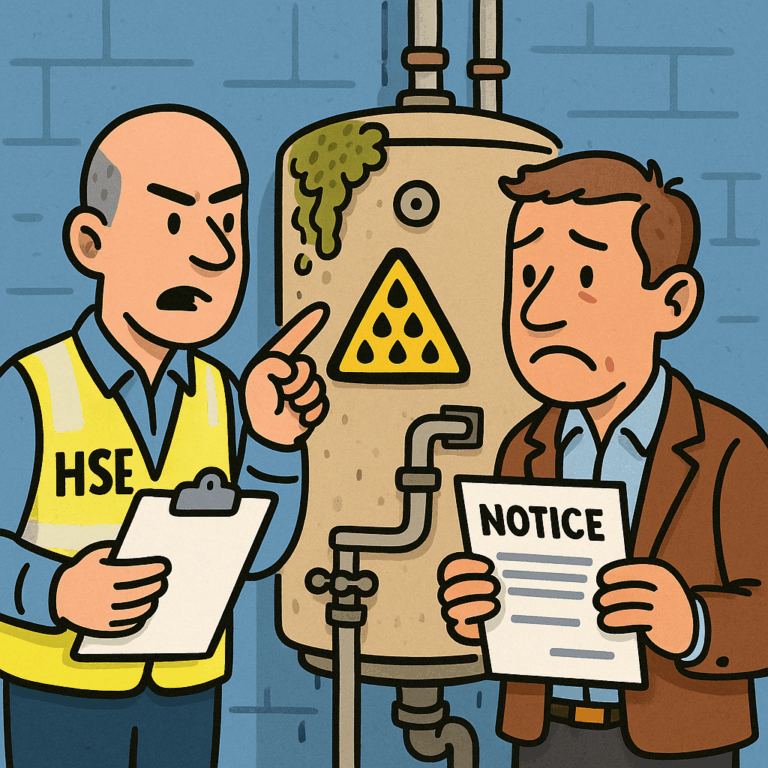

The rental had an ageing hot water system, but the landlord never considered legionella risk. When a tenant complained of recurring health issues, the council investigated and referred the case to the Health and Safety Executive (HSE). The landlord had no written risk assessment and no evidence of controls such as flushing or temperature checks. Although no outbreak was confirmed, the failure to demonstrate compliance exposed the landlord to potential enforcement and reputational damage.
Landlords in the UK have a duty under the Health and Safety at Work etc. Act 1974 and associated regulations to assess and control the risk of legionella bacteria in water systems. This doesn’t usually mean expensive testing, but it does require a simple documented risk assessment and sensible precautions — for example, ensuring water is stored at safe temperatures, flushing little-used outlets, and keeping tanks clean. The landlord in this case mistakenly believed that only large buildings or HMOs needed checks, but the duty applies to all rental properties.
The lesson is straightforward: legionella is rare but the legal duty is clear. A short written assessment, reviewed periodically, shows compliance and protects landlords if complaints arise. Ignoring the requirement risks enforcement, penalties, and avoidable disputes with tenants.
What do you think?
Do you carry out your own legionella risk assessments, or do you bring in professionals? Have tenants ever queried water safety in your rentals?
Source: HSE guidance on landlords and legionella
Previous articles in this series
Landlord Lessons: The AST date mistake
Landlord Lessons: The missing inventory
Landlord Lessons: The verbal agreement trap
Landlord Lessons: The gas safety lapse
Landlord Lessons: The unprotected deposit
Landlord Lessons: The unlicensed HMO
Landlord Lessons: The electrical safety lapse
Landlord Lessons: The Right to Rent slip
Landlord Lessons: The ignored repair
Landlord Lessons: The insurance blindspot
Landlord Lessons: The rent-to-rent risk
Landlord Lessons: The Section 21 error
Landlord Lessons: The Section 8 misstep
Landlord Lessons: The selective licensing oversight
Landlord Lessons: The EPC blindspot
Landlord Lessons: The rent increase mistake
Landlord Lessons: The service charge shock
Landlord Lessons: The tax record slip
Landlord Lessons: The guarantor gap
Landlord Lessons: The referencing shortcut
5 comments on this article
Learn from your peers’ experience
A different perspective could help you spot an issue, avoid a mistake or find a better way forward. Read the comments and add your own views if you wish.
Previous Article
A Major CGT Bombshell Hidden in the 2025 Budget
Member Since May 2015 - Comments: 2326 - Articles: 2
11:27 AM, 28th November 2025, About 11 months ago
Avoid all legionella problems by not having any stored water other than the toilet cistern. Supply hot water by means of a continuous flow 12 kW electric (or gas if present) heater.
Member Since November 2022 - Comments: 37
12:05 PM, 28th November 2025, About 11 months ago
We are 3 flats on a shared water main in a converted house. Whilst the ground floor has a combi boiler the other two flats have hot water tanks and cold water header tanks in the loft. As a shared main the water pressure is insufficient to use combi boilers in the top two flats. What can be done to lower the risk in this case.
Member Since May 2016 - Comments: 1587 - Articles: 16
12:44 PM, 28th November 2025, About 11 months ago
I used to train Legionella courses, haven’t done any for a while.
There needs to be sufficient localised demand to make running a course viable.
Member Since February 2022 - Comments: 212
8:44 PM, 29th November 2025, About 11 months ago
If you’re not on combi just fit a hidden timer setting the immersion to come on once a week for 3hours at 12AM to 70C.
Member Since June 2014 - Comments: 327
1:10 PM, 12th December 2025, About 10 months ago
Legionella Risk Assessment is more than simply checking stored hot water at a high temperature, as this approach can introduce risk of scalding, which is a bigger health hazard. The assessor needs to understand the causal chain which can lead to death and the influence of heating system, be this combi boiler, vented or unvented system and type of shower.