
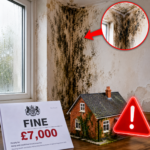
Landlords face £7,000 fines for damp and mould in government crackdown
4 months ago | 12 comments


The government has released data showing a divide in damp and mould across the private rented sector and social housing.
According to the government’s local authority housing stock condition modelling report 2024, damp and mould remain prevalent across both rented tenures, alongside homes classed as non-decent.
The findings come as all private and social landlords will need to meet the Decent Homes Standard by 2035.
According to the data, in 2024, 10% of private rented sector dwellings had a problem with damp, compared with 7% of social rented sector dwellings and 4% of owner-occupied homes.
In the private rented sector, homes were more likely to have damp in Yorkshire and the Humber, the West Midlands, the East Midlands, and parts of the South East and North West.
In the social rented sector, the highest proportions were in London boroughs, with the North East and the East of England showing the lowest levels.
The report classed penetrating or rising damp as “externally driven damp” and serious condensation as “internally driven damp”, both of which can be caused by property defects.
In 2024, 2% of dwellings experienced externally driven damp only, 2% internally driven damp only, and 1% both types of damp. Serious condensation (3%) was more prevalent than penetrating damp (2%) or rising damp (1%).
Dwellings in the East Midlands (4%) were more likely to have externally driven damp only than other regions (1–3%), while London saw higher levels of internally driven damp only than externally driven damp only (3% vs 1%).
Across England, homes in higher rainfall areas were slightly more likely to experience damp than those in drier regions.
The data also shows that, across both rented tenures, the highest rates of non-decency were found in homes in local authorities in the South West, coastal areas of the South East, the Midlands and Yorkshire and the Humber.
Failing the Decent Homes Standard on multiple criteria was less common in London than other regions.
London, and areas of the Midlands and the South closest to the capital, had the lowest rates of homes with Category 1 hazards. In the private rented sector, hazards relating to falls were more common in Yorkshire and the Humber than in most other regions.
Having a Category 1 hazard was the most common reason for a dwelling failing the Decent Homes Standard in 2024, with 9% of all dwellings affected, while 15% of dwellings were classed as non-decent overall.
The news comes as the government has also announced changes to the Housing Health and Safety Rating System (HHSRS) used by councils to identify hazards in residential properties.
Landlords can now face on-the-spot fines of £7,000 for severe damp and mould.
1 comment on this article
A different perspective could help you spot an issue, avoid a mistake or find a better way forward. Read the comments and add your own views if you wish.
4 months ago | 12 comments


5 months ago | 15 comments
Member Since August 2013 - Comments: 125
11:36 AM, 13th July 2026, About 3 months ago
How I wish that articles on this matter would distinguish between damp (rising damp, gutter leaks) and mould and condensation (heating and ventilation issues).