Automated Valuation Models (AVMs) are a quick way to price your portfolio without booking a full inspection. Used correctly, they are good enough for decision-making, broker conversations and annual reviews. This guide shows how to build a tidy AVM pack, when to trust it, when to upgrade to a RICS valuation, and how to use the numbers to decide whether to sell, refinance or rebalance.
Companion guides
Use these alongside this article to run the numbers and sense-check decisions:
AVM: a data-driven estimate based on comparable sales, trends and property attributes. Fast, consistent and portfolio-friendly.
Desktop/drive-by/RICS inspection: a valuer’s opinion with differing levels of inspection. Slower, costlier, and often required at the point of lending.
Rule of thumb: AVMs are perfect for planning. Upgrade to a RICS valuation when a lender or transaction requires it, or where the asset is unusual.
When AVMs are “good enough”
First-pass decisions: sell vs refinance vs hold, partial sell-down sizing, and debt re-basing to a target LTV.
Broker conversations: a clean AVM pack helps a broker test appetite and stress models early.
Annual review: check LTV drift, rent coverage and maintenance planning without commissioning full reports.
When to upgrade to a RICS valuation
Complex or thin-data assets: HMOs, mixed-use, unusual construction, short leases, or micro-markets with few comparables.
Lender requirement: some refis will start with an AVM/desktop but may still instruct full inspection.
Material works or title issues: where the story needs professional context to land with underwriters.
Build a tidy AVM pack (portfolio-wide)
Create a single spreadsheet and keep it updated. Columns that matter:
Address / Unit ID / Tenure
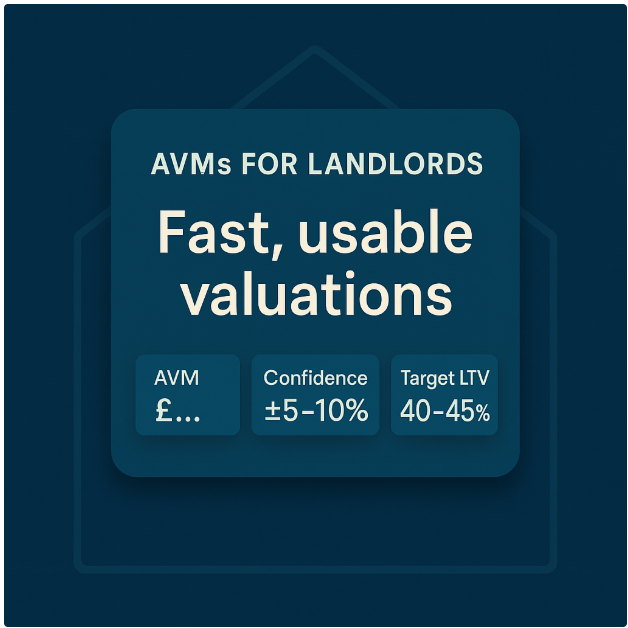
AVM value (date-stamped) and confidence band (e.g. ±5–10%)
Current mortgage balance, rate, maturity, any ERC timetable
Rent (pcm), realistic operating cost % and maintenance reserve
Indicative value per square foot (helps spot AVM outliers)
Total debt, average rate, next 12-month maturities
Headline LTV and stress LTVs at −5% and −10% values
Target LTV (e.g. ~40–45%) and gap to target
How to sanity-check your AVMs
Comparable sense-check: scan 3–5 recent local sales; if your AVM implies an odd £/sq ft vs true comps, flag it.
Band test: for terraces/semi-detached flats, test a ±5–10% range and see how LTV and ICR move.
Rental realism: use current tenancy rents, not aspirational listings. Adjust for voids and maintenance.
Quirk adjuster: apply a conservative haircut where issues exist (short lease, cladding, flood, non-standard construction).
Worked example – AVMs driving a calm decision
Illustrative only, not advice.
Portfolio AVM: £2,000,000 (band ±5%)
Total debt: £1,200,000 at mixed rates
Headline LTV: 60% (1,200,000 ÷ 2,000,000)
Stress LTVs: at −5% value (1,900,000) → 63.2%; at −10% (1,800,000) → 66.7%
Decision: aim to re-base toward 45% over 18 months. If a two-unit partial sell-down yields £180,000 net and a refinance retires £300,000, new debt ≈ £720,000. On the original AVM, LTV becomes 36%; even at a −10% band, LTV ≈ 40%. You have lender-friendly headroom and better sleep at night.
Using your AVM pack with brokers and lenders
One-pager cover sheet: portfolio value, debt, LTV (headline and stress), rent roll, maturities, and your target LTV/liquidity buffer.
Sequence: show any planned selective disposals and exactly how proceeds will reduce expensive debt.
Clarity: highlight quirks upfront; underwriters value transparency and a practical fix plan.
Annual review routine (keeps everyone calm)
Refresh AVMs and rent roll quarterly or at least annually.
Re-run LTV, ICR and a 12-month maturity view; agree tasks.
Update your lender/broker note if the story has changed.
Record all changes in minutes; tidy governance reassures banks.
Pitfalls to avoid
Treating AVMs as gospel: always apply a confidence band and a comparator check.
Ignoring ERC and capex: your plan must include redemption timing and realistic works.
Selling top performers: choose disposals by yield, capex and friction, not convenience.
No buffer: ring-fence 6–12 months of interest/works before any discretionary spend.
Numbers and documents to prepare
AVM spreadsheet (property-level and summary tabs)
Debt schedule with balances, rates, maturities, ERCs and security
Three-line cash flow per unit: rent, operating costs, interest
One-page note explaining your target LTV and liquidity buffer
Short sequence plan for any selective disposals and refinance
How we help
Our consultation service covers de-leveraging, retirement planning, business continuity and legacy planning for landlords. The process is written, structured and client-led. It is not a phone call. We base our recommendations on a conditional-logic Fact Find followed by focused email exchanges. Your inputs drive the analysis and the priorities. Our role is to organise the options, test commercial feasibility, and document an implementation plan that your own accountant, solicitor and regulated adviser can execute.
Scope of topics we cover
Business continuity and lender management, including target LTV setting and liquidity buffers
Succession and legacy planning that keeps control tidy, including equalising between children without selling core assets
Structuring options such as LLP governance, company housekeeping and Family Investment Company considerations, with clear signposting to legal drafting where needed
Life insurance trust and loan-back mechanics, including trustee duties, loan terms and security options
Refinancing pathways, broker briefing notes, and the documents underwriters expect to see
Valuations approach using AVMs for portfolio snapshots and when to commission a full valuation
Director loan accounts and intra-group balances, with tidy-up options before, during and after an owner’s death
Insurance strategy at a commercial level, including whole of life sizing logic and ownership routes, with referral to a regulated adviser for product selection
Governance pack items such as shareholders’ agreements, members’ agreements, Wills and LPAs, flagged for your solicitor to draft or update
How it works
You complete our conditional-logic Fact Find and property schedule
We follow up by email to clarify objectives and any missing data
We prepare a tailored 30+ page written report setting out your options, worked examples, risks, and recommended next steps
What you receive
A 30+ page personalised report with numbered recommendations and a clear sequence of actions
This article is for information only. Calculations are illustrative and based on your inputs. Please ask your accountant to verify CGT and your solicitor to confirm legal steps before you proceed with a sale or refinance.
Property118 does not provide formally regulated or insured advice on law, tax, or financial services, including life insurance, mortgages, pensions, or investment products.
Our role is to present researched planning recommendations based on our interpretation of current legislation, HMRC guidance, established case law, and our extensive experience supporting UK landlords.
While our bespoke recommendations are always based on detailed research, we strongly recommend that you share them with appropriately regulated professional advisers, such as your solicitor, accountant, or financial adviser, and ask them to review and confirm the correct legal and tax treatment before proceeding.
Specific regulated responsibilities include:
Tax calculations and filings – Your accountant
Stamp Duty Land Tax and equivalents – Your solicitor
Company structuring – Your accountant
Legal drafting – Your solicitor or Barrister
Trust, wills, and succession planning – A STEP-qualified solicitor or trust specialist
Life cover, pensions, and other financial services – An FCA-regulated financial adviser
Property118 is happy to work with your existing advisers or introduce you to trusted professionals. Our planning is designed to support you in making commercially led decisions that can then be implemented through appropriate regulated channels.
Members can reply to discussions, connect with experienced landlords, and access full member profiles showing years of expertise. Don't stay on the sidelines - join the UK's most active landlord community today.
Some cookies are needed to make the site work, and we always set those. We would also
like to use analytics and advertising cookies to understand how the site is used —
but only if you say yes. You can change your mind at any time in our
cookie policy.





Not a member yet? Join In Seconds
Login with