

£400,000 just to pay rent in retirement – who will house Britain’s pensioners?
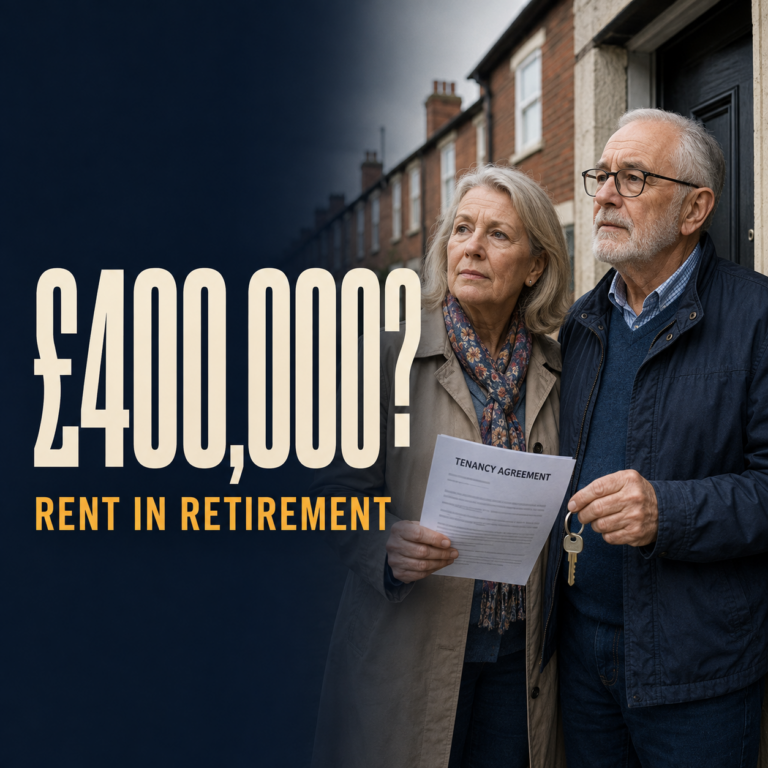

Generation Rent may not be disappearing. It may simply be getting older, and neither Britain’s pension system nor its housing policy looks ready for what follows.
A Facebook post by Adam Lawrence recently stopped me in my tracks. It suggested that somebody retiring as a tenant could need £400,000 in pension savings just to pay the rent, before allowing for food, heating, transport or anything that might make retirement enjoyable.
My first reaction was probably the same as yours: surely £400,000 was the social-media version of the story, selected because it was the number most likely to make people stop scrolling. I therefore followed it back to its source, and what I found was more nuanced than the headline but, in some respects, considerably more worrying.
The figure comes from a July 2026 report by the Pensions Policy Institute, an independent pensions research body. The report was commissioned by the Association of British Insurers following a competitive tender, although the PPI makes clear that the funding does not imply ABI agreement with its findings.
It is not a prediction that every private tenant will receive a £400,000 rental bill on retirement. It is modelling of the pension savings required to fund the rent on a two-bedroom private rental home throughout retirement, with a broad regional range of £200,000 to £400,000. The PPI says the upper end is most likely to be required in higher-cost areas such as London and the South East.
What the PPI actually calculated
The PPI’s regional examples demonstrate why one national figure would be misleading. At a monthly rent of £700, it calculated that a single retiree could require approximately £173,500 to fund the rent through retirement, while the household requirement for a couple was £211,000. At £850 a month, those figures increased to £210,000 and £255,400 respectively; at £1,170 a month, they reached £288,600 for a single retiree and £351,000 for a couple.
| Illustrative monthly rent | Single retiree | Retired couple |
|---|---|---|
| £700 | £173,500 | £211,000 |
| £850 | £210,000 | £255,400 |
| £1,170 | £288,600 | £351,000 |
Those are modelled pension requirements rather than the simple total of a pile of future rent invoices, and the outcome depends upon location, longevity and household composition. Nevertheless, even the lower end of the range is formidable when compared with what people approaching retirement have actually accumulated.
According to the same PPI research, median private pension wealth among people aged 60 to 64 is approximately £154,000 across the population as a whole. For women it is about £105,000. Those figures include people with no private pension wealth at all; when the calculation is restricted to people who possess some private pension wealth, the median rises to approximately £286,000.
There is another important qualification. “Private pension wealth” is broader than a cash pension pot and includes the capitalised value of occupational pensions, including defined-benefit entitlements. The underlying figures are based on the latest available Wealth and Assets Survey data rather than everybody’s pension balance as at this morning.
However carefully the comparison is qualified, its significance is difficult to avoid. The renter must find the money for housing from resources that are also expected to pay for food, energy, Council Tax, transport, repairs to the washing machine and every other cost of later life. The State Pension and means-tested support will help some households, but outright homeowners receive the State Pension too and do not normally have an open-ended market rent to fund alongside it.
The pension that never appears on a statement
It would be wrong to say that outright owners live completely free of housing costs. Buildings require maintenance and insurance, flats may attract service charges and an inconveniently timed roof repair can make a painful hole in anybody’s retirement budget. Even so, their financial exposure is structurally different from that of somebody who must pay market rent every month for as long as they need a home.
Economists call the housing service enjoyed by an owner-occupier “imputed rent”. The Office for National Statistics recognises it within the national accounts, but it does not arrive as income and it never appears on a pension statement. Its value is experienced through a bill that largely no longer arrives.
For many British households, therefore, a paid-off home is one of their most important retirement assets. It provides both somewhere to live and protection against the cost of renting that same home in the market. Pension policy has historically been able to treat housing expenditure in retirement almost as background noise because outright ownership was the normal destination for so many people.
The PPI’s warning is that this assumption is becoming increasingly unsafe.
Has Generation Rent really started to reverse?
The second part of Adam Lawrence’s post highlighted an apparently encouraging change in the latest English Housing Survey. In households headed by somebody aged 16 to 34, owner occupation increased from 31% in 2014/15 to 42% in 2024/25. Private renting fell from 50% to 43% over the same period.
That is a substantial and welcome shift. A healthy private rented sector should provide good homes for people who need or choose to rent; its success should not depend upon permanently preventing younger tenants from buying homes of their own.
There is, however, a crucial technical point. The survey does not measure the housing tenure of every individual under 35. It measures households whose Household Reference Person is aged 16 to 34 — normally the person in whose name the property is owned or rented and, for joint households, generally the person with the higher income. Young adults still living in a parent’s home are therefore recorded under the parent’s age group, not their own.
Nor does the survey follow the same people through time. It compares cross-sectional snapshots of households ten years apart, which means the figures support a recovery in ownership among younger-headed households but do not prove that “Generation Rent” has disappeared.
The full age comparison is more revealing:
| Age of Household Reference Person | Owner-occupied 2014/15 | Owner-occupied 2024/25 | Privately rented 2014/15 | Privately rented 2024/25 |
|---|---|---|---|---|
| 16–34 | 31% | 42% | 50% | 43% |
| 35–64 | 68% | 64% | 16% | 18% |
| 65 and over | 77% | 79% | 6% | 6% |
While the youngest household group moved towards ownership, households headed by somebody aged 35 to 64 moved modestly in the opposite direction. Owner occupation fell from 68% to 64%, while private renting increased from 16% to 18%. That middle group matters because it contains the people now progressing towards retirement, including many who have less time to buy a home and repay a mortgage before their employment income ends.
Generation Rent may not be disappearing. Part of it may simply be getting older.
We should not pretend that the two changes prove one caused the other; they concern different groups and come from survey snapshots rather than a single cohort being followed. Read together, however, they point towards a private rented sector whose future tenant population could be older, more settled and far more dependent upon fixed incomes.
By 2044, the private tenant could look very different
The PPI’s 20-year projection makes the scale of that change much clearer. It expects the proportion of pensioner households in owner occupation to fall from 79% in 2024 to 64% in 2044. Over the same period, the proportion renting privately is projected to treble from 6% to 18%, with social renting also increasing from 15% to 18%.
In household numbers, the PPI projects private-renting pensioner households increasing from approximately 511,500 to 1.86 million — an addition of more than 1.35 million. Including social tenants, it forecasts almost two million more pensioner households living in rented accommodation than today.
A projection is not a promise, and 2044 is a long way away. Interest rates, housebuilding, migration, pension policy, welfare provision and future governments could all alter the result. Nevertheless, it would be reckless to dismiss a trend simply because its largest consequences will arrive gradually.
The direction is consistent with the weaker ownership position already visible among people approaching retirement. The PPI reports that only 65% of households aged 45 to 65 are currently owner-occupiers, around 15 percentage points fewer than 20 years ago. Those households are already in the demographic pipeline; they cannot all be transformed into mortgage-free homeowners by a ministerial announcement.
More demand does not mean unlimited affordability
Landlords could look at the projected increase in older renters and see only a highly attractive demand story. That would be a serious mistake, because the same research says the largest growth in private renting is expected among lower-income couples. These may be long-term tenants, but they will not necessarily be tenants capable of absorbing repeated rent increases above their pension income.
The PPI reports that approximately 35% of private-renting pensioners are already in poverty, compared with 12% of owner-occupiers. Housing Benefit and Pension Credit can protect some households from the worst consequences, but entitlement is means-tested, support does not always match the local rent and those with modest savings or income just above the qualifying thresholds can still face an uncomfortable gap.
This is why demographic demand and commercial affordability must not be confused. A landlord cannot pay the mortgage, maintain the property and meet increasingly demanding standards with a waiting list of people who cannot afford the rent. Equally, the Treasury cannot assume that restricting private rental supply will make the liability disappear; it may simply reappear as a larger Housing Benefit bill, greater demand for social housing or older people being moved away from the communities on which they depend.
The latest short-term indicators should also keep everybody grounded. The July RICS Residential Market Survey recorded a tenant-demand net balance of minus one, which RICS described as broadly flat, rather than evidence of tenants suddenly vanishing from the market. One survey reading tells us about current weather; the age and tenure data describe the climate forming over the next two decades.
What sort of homes will older tenants actually need?
This is where the research becomes commercially useful to landlords. An ageing tenant population does not automatically validate every inexpensive two-bedroom terrace or every spreadsheet showing an attractive gross yield. A home that works perfectly for a fit 45-year-old may become difficult at 75 if it has steep stairs, an upstairs bathroom, high heating costs and poor access to shops, healthcare or public transport.
The English Housing Survey offers a helpful clue. Among households headed by somebody aged 65 or over who did not intend to move, 76% said their home met their needs, 73% said they liked the local area and 53% valued living near friends or family. Older households often remain in place not because the kitchen has fashionable handles, but because the home and its location support their daily lives.
For landlords investing with this market in mind, low running costs, reliable heating, manageable access, sensible bathrooms and the potential for future adaptations may become increasingly important. Two-bedroom homes can still be valuable because the second room may accommodate visiting family, a carer or medical equipment, but bungalows, ground-floor flats and accessible semis may sometimes be better suited than the traditional terrace.
The commercial model must also work without heroic assumptions. Buying well, maintaining adequate reserves, keeping borrowing at a manageable level and achieving a yield that covers finance, repairs, voids and compliance will matter far more than a PowerPoint forecast of relentless rent and capital growth. Older tenants may offer longer occupation and lower turnover, but in return they will reasonably expect dependable repairs, predictable rent reviews and the security of knowing that their home will remain suitable as their needs change.
Who is expected to provide these homes?
This is the uncomfortable policy question. The homes could be provided by councils and housing associations, institutional build-to-rent operators, individual landlords or some combination of all four. What government cannot do is legislate away the need for them.
There is a contradiction at the heart of current housing politics. Ministers understandably want more young people to become homeowners, while policy is often discussed as though the private rented sector will become less necessary once that happens. Yet the evidence suggests that even if ownership continues to recover among younger-headed households, Britain will simultaneously need far more rental homes for people reaching retirement without a paid-off property.
A healthy housing market should be able to do both. It should help tenants who can and want to buy to make that transition, while preserving a professionally managed supply of secure, affordable homes for people who cannot buy, do not wish to buy or have reached an age when buying is no longer realistic.
Small landlords should not interpret the coming demographic change as an invitation to exploit scarcity. Government should not interpret the existence of landlords as an excuse to avoid building social and specialist housing. The rational outcome requires investors who can provide suitable homes at rents that fixed-income households can realistically pay, alongside a welfare system capable of supporting those for whom even an affordable market rent is beyond reach.
The number that matters most
The £400,000 figure was the number that made me investigate, but it is not the most important conclusion. It applies towards the upper end of the market, while the precise pension requirement for any individual will depend upon where and how they live.
The number that matters more is 18%: the projected proportion of pensioner households that could be renting privately by 2044, compared with 6% today. If that projection is even approximately right, the next defining debate about the private rented sector may not be about twenty-somethings struggling to assemble a deposit. It may be about seventy- and eighty-somethings whose pensions were never designed to support a market rent for the rest of their lives.
For landlords, that is a long-term commercial signal, but it comes with an equally long-term social responsibility. For government, it is a warning that reducing rental supply without creating a credible replacement merely moves the cost elsewhere. Britain must decide who will provide these homes, what type of homes they will be and how their occupants will afford them after earnings from work have ended.
That question is much larger than a Facebook headline, and the clock is already running.
73 comments on this article
Learn from your peers’ experience
A different perspective could help you spot an issue, avoid a mistake or find a better way forward. Read the comments and add your own views if you wish.
Member Since October 2013 - Comments: 1751 - Articles: 3
12:01 PM, 25th August 2026, About 2 months ago
Reply to the comment left by Beaver at 25/08/2026 – 11:52
Equity Release is back in fashion. Upside of Labour’s economic chaos is rates are good. For those anticipating to somehow use their house as their pension, Equity Release may be the answer. It’s a gamble against early death, but it may be the only option available to those with the State pension only and would like a more comfortable retirement.
Member Since May 2018 - Comments: 2550
12:19 PM, 25th August 2026, About 2 months ago
Reply to the comment left by NewYorkie at 25/08/2026 – 12:01
If you own your own home as a pensioner you are entitled to rent out rooms under the Rent a Room scheme and earn £7,500 per year tax free. Many retired people do. Furthermore, you are entitled to rent your principle private residence out for £7,500 per year tax free and rent somewhere else. Somewhere with a downstairs bathroom for example.
Member Since October 2013 - Comments: 1751 - Articles: 3
12:25 PM, 25th August 2026, About 2 months ago
Reply to the comment left by Beaver at 25/08/2026 – 12:19
I thought you had to be living there.
Member Since May 2018 - Comments: 2550
12:55 PM, 25th August 2026, About 2 months ago
Reply to the comment left by NewYorkie at 25/08/2026 – 12:25
No, you can still rent your home out and claim it as your PPR and rent somewhere else (as many MPs did). Whether that makes sense depends upon the circumstances. I had this conversation with someone recently who chose to move. The stamp duty was £14,000 “for nothing” as she put it. On top of all the other costs of moving you are looking at a total bill for moving of probably £20,000. But the cost of putting in downstairs bathing facilities is typically £2,000-4,000, usually around £2,500. But if you need time to think, plan, see how things work out then renting the PPR out and renting somewhere else is an option. For most people their best option is going to stay put and rent out rooms under the Rent a Room Scheme. The Rent a Room scheme is a great piece of legislation and fiscal policy, unlike the Renters Rights Act, which is terrible.
Member Since May 2018 - Comments: 2550
2:09 PM, 25th August 2026, About 2 months ago
Reply to the comment left by Fergus Wilson at 25/08/2026 – 13:58
Whether elderly people can afford to rent properties or not depends upon:
1. Do they have pensions including private pensions.
2. Do they own their own home.
3. Do they have savings.
On savings elderly people are often invested in premium bonds (average age for a premium bond holder is 53). One of the issues for elderly people is care costs. If elderly people need live-in home care and have savings of more than about £24,500 from memory then they have to pay for all their care costs. Below this figure they have to pay for some until a threshold of about £14,250 when they don’t have to pay at all, even if they own their own home. Live-in care costs per annum for a significant amount of care for five days (e.g. help with washing) will typically be around £8,000 per annum, more if it includes weekends. So clearly even if they can save half of this by having downstairs bathing facilities put in this pays for the cost of putting them in.
The simple answer to what often seems like a complex situation is don’t let people bully you into moving if you don’t want to move and stop lending money to the government; they didn’t work as hard as you did and they are only going to take the triple-lock away from you. Cash in £4,000 of premium bonds and pay for the downstairs bathing facilities now, just before you need them, rather than 6 months after you need them.
Finally, ignore people bullying you into trying to move or ‘downsize’. And be very careful indeed of independent financial advisers who are trying to pray on your fears about inheritance tax in order to get you to do equity release.
Member Since June 2024 - Comments: 27
2:30 PM, 25th August 2026, About 2 months ago
Reply to the comment left by Beaver at 25/08/2026 – 14:09
I opted at 83 fed up with ‘outside’ smokers finding after they left, dog ends under the bed and the stink of cannabis in the hall to not renew my HMO licence and have two rent a room licencees paying tax on the income above £7500 a year. After managing shared accomodation in Canada Montevideo and here I could write a book 🙂
Member Since May 2018 - Comments: 2550
2:42 PM, 25th August 2026, About 2 months ago
Reply to the comment left by Tony Edwards at 25/08/2026 – 14:30
I think that this is absolutely a smart thing to do. The i paper recently claimed that because pensioners were using the rent-a-room scheme this justified pressurising them into downsizing:
https://inews.co.uk/opinion/retirees-renting-out-rooms-is-proof-they-can-afford-to-downsize-4026730
I find this kind of commentary deeply offensive especially as the stamp duty (payment for nothing) is way more than putting in the bathing facilities. Retired people often have capacity even in their 80s and 90s. Not only are they capable of using the rent-a-room scheme, if they have more say about who is in the property the social contact or intellectual stimulation are often not a bad thing. My grandfather used to do it in the 1970s. In my experience though, elderly people often use the upstairs rooms for storage for furniture they only use occasionally, visiting grandchildren, visiting children, live in care (sometimes as volunteers). In my grandfather’s case it was students that he used to rent to.
I think that nobody (not the government, not independent financial advisers, not family) should be trying to bully elderly people into not living where they want to live. However, one of the issues with retirement is that many retired people have opted (often due to family pressure) to move into ‘retirement properties’ that are leasehold. When the retiree dies they still have to pay fees:
https://www.bbc.co.uk/news/articles/ckgykp79ezyo
In April of next year, Rachel Reeves’ inheritance tax changes mean that IHT will become more of an issue for families. Close to home you don’t pay IHT on transfer to family members in e.g. Portugal; away from home you usually don’t pay it in Canada, Australia or New Zealand. What this means is that from Spring next year renting is going to be a better option for many pensioners than for example retirement flats.
Member Since May 2018 - Comments: 2550
3:53 PM, 25th August 2026, About 2 months ago
Reply to the comment left by Fergus Wilson at 25/08/2026 – 15:31
I can’t remember ever asking old people to ask for euthanasia whether on this thread, on this site (which like about 43% of the sites on the internet is a WordPress site) or anywhere else.
From spring next year when Rachel Reeves’ changes on IHT kick in renting is going to be a more attractive option for many retired people and their families than for example retirement homes. However, there is another reason why rented property is a good option for retired elderly people and that is because elderly retired people are vulnerable to rogue traders:
https://www.thenorthernecho.co.uk/news/26490185.warning-guisborough-residents-targeted-rogue-traders/
However, if you are a landlord using an agent then you automatically have a process for managing repairs and avoiding rogue traders. I use an agent and typically I get a request for a repair by phone and/or email. I say yes, no or what needs to be done, even if I’m out of the country, and get an email to authorise the repair which I generally do within 24 hours. Renting to elderly retired people isn’t a problem for me, I know what I’m dealing with, although I might need to know if there are attorneys and have permission to contact them if for example the rent isn’t paid promptly (although in reality my agent would deal with that).
Member Since June 2019 - Comments: 973
3:05 PM, 27th August 2026, About 2 months ago
Reply to the comment left by Beaver at 25/08/2026 – 15:53
I have been in ‘care’ homes where dementia patients shout for help all day or are drugged massively becoming zombies – they are only being kept alive for the benefit of the coffers of the care home providers .
I think there needs to be balance, but I can imagine a renting 80 year old being encouraged by their hiers to stop spending their inheritance.
It will be very difficult to evict pensioners in future as they will be unlikely to meet your insurance companies criteria.
Member Since September 2023 - Comments: 133
4:44 PM, 27th August 2026, About 2 months ago
I am not happy about what I am reading!
Paul Essex makes the point that some old people feel coerced into shortening their lives for financial reasons.
It costs a small fortune to keep an old person in a nursing home.
All HMG can do is not throw money at it!