

The landlords with the most experience are the ones stepping back


Experience was once the biggest advantage a landlord could have. It meant better buying decisions, stronger relationships with lenders, and a clearer understanding of how to navigate the inevitable ups and downs of the market. Over time, that experience usually translated into larger portfolios, lower borrowing and a more resilient position overall.
What is becoming increasingly clear is that this same group is now leading a different kind of decision: they are stepping back.
These are not landlords who misjudged the market or overextended themselves. In many cases, they are the ones who got it right. They built portfolios steadily, reduced risk over time and now sit on substantial levels of equity. That is precisely why their behaviour matters. When experienced landlords begin to reduce exposure, it is rarely about short-term pressure. It reflects a reassessment of what comes next. At a certain point, the focus shifts away from growth and towards control, simplicity and long-term certainty.
The question changes from “what else can I acquire?” to “what do I actually want to keep?”.
This is where the current market begins to look different from previous cycles.
Data from the Property118 Landlord Sentiment Survey Q1 2026 supports this shift, with the average respondent holding 9.7 properties and a majority indicating an intention to reduce rather than expand.
That combination is significant because it shows that the landlords most capable of continuing to grow are not necessarily choosing to do so. Instead, they are refining, simplifying and, in some cases, exiting altogether. This creates a different kind of signal. Markets tend to follow the behaviour of their most experienced participants. When that group becomes more selective, the overall direction of travel changes with them.
For now, one conclusion stands out: the landlords who understand the market best are increasingly the ones choosing to step back from it.
For many landlords, the question is not whether the market is changing, but what that change means for their own position.
If you are holding a portfolio with relatively low borrowing, or are beginning to reassess how your assets are structured, this is often the point where a more joined-up view becomes useful.
An invitation for established landlords
If you find the Property118 articles helpful and are curious about how those ideas apply to your own portfolio, you are welcome to take the conversation a step further.
These conversations are typically most useful for landlords with established portfolios and relatively modest borrowing who are beginning to reflect on how their assets could work more effectively in the years ahead.
From there we can arrange a free introductory discussion to explore how your portfolio works as a whole and what that might mean for the years ahead.
|
★★★★★
|
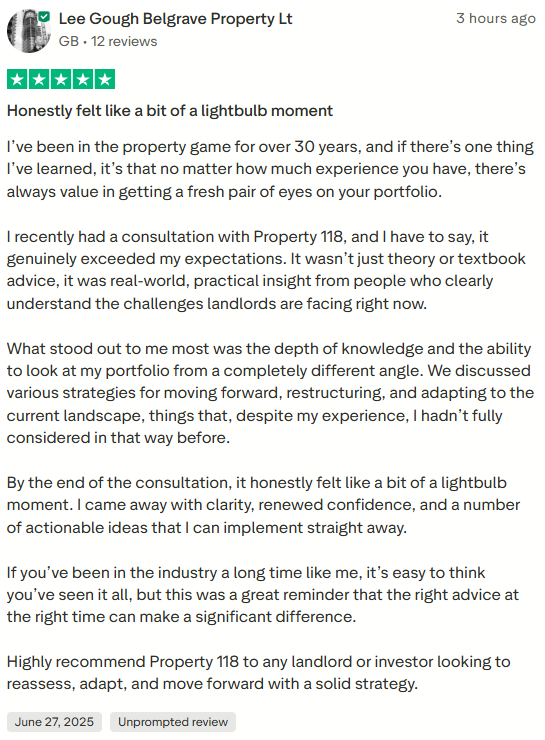
Help other landlords find Property118If you have found Property118 useful, a short Trustpilot review would make a meaningful difference. It helps other landlords decide whether our research is worth following. |

2 comments on this article
Learn from your peers’ experience
A different perspective could help you spot an issue, avoid a mistake or find a better way forward. Read the comments and add your own views if you wish.


Previous Article
Firm warns landlords to act now ahead of Decent Homes StandardNext Article
HMO and flat-share tenant swaps warning issued
Member Since January 2015 - Comments: 1619 - Articles: 1
1:17 PM, 8th May 2026, About 5 months ago
The government, many tenants and tenant action groups (Shelter, Generation Rent, even Citizens Advice) will reap what they have sown.
No one to blame but themselves.
BUT too many PRS landlords do NOT know, maybe never have known, the legislation or regulations of this business and MUST bare part of the reason for the RRA, and the previous Renters Reform Bill.
Member Since October 2020 - Comments: 1384
4:07 PM, 11th May 2026, About 5 months ago
Hardly surprising that its the most experienced landlords that are exiting. They’re the ones that know what’s coming.