

The great landlord contradiction: wanting companies, stuck in personal ownership


If most landlords were starting again today, many would not structure things the same way. That is becoming increasingly clear. There is a growing disconnect between how portfolios are currently held and how landlords would choose to hold them if given a clean slate. The preference has shifted, but the structure has not. That gap is not accidental. It reflects friction.
For landlords who have built portfolios over many years, decisions were made under different conditions. Financing, tax treatment and practical considerations all pointed towards personal ownership at the time. Those decisions were rational when they were made.
The problem is that structures do not evolve as easily as thinking does. Changing ownership is rarely straightforward. It can involve financing constraints, tax considerations and legal complexity, all of which create inertia. As a result, many landlords find themselves operating within structures that no longer reflect how they would choose to invest today. This creates a tension. On one hand, there is a clear preference for a different approach. On the other, there are practical barriers to getting there.
Evidence of this can be seen in the Property118 Landlord Sentiment Survey Q1 2026, where a majority of landlords still hold property in personal ownership, despite many indicating that they would favour company structures for future acquisitions.
That combination is telling because it shows that the issue is not awareness, it is implementation. Landlords understand the direction they would take if starting today, but existing portfolios anchor them to decisions made in the past. Over time, that gap becomes more noticeable, particularly as portfolios mature and long-term planning becomes more important. This is where structural questions begin to move to the forefront, not because landlords are looking to make wholesale changes overnight, but because they are increasingly aware that their current structure may not fully support where they want to go next.
For now, one conclusion stands out: landlords are not lacking clarity about how they would invest today, they are navigating the complexity of changing what they built yesterday.
For many landlords, the question is not whether the market is changing, but what that change means for their own position.
If you are holding a portfolio with relatively low borrowing, or are beginning to reassess how your assets are structured, this is often the point where a more joined-up view becomes useful.
An invitation for established landlords
If you find the Property118 articles helpful and are curious about how those ideas apply to your own portfolio, you are welcome to take the conversation a step further.
These conversations are typically most useful for landlords with established portfolios and relatively modest borrowing who are beginning to reflect on how their assets could work more effectively in the years ahead.
From there we can arrange a free introductory discussion to explore how your portfolio works as a whole and what that might mean for the years ahead.
|
★★★★★
|
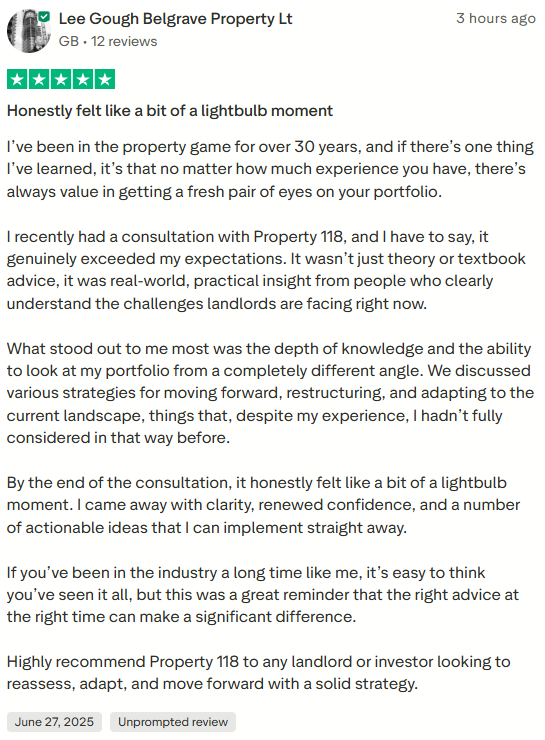
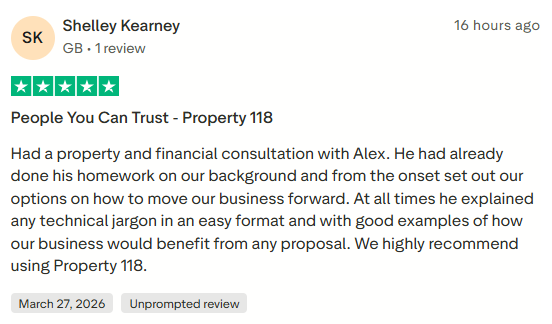
Help other landlords find Property118If you have found Property118 useful, a short Trustpilot review would make a meaningful difference. It helps other landlords decide whether our research is worth following. |
4 comments on this article
Learn from your peers’ experience
A different perspective could help you spot an issue, avoid a mistake or find a better way forward. Read the comments and add your own views if you wish.


Member Since January 2024 - Comments: 434
11:12 AM, 13th May 2026, About 5 months ago
Answer: sell your properties, pay the tax and get out of the PRS. There are much easier, more flexible, lower risk and lower administration investments available.
Many come with the potential for better income and capital returns and lower taxation on both.
It is also much easier to carry out estate planning with non-property investments.
Member Since June 2016 - Comments: 2
8:38 AM, 17th May 2026, About 5 months ago
Reply to the comment left by Ryan Stevens at 13/05/2026 – 11:12
We live off our PRS and would love to know what other lower risk better return investment exists? We are facing remorgaging amd looking at having to borrow to cover the higher rates – as selling has proven difficult if not impossible. Yet – moving to a LTD set up does not work due to the expense… so.. wothout wanting to go back on the ferret wheel… do let me know what other investments you are refering too – that brings us a regular income and known risks exposured too.
Member Since January 2011 - Comments: 12262 - Articles: 1491
7:33 PM, 17th May 2026, About 5 months ago
Reply to the comment left by Suzana Urlich at 17/05/2026 – 08:38
Please book a free 30-minute Portfolio Review
Member Since January 2024 - Comments: 434
10:32 AM, 18th May 2026, About 5 months ago
Reply to the comment left by Suzana Urlich at 17/05/2026 – 08:38
Selling at the moment is very difficult due to Iran, interest rates and the rush for the exit by many landlords. Hence it may take a while to get to a position where you can invest elsewhere.
Property is good if you can leverage it with loans at low rates of interest. However, nowadays it is difficult to get a real rate of capital return and it is becoming difficult to make a real rate of income return, especially if geared property is held personally and you are taxed on rental profits before interest.
Once you have sold your properties then speak to an independent financial advisor if you do not have much experience of investing, they will be able to guide you on investments that suit your attitude to risk.