
ECO4 and Great British Insulation Scheme in listed properties?
1 year ago | 1 comments


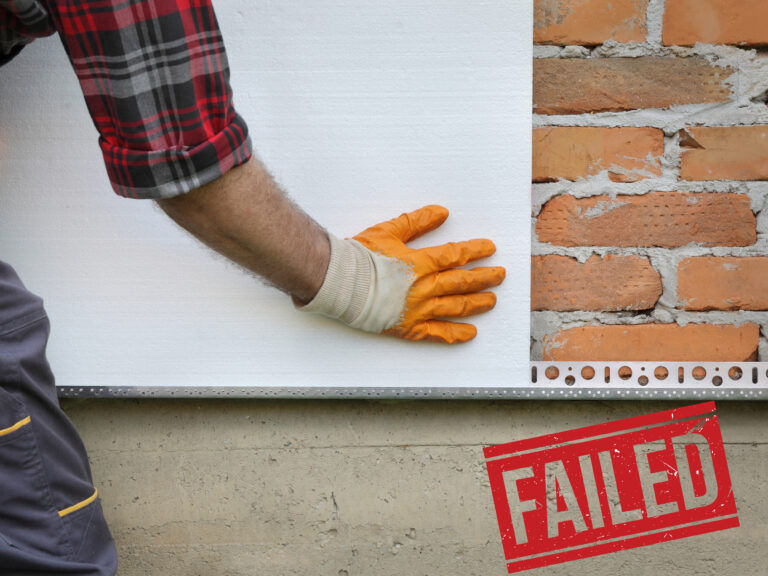
A spending watchdog has slammed government schemes designed to insulate homes as “a failure”, costing homeowners thousands of pounds.
A report by the National Audit Office (NAO) reveals 98% of homes with external wall insulation installed under the government’s energy company obligation (ECO) scheme require work to correct major issues that will cause problems such as damp and mould.
The government’s energy efficiency scheme requires energy companies to fund the installation of measures such as insulation in homes.
ECO is a government scheme intended to tackle fuel poverty and reduce carbon emissions in Great Britain.
There are currently two ECO schemes: ECO4 runs from April 2022 to March 2026, and the Great British Insulation Scheme (GBIS), with broader eligibility, runs from March 2023 to March 2026.
Poor installation work has left thousands of properties with serious problems. An estimated 22,000 to 23,000 homes with external wall insulation installed under the scheme, around 98% of the total, and between 9,000 and 13,000 homes with internal insulation (29% of the total) have major issues that now need fixing.
The NAO says weak government oversight meant widespread problems with the Energy Company Obligation (ECO) scheme were not identified sooner.
It also criticised an “overly complex” consumer protection system, with unclear and fragmented roles between the Department for Energy Security and Net Zero (DESNZ), Ofgem, and private certification bodies.
The NAO report also reveals in November last year Ofgem estimated that businesses had falsified claims for ECO installations in between 5,600 and 16,500 homes, potentially claiming between £56 million and £165 million from the energy suppliers operating under the scheme.
Gareth Davies, head of the National Audit Office, said: “ECO and other such schemes are important to help reduce fuel poverty and meet the government’s ambitions for energy efficiency.
“But clear failures in the design and set-up of ECO and in the consumer protection system have led to poor-quality installations, as well as suspected fraud.
“DESNZ must now ensure that businesses meet their obligations to repair all affected homes as quickly as possible. It must also reform the system so that this cannot happen again.”
The NAO is urging the DESNZ to reform the consumer protection system for retrofit schemes and to report annually on a statistically robust estimate of the level of fraud and non-compliance in each of its retrofit schemes.
They also add that the government must take clear responsibility for ECO schemes and clarify its approach to repairing faulty ECO scheme installations alongside its Warm Homes Plan.
Anna Moore, co-founder and CEO of retrofit specialist Domna, points out that the contractors delivering ECO are the same firms now delivering the Warm Homes Plan.
She said: “The NAO’s report makes for grim reading, as energy efficiency upgrades to our housing stock are essential but have typically been marred by poor oversight and an inability to effectively deliver earmarked funds.
“It’s a problem that goes much further than the Energy Company Obligation scheme, the contractors delivering ECO are the same firms now delivering Warm Homes. The government has added red tape and slowed delivery without fixing quality problems, spending £280mn of the £1.9bn Social Housing Decarbonisation Fund Wave 2.1 on administration, while delivering just 27% of planned installs.”
She adds: “The government should redirect resources to site-based inspection teams with real authority. We should enforce existing PAS 2035 standard, the government-backed framework that sets out how energy efficiency retrofits must be properly assessed, designed and delivered, which call for the assessment and compliance roles to be separate from delivery.
“ECO funding should go through managing agents, who have a vested interest in compliance, rather than directly to contractors. That would raise quality and cut waste, and avoid the disastrous results that we have seen in this latest debacle.”
2 comments on this article
A different perspective could help you spot an issue, avoid a mistake or find a better way forward. Read the comments and add your own views if you wish.
1 year ago | 1 comments

1 year ago | 1 comments

1 year ago | 110 comments
Member Since March 2024 - Comments: 346
11:03 AM, 15th October 2025, About 1 year ago
I can’t believe it is simply bad installation that has led to virtually all these homes (98%) needing remedial works (taking the insulation off?).
Homes built in the solid wall era of Victorian and earlier, usually without damp proof courses as built, were designed to BREATHE! It has been known for years that applying cement based render coats (any original rendering would have been lime rather than cement based), spray on treatments and stone cladding is not good for them and I cant see much difference between that and suffocating them in 100mm of insulation.
I’m sure plenty of corners were cut but when that many installations are detrimental to properties and occupants the fault lies with those pushing this costly, for proportionally little benefit in energy bill savings, so called solution. That’s YOU Ed Miliband.
My one remaining property is a solid wall house just one point off a C. I would not agree to soild wall insulation even if it were provided free.
Member Since June 2013 - Comments: 3376 - Articles: 83
1:15 PM, 15th October 2025, About 1 year ago
I’ve been telling Govt this for years & they never listened. Well said Keith, houses are mean’t to breathe. I’ve had dozens of Cavity walls done in my houses & mould years later.
I started to refuse the internal wall insulation last few years as could see this coming & getting worse.
Mine started in 2010.