

Rental Yields – Chart of the top 50 areas in England and Wales
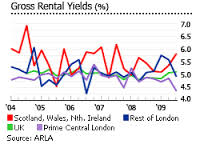

HSBC has released a report showing the average rental yields for the top Buy to Let hotspots of England and Wales based on data from the Office of National Statistics (ONS) and Land Registry.
This information broken down to specific areas is valuable for Landlords looking for future property investments, giving a base line picture of what rental yields and incomes are achievable.
The figures show that in some areas private landlords already own more than 1 in 4 properties of the housing stock with Southampton being the highest yielding area on average.
The Top 50 Buy to Let Hotspots by Rental Yield are:
| Location | Percentage of Rental Housing Stock | Average House Price | Average Rent (Monthly) | Average Rent (Annual) | Rental Yield (gross) |
| Southampton | 23.42% | £138,311 | £901 | £10,812 | 7.82% |
| Blackpool | 24.16% | £75,943 | £494 | £5,928 | 7.81% |
| Kingston upon Hull | 19.02% | £69,519 | £450 | 5400 | 7.77% |
| Manchester | 26.85% | £102,631 | £650 | £7,800 | 7.60% |
| Nottingham | 21.64% | £83,313 | £524 | 6288 | 7.55% |
| Coventry | 19.02% | £104,970 | £624 | 7488 | 7.13% |
| Slough | 23.07% | £171,581 | £975 | £11,700 | 6.82% |
| Oxford | 26.11% | £244,893 | £1,375 | £16,500 | 6.74% |
| Liverpool | 21.75% | £91,012 | £498 | 5976 | 6.57% |
| Portsmouth | 22.28% | £141,971 | £775 | 9300 | 6.55% |
| Cardiff | 20.32% | £140,882 | £750 | 9000 | 6.39% |
| Cambridge | 23.91% | £179,699 | £949 | £11,388 | 6.34% |
| Southwark | 22.22% | £401,405 | £2,058 | 24696 | 6.15% |
| Luton | 21.27% | £127,473 | £650 | 7800 | 6.12% |
| Newham | 32.62% | £229,141 | £1,126 | £13,512 | 5.90% |
| Leicester | 21.28% | £112,226 | £550 | 6600 | 5.88% |
| Bournemouth | 28.21% | £170,493 | £825 | £9,900 | 5.81% |
| Enfield | 21.18% | £261,163 | £1,200 | 14400 | 5.51% |
| Brighton and Hove | 28.04% | £229,622 | £1,049 | £12,588 | 5.48% |
| Brent | 28.82% | £337,723 | £1,517 | £18,204 | 5.39% |
| Forest Heath | 21.80% | £179,699 | £795 | 9540 | 5.31% |
| Torbay | 21.43% | £139,168 | £598 | 7176 | 5.16% |
| Southend-on-Sea | 20.72% | £152,171 | £650 | 7800 | 5.13% |
| Watford | 18.89% | £240,239 | £997 | 11964 | 4.98% |
| Bristol, City of | 22.11% | £169,425 | £695 | 8340 | 4.92% |
| Kingston upon Thames | 21.04% | £333,122 | £1,363 | 16356 | 4.91% |
| Reading | 24.68% | £196,309 | £795 | £9,540 | 4.86% |
| Hounslow | 22.23% | £285,927 | £1,148 | 13776 | 4.82% |
| Wandsworth | 30.02% | £428,987 | £1,694 | £20,328 | 4.74% |
| Lewisham | 22.97% | £283,031 | £1,101 | 13212 | 4.67% |
| Shepway | 20.17% | £181,399 | £695 | 8340 | 4.60% |
| Tower Hamlets | 30.84% | £364,296 | £1,387 | £16,644 | 4.57% |
| Eastbourne | 21.65% | £177,408 | £675 | 8100 | 4.57% |
| Harrow | 20.37% | £306,381 | £1,148 | 13776 | 4.50% |
| Croydon | 19.83% | £254,591 | £949 | 11388 | 4.47% |
| Exeter | 19.56% | £187,680 | £693 | 8316 | 4.43% |
| Isles of Scilly | 20.63% | £180,227 | £654 | 7848 | 4.35% |
| Lincoln | 19.36% | £119,076 | £429 | 5148 | 4.32% |
| Redbridge | 21.63% | £292,459 | £1,049 | 12588 | 4.30% |
| Cheltenham | 20.15% | £170,573 | £598 | 7176 | 4.21% |
| Ipswich | 18.75% | £153,163 | £524 | 6288 | 4.11% |
| Richmond upon Thames | 20.55% | £485,496 | £1,647 | 19764 | 4.07% |
| Westminster | 37.56% | £767,112 | £2,578 | £30,936 | 4.03% |
| Norwich | 20.10% | £179,699 | £598 | 7176 | 3.99% |
| Camden | 30.46% | £646,043 | £2,145 | £25,740 | 3.98% |
| Hastings | 27.19% | £177,408 | £550 | £6,600 | 3.72% |
| Haringey | 30.33% | £372,278 | £1,148 | £13,776 | 3.70% |
| Thanet | 21.96% | £181,399 | £524 | 6288 | 3.47% |
| Hammersmith and Fulham | 30.05% | £593,787 | £1,690 | £20,280 | 3.42% |
| Kensington and Chelsea | 33.97% | £1,090,943 | £3,033 | £36,396 | 3.34% |
Broken down by the top 10 London hotspots:
| Location | Average Property Price | Average Rent (Monthly) | Rental Yield (gross) |
| 1. Southwark | £401,405 | £2,058 | 6.15% |
| 2. Newham | £229,141 | £1,126 | 5.90% |
| 3. Enfield | £261,163 | £1,200 | 5.51% |
| 4. Brent | £337,723 | £1,517 | 5.39% |
| 5. Kingston upon Thames | £333,122 | £1,363 | 4.91% |
| 6. Hounslow | £285,927 | £1,148 | 4.82% |
| 7. Wandsworth | £428,987 | £1,694 | 4.74% |
| 8. Lewisham | £283,031 | £1,101 | 4.67% |
| 9. Tower Hamlets | £364,296 | £1,387 | 4.57% |
| 10. Harrow | £306,381 | £1,148 | 4.50% |
HSBC head of mortgages Peter Dockar said “house prices in the top-yielding locations, while still out of reach among many first time buyers are relatively affordable for landlords investing in property and the demand from young professionals has pushed up rents and driven up the returns. London is often seen as the haven of property investment with many believing the streets are paved with gold. However, while the highest rents in the country are an attractive draw for landlords, high house prices in the capital squeeze yields and limit the returns available. As a result returns can often be far more attractive in other areas so it certainly pays for landlords to do their research.”
Comments
Have Your Say
Every day, landlords who want to influence policy and share real-world experience add their voice here. Your perspective helps keep the debate balanced.
Not a member yet? Join In Seconds
Login with
Previous Article
Boris's new London Rental Standard
Member Since February 2011 - Comments: 3453 - Articles: 286
10:50 AM, 29th May 2014, About 12 years ago
An excellent reference guide for me when talking to readers about Buy to Let mortgages
Plus this is useful information to combine with our property research tool
https://www.property118.com/property-search-tool/
Comments: 226
11:03 AM, 29th May 2014, About 12 years ago
Does anyone have a view on how “average house price” against “average rent” produces any kind of valuable metric?
I am struggling to see it.
If the area has a wide range of property prices, this “average yield” becomes less of an indicator imho.
Also, I assume they are based on private rents, not LHA rents? Therefore, they are not representative of an area where there is a high proportion of LHA tenants.
Surely tenant demand is the first most important consideration of any BTL investor?
I would not recommend newbies using these tables as any kind of guide as the value in them is questionable.
My view is that, in property, the devil is in the detail, not relying on averages or being directed to so-called “hotspots”.
Interested to hear what others think. 🙂
Member Since January 2014 - Comments: 37
11:04 AM, 29th May 2014, About 12 years ago
It’s interesting to give a rough indiciation, but it’s slightly[1] silly comparing average rental price with average house price given the average rental property will be worth considerably less than the average house.
It would also be interesting to see their definition of a ‘hot spot’ as this seems very southern biased
[1] Without bothering to look I’m not sure how easy it would be to come up with an average price of rented property – I guess Nationwide and Lloyds could have a stab at it based on their mortgage books.
Member Since May 2014 - Comments: 11
11:04 AM, 29th May 2014, About 12 years ago
Yields.
Not yeilds.
Member Since February 2011 - Comments: 3453 - Articles: 286
11:08 AM, 29th May 2014, About 12 years ago
Reply to the comment left by “Farah Damji” at “29/05/2014 – 11:04“:
Oooops missed one
Member Since June 2013 - Comments: 119 - Articles: 2
11:13 AM, 29th May 2014, About 12 years ago
Agreed……. A very useful tool. However, here in Oxford, we have seen property values “leap” in the last 12 months by as much as 21% in certain parts of the city, and we have seen a number of flats have a 50% hike in value over an eighteen month period. It is certainly the case that in parts of prime central London values are also rising by over 10%pa and this has driven investment to a greater extent than yield. It is no longer the case that yield is the primary driver for investment in key streets and neighbourhoods.
It would be useful to have an extension of the table showing capital value shifts to give a more clear picture of real return.
Member Since February 2011 - Comments: 3453 - Articles: 286
11:21 AM, 29th May 2014, About 12 years ago
The figures are a starting point for a basic ratio showing cost of purchase (investment) against income and I am guessing skewed towards your standard residential single AST BTL.
EG I knew Manchester and Southampton were good for yield.
These figures are not the be all and end all but can certainly assist less experienced investors to know if what they are looking at is even in the ball park.
Member Since January 2011 - Comments: 12193 - Articles: 1395
11:21 AM, 29th May 2014, About 12 years ago
I agree with other comments, I have yet to find the “average” property, they are all so different. Lies, damn lies and stats comes to mind when reading this article.
Where did the data come from to calculate average rents one has to wonder? I’m not aware of a central register for this, is anybody?
Combining two averages is virtually meaningless, other than for PR purposes for HSBC Mortgages of course 😉
Will the average house (if such a think exists) actually provide an average rent? I doubt it!
.
Comments: 226
11:27 AM, 29th May 2014, About 12 years ago
This article has got significant media attention across the board because of the “eyeball grabbing” headline – nothing wrong in that either.
The good thing is that discussions such as this one allow a “community generated” scrutinisation of the information to understand if it holds any real value.
Take Brighton – its the most unaffordable place in the U.K. for first time buyers.
Brighton and Hove have also issued over 1500 HMO licences in the past two years.
These facts affect the market dramatically.
So, you buy an investment property, but who are you going to exit to, bearing in mind that investors will look for big discounts?
I always try to buy a property that has owner-occupier appeal as well as tenant appeal.
In property, I have found that it’s always best to start with the end in mind and work back from there.
Member Since February 2011 - Comments: 3453 - Articles: 286
11:28 AM, 29th May 2014, About 12 years ago
Reply to the comment left by “Mark Alexander” at “29/05/2014 – 11:21“:
I agree it was done by HSBC for PR purposes but why else would they have done it.
I have looked at the ONS data before on this subject and decided it would not be worth losing a week of my life on it so just glad someone else has spent the time. Phew!:)