


Where to invest if I sell my rentals?
11 months ago


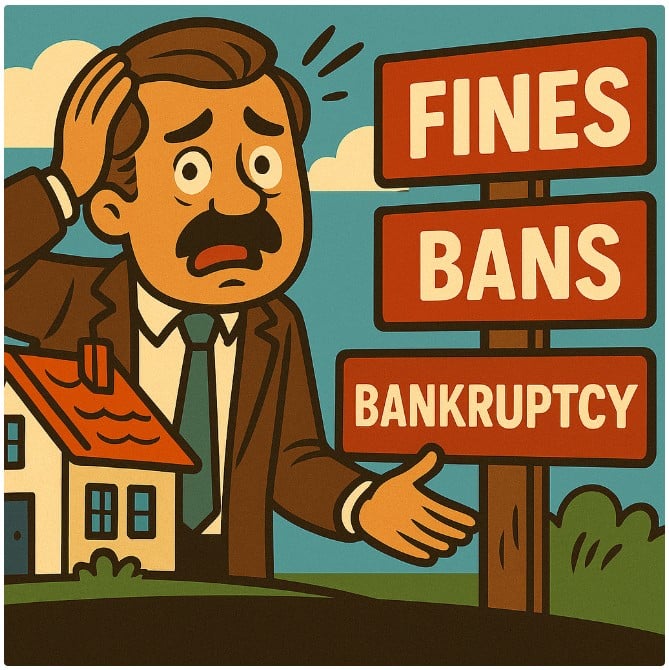
The conversation among private landlords has changed. It is no longer about yields, regulation or market cycles, it’s about survival. The publication of the government’s new civil penalty tables has pushed the sector into unfamiliar territory, where the financial consequences of ordinary operational mistakes are measured in five-figure sums, and the prospect of a banning order is no longer remote.
Across forums, advisory meetings and industry groups, landlords are expressing the same concern. They feel exposed, and they feel targeted. Some now feel unwelcome in the very market they have supported for decades. The shift has been sudden, and it has reshaped expectations about what it means to let property in the UK.
This sense of unwelcome is not just emotional. It is reinforced by policy decisions that introduce penalties large enough to destabilise a portfolio and enforcement powers strong enough to remove a landlord from the sector entirely. Meanwhile, other governments in Europe are signalling the opposite intention. Portugal’s recent move to reduce rental tax to 10% is a striking reminder that not every country is choosing to drive out private investment.
This divergence matters because landlords are increasingly comparing risk, reward and political climate across borders. The UK appears to be moving in one direction while competitor jurisdictions move in another. The consequences for supply, investment and market stability will be felt long before the first banning order of the new regime is issued.
Landlords are right to be concerned. The risks they face are significant, and for some, the financial outcomes can be terminal.
The new civil penalty tables make the scale of the risk impossible to ignore. A selective licensing breach now begins at £12,000. A possession error begins at £30,000. Reletting during a restricted period is set at £25,000. Breaching a banning order carries a starting penalty of £35,000. These are not maximums, they are baselines. They reflect the government’s expectation that councils will enforce actively and consistently.
The escalation is not limited to fines. Councils now have a clearer pathway to apply for banning orders. These orders do more than punish, they prohibit. A banning order removes the landlord from the sector entirely, revokes licences, forces properties into management arrangements and places the individual on the national rogue landlord database. Once imposed, recovery is difficult and in many cases impossible.
The combination of high penalties and lifetime commercial consequences raises a fundamental question about the direction of policy. Private landlords supply most of the rental properties in the UK, yet they are now subject to financial risks that exceed those imposed in many sectors of the regulated economy. A minor administrative failure in property management can now attract penalties that surpass those issued for dangerous conduct in other areas of law.
The effect on behaviour is already visible. Landlords who once focused on refurbishment, portfolio growth or strategic refinancing now spend much of their time calculating whether the returns justify the risks in the long term.
This is not a prediction of market collapse, it is a simple observation. When a government raises the cost of participation, some participants will leave. When another government signals it wants landlords to stay, as Portugal has done by reducing rental tax to 10%, investors pay attention.
The UK can sustain a strong rental market only when private investment is respected, stable and rewarded proportionately. At present, the message being received by landlords is the opposite. Uncertainty is rising, penalties are rising, and administrative risk is rising. That is not a sustainable foundation for a sector that houses millions of people.
The coming year will determine how landlords respond. Some will modernise their processes and remain, others will scale back or exit entirely, but every landlord should recognise that the risk calculus has changed. A fine can now wipe out profit, a ban can wipe out a business, and bankruptcy is not an abstract possibility for those with high leverage and sudden enforcement action.
The warnings are clear; Landlords risk fines, bans and potential bankruptcy. The choices made now will determine who survives the new era of enforcement and who does not.
For landlords who decide not to absorb the new risks, the next question is how to exit safely and sensibly. Selling strategies were discussed in my recent article linked below.
However, selling is only half of the decision. The other half is where to place the capital once the exit is complete. Rising regulatory risk in the UK does not mean investment opportunity has disappeared altogether. It simply means the playing field has changed. Some investors will look overseas to jurisdictions offering stability and lower taxation. Others will redirect capital into asset classes with lower regulatory exposure. The important point is that landlords have options, and with careful planning the proceeds of a property sale can be deployed in a way that preserves income while avoiding the escalating compliance burden. I recently published an article on this subject too – see link below.
https://www.property118.com/where-to-invest-if-i-sell-my-rentals/
These decisions are not easy, but the environment now demands clarity. Holding rental property is no longer a passive activity (was it ever?). It has become a highly regulated business with heightened exposure, serious penalties and irreversible consequences for those who fall foul of the rules, intentionally or not. Whether landlords stay or leave will depend on their appetite for risk, their ability to adapt and the strength of their long-term objectives.
25 comments on this article
A different perspective could help you spot an issue, avoid a mistake or find a better way forward. Read the comments and add your own views if you wish.

Previous Article
Share of Freehold company in a real mess?
11 months ago

11 months ago | 6 comments

10 months ago | 54 comments
Member Since January 2015 - Comments: 1619 - Articles: 1
9:15 AM, 20th December 2025, About 10 months ago
Reply to the comment left by Gilly Osborne at 17/12/2025 – 11:37
Get out asap.
I started off loading in 2022. Best thing I did.
No more sleepless nights over abusive tenants, how high I need to jump, seeing properties decorated and maintained to a high standard being damaged or trashed.
Member Since January 2015 - Comments: 1619 - Articles: 1
9:19 AM, 20th December 2025, About 10 months ago
Reply to the comment left by Gilly Osborne at 17/12/2025 – 12:29
That used to be the way, many of us did it, but now has a s21 has a 6 month life.
So reserve before 1st March, 1st February to be safe, if you want out.
Member Since September 2015 - Comments: 12
10:18 AM, 20th December 2025, About 10 months ago
Reply to the comment left by Judith Wordsworth at 20/12/2025 – 09:15
Thank you Judith
Member Since December 2025 - Comments: 33
2:08 PM, 20th December 2025, About 10 months ago
Reply to the comment left by Judith Wordsworth at 20/12/2025 – 09:11
I agree that the “s21 Notice day” might have had an effect but I have seen in my lifetime how hard it is to mobilise investors of all kinds. The Share Society has run numerous campaigns and so has the Taxpayers Alliance but they never amount to much. The successful changes in society have been those managed by organisations like the Fabian Society which attract those who gravitate naturally to collectivist groups, whereas investors tend to be individualistic and, as a rule, will sell and re-invest elsewhere if conditions become hostile.
So far as tent cities are concerned we don’t have those yet although I have seen a few tents in some places. But we are definitely seeing groups of vans appearing – there is a large number of van dwellers in Bristol. Sorry to use a BBC link, but it was the easiest to find: https://www.bbc.com/news/articles/c8673vy0jp5o
Member Since May 2015 - Comments: 13
2:13 PM, 20th December 2025, About 10 months ago
Not sure this is best place to post this but would appreciate thoughts on the student rental sector. I have 3 properties that are all let to students. How will things work with student lets once the renters rights act comes into force May next year?
As far as I understand Fixed term tenancies will no longer be allowed – also even existing contracts will be come rolling! (Unless of course you are a corporate landlord). Student rental agreements are almost all 12 month fixed term that run from 1st August to 31st July to align with the academic year.
So here is the problem – normally we would sign up a new group for a house next year in January next year? However, the current student tenants could then decide in May (under the new law) that they are not now leaving the property on 31st July, due to the change in the law.
It’s a policy mess as far as I can see. That can only end in chaos for this sector. At the moment the current students, like our properties and have asked if they can stay another year. As far as I see my hands are tied and I can’t say no.
So going forward I can’t see how I can manage the situation at all. Anyone other small private Landlords in this sector have solved this conundrum?