

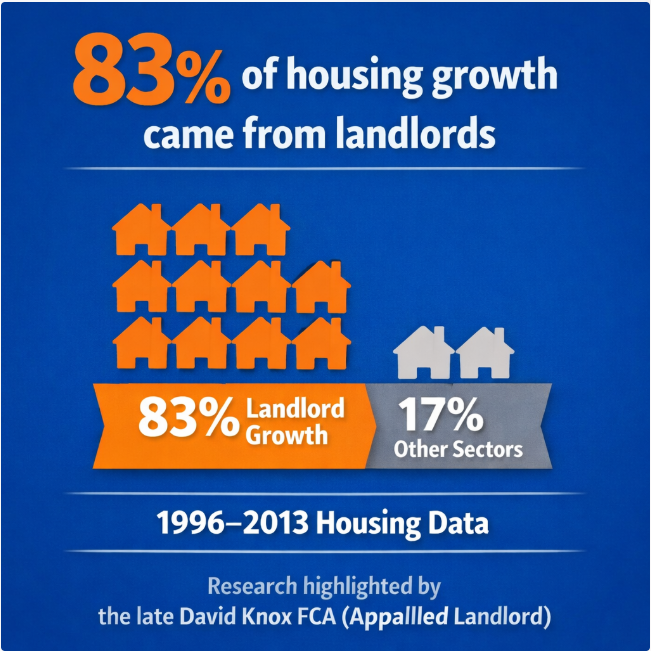
83% of housing growth came from private landlords

The overlooked statistic from England’s housing data that could reshape the policy debate.
Housing debates in Britain often start from a familiar assumption; that the growth of the private rented sector reduced housing supply by diverting homes away from first-time buyers, but one statistic tells a very different story.
Between 1996 and 2013, the number of dwellings in England increased from 20.3 million to 23.3 million homes, and during that same period the number of privately rented homes rose from around 2.0 million to 4.5 million. In other words, roughly 2.5 million of the additional homes appeared within the private rented sector.
That means the private rented sector accounted for around 83% of the increase in England’s housing stock during that period.
The statistic was highlighted back in 2016 by Property118 contributor David Knox, writing under the pseudonym “Appalled Landlord”, in an open letter to a Member of Parliament.
At the time, it challenged a narrative that was already gaining traction in housing policy debates. Today, it raises a more important question …
If private landlords played such a significant role in expanding housing supply in the past, what role could they play in addressing the housing shortage today?
How the private rented sector expanded so quickly
The growth of the private rented sector during the late 1990s and early 2000s did not happen by accident; several structural changes occurred at the same time.
The introduction of buy-to-let mortgages in the mid-1990s made it easier for individuals to invest in rental property. Financial institutions recognised that rental income could support borrowing, and lenders began offering products specifically designed for landlords. At the same time, demographic changes were increasing demand for rental housing. Labour mobility, rising student numbers and delayed home ownership meant more households were looking for rented accommodation, but demand alone does not increase housing supply.
What changed was the willingness of thousands of small investors to deploy capital into housing. Instead of relying solely on large developers or housing associations, the market suddenly had hundreds of thousands of individual participants willing to finance, renovate and operate rental homes. Many of those investors were not building entirely new homes. They were bringing existing housing stock back into productive use. That process, multiplied across the country, significantly expanded the number of homes available to rent.
The practical ways landlords increased housing supply
The expansion of the private rented sector did not simply involve buying completed homes and letting them out. Landlords often undertook projects that changed the way existing housing stock was used.
One common route was the renovation of empty or neglected properties. Across many towns and cities, landlords purchased houses that had been vacant or poorly maintained and refurbished them for rental use. Those properties that might otherwise have remained empty were returned to the housing market.
Another mechanism was conversion. Large houses were frequently converted into Houses in Multiple Occupation (HMOs), increasing the number of people who could live within the same building. In many urban areas this provided accommodation for students, young professionals and migrant workers who might otherwise have struggled to find housing.
Landlords also played an important role in supporting new developments. Purchasing properties off-plan helped developers secure financing for projects that might otherwise have stalled. Early investor purchases often provided the certainty developers needed to move ahead with construction.
In addition, some landlords converted commercial buildings or subdivided larger properties into smaller units, creating additional dwellings without requiring entirely new construction.
Taken individually, these projects may appear small, but taken together, they represented a significant contribution to housing availability.
This is why the statistics highlighted by David Knox are so striking; they suggest that the expansion of the private rented sector was not simply a shift in tenure. In many cases it involved bringing additional housing into use or increasing the number of households that existing buildings could accommodate.
What changed after the expansion years?
The period between the late 1990s and early 2010s was unusually favourable for investment in the private rented sector. Demand for rental housing was growing, credit was widely available and the regulatory framework was relatively stable. For many investors the economics of rental property were predictable enough to justify long-term commitments.
During the past decade, however, the environment for landlords has changed significantly.
A number of policy reforms were introduced that altered the financial and regulatory landscape of the sector. These included changes to mortgage interest tax relief, higher rates of Stamp Duty Land Tax on additional properties, tighter lending standards for buy-to-let borrowing and the gradual expansion of licensing and regulatory requirements in many local authority areas.
Each of these measures had its own policy objective. Some were introduced to address financial stability concerns, others to raise tax revenue or improve housing standards. but taken together they changed the risk profile of residential property investment.
For many smaller landlords, particularly those using borrowing to finance their investments, the economics became more uncertain. At the same time, rising interest rates and construction costs made property investment more capital intensive. The result has been a noticeable shift in behaviour.
Instead of expanding portfolios, many landlords have slowed investment, paused acquisitions or begun selling properties. At the same time fewer new investors have entered the sector than during the expansion years. None of this means the private rented sector is disappearing; millions of households still rely on it for housing. However, the pace of growth that characterised the earlier period has clearly slowed.
Why investor confidence matters in housing supply
Housing supply is often discussed primarily in terms of planning policy and large-scale development. Those factors are undeniably important; major housing developments require land allocation, infrastructure and the financial capacity of large builders, yet the experience of the private rented sector shows that housing supply can also expand through many smaller investment decisions.
When thousands of individual investors renovate vacant homes, convert properties or support new developments through early purchases, the cumulative effect can be substantial.
The expansion of the private rented sector between 1996 and 2013 illustrates how powerful that distributed investment model can be.
Conversely, when those investors lose confidence in the stability or profitability of the sector, the flow of capital into housing can slow just as quickly.
This dynamic is not unique to housing. In any sector where private capital plays a role, investment tends to follow confidence.
If private landlords once contributed significantly to the expansion of housing supply, what conditions would need to exist for them to do so again?
What would encourage landlords to invest again?
If housing policy is ultimately about increasing the number of homes available to live in, it is reasonable to ask what conditions encourage investment in housing.
The expansion of the private rented sector between 1996 and 2013 did not occur because government instructed landlords to invest. It happened because thousands of individuals concluded that investing in housing was both economically viable and socially acceptable.
Those conditions were not created by a single policy decision, they were the result of several factors working together.
The tax treatment of rental income was broadly aligned with other forms of business investment. Mortgage lending for buy-to-let was accessible but still subject to prudent underwriting. Regulatory requirements existed but changed relatively slowly, allowing investors to plan with some confidence.
Most importantly, the sector operated within a framework that was broadly predictable.
When investment decisions involve assets that may be held for decades, predictability matters. Investors do not require guaranteed returns, but they do need to understand the rules under which they are operating. When the policy environment becomes uncertain or changes frequently, investors tend to pause before committing capital.
The experience of the past decade suggests that investor behaviour in the housing market is no different from other sectors of the economy. When returns become less predictable or risks increase, investment tends to slow. Conversely, when the environment supports stable long-term investment, capital tends to return.
Lessons for housing policy
The purpose of this article is not to suggest that the private rented sector alone can solve Britain’s housing shortage. Housing supply depends on many factors, including planning policy, infrastructure, land availability and the capacity of major housebuilders, but the historical evidence does suggest that private landlords once played a significant role in expanding housing availability.
They did so not through large-scale national programmes, but through thousands of individual decisions to renovate properties, convert buildings and invest in new developments.
If policymakers are searching for ways to increase housing supply, that experience raises a question worth considering; is the current policy environment encouraging or discouraging that kind of distributed investment?
If the goal is to increase the number of homes available to rent or buy, the answer to that question may matter more than is often acknowledged in housing debates.
A simple thought experiment
Imagine the housing market between 1996 and 2013 without the private rented sector.
During that period England added around 3 million homes to its housing stock. Roughly 2.5 million of those appeared within the private rented sector.
Remove that expansion and the housing market would have looked very different.
Many of the renovated properties, converted buildings and investor-backed developments that became rental homes might never have appeared in the housing supply at all. That observation does not solve today’s housing shortage, but it does highlight something worth remembering when policymakers discuss the role of private landlords.
A statistic worth remembering
When David Knox wrote his open letter several years ago, he highlighted a statistic that had received relatively little attention.
During the period between 1996 and 2013, roughly 83% of the increase in England’s housing stock occurred within the private rented sector.
The number itself does not provide a complete explanation of Britain’s housing challenges, but it does remind us of something important. At one point in recent history, private landlords were responsible for a large share of the expansion in available housing. If Britain is searching for ways to increase housing supply again, it may be worth asking why.
Attribution
The statistic referenced in this article was highlighted by Property118 contributor David Knox, who wrote under the pseudonym “Appalled Landlord”.
David passed away in January 2020, but his research into housing policy and landlord economics remains part of the Property118 archive.
His original article can be read here:
Support Property118 and keep the platform independent
If you value evidence-led reporting like this, you can support the work here.
Monthly support helps fund independent reporting, research, and the free landlord forum.
3 comments on this article
Learn from your peers’ experience
A different perspective could help you spot an issue, avoid a mistake or find a better way forward. Read the comments and add your own views if you wish.
Previous Article
East London boroughs top decade of house price growth
Member Since September 2015 - Comments: 9
11:52 AM, 7th April 2026, About 6 months ago
Really sorry to hear about David, but all I can say beyond that is how right he was!!!! I’ve been saying very similar for years. The specious argument that private landlords don’t build properties ignores the fact that it was their demand (and specifically their capital) that enabled projects to be constructed in the first place. Remove that and nothing gets built. The most frightening property statistic is that, despite local planners approving a greater percentage of projects than ever, the number of new projects being approved has never been lower. Once those projects already approved have been completed, there’ll be NOTHING coming through. That’s when the real crisis will begin, especially with 180,000 social houses having been lost over the past 10 years (just look at auction catalogues for associations selling homes they can’t even afford the repairs on).
Member Since June 2019 - Comments: 973
8:16 PM, 7th April 2026, About 6 months ago
The lack of landlord buyers has left many people unable to trade up, the whole market has stalled in East Anglia at the moment.
Member Since May 2021 - Comments: 3
3:31 PM, 8th April 2026, About 6 months ago
What occurred was strongly influenced by real interest rates (nominal rate less inflation rate). Buy to let was a golden alternative to often negative real interest rates in a savings account (which are even taxed), especially for the majority who regard stocks and shares as too risky. Moreover, tax relief on the mortgage reduced the interest rate on repayments. Even those without savings could join the buy to let bandwagon. What has happened since the Section 24 restriction on mortgage tax relief for the unincorporated, just shows how much all this was influenced by interest rates