

House price growth cooling for the second consecutive month

The latest Nationwide House Price index statistics for May showed annual growth cooling slightly for the second consecutive month, but still in double figures at 11.2% from 12.1% in April. However, prices were still up 0.9% month-on-month for May with the average now standing at £269,914.
Commenting on the figures, Robert Gardner, Nationwide’s Chief Economist, said: “Despite growing headwinds from the squeeze on household budgets due to high inflation and a steady increase in borrowing costs, the housing market has retained a surprising amount of momentum. Demand is being supported by strong labour market conditions, where the unemployment rate has fallen towards 50-year lows, and with the number of job vacancies at a record high. At the same time, the stock of homes on the market has remained low, keeping upward pressure on house prices.
“We continue to expect the housing market to slow as the year progresses. Household finances are likely to remain under pressure with inflation set to reach double digits in the coming quarters if global energy prices remain high. Measures of consumer confidence have already fallen towards record lows. Moreover, the Bank of England is widely expected to raise interest rates further, which will also exert a cooling impact on the market if this feeds through to mortgage rates.
Adding or maximising space is still very popular since the pandemic
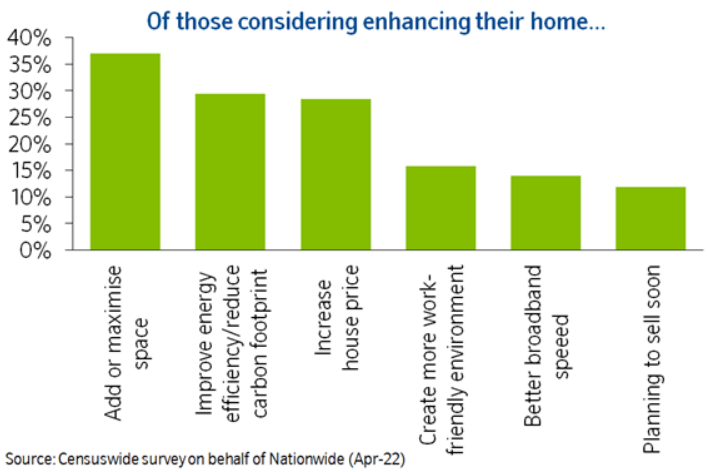
“Our recent housing market survey revealed that, as well as more people looking to move, over half of those surveyed (54%) are considering enhancing their home.
“The most popular option for those looking to make improvements was to add or maximise space, with more than a third (37%) citing this as a motivating factor. Interestingly, 29% of those surveyed wanted to improve energy efficiency or reduce the carbon footprint of their home. This consideration has become increasingly relevant in light of surging energy costs, though decarbonising and adapting the housing stock is also important if the UK is to meet its 2050 emissions target.
House prices since 1952
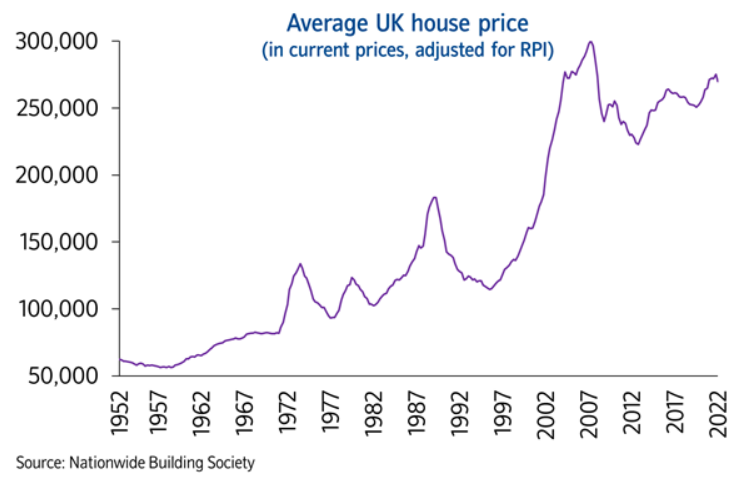
“2022 marks the Queen’s Platinum Jubilee and it is also 70 years since we produced our first house price data. The housing market was very different back in 1952, with just 32% of households owning their own home, compared to 65% today.
“The UK average house price in 1952 was £1,891 – which is around £62,000 in today’s money. This means that current average house prices are 4.3 times higher than 1952 levels in real terms (adjusting for retail price inflation).
“In 1952 the typical house cost four times average annual earnings, but today the average home costs 6.9 times earnings – a record high. However, borrowing costs were higher back then, with Bank Rate at 4.0%, compared to 1.0% currently.
“In the early 1950s, almost all mortgages were advanced by building societies, where the overwhelming majority were small, locally-based lenders. In 1952, there were 800 societies operating in the UK, compared to 43 today.”
1 comment on this article
Learn from your peers’ experience
A different perspective could help you spot an issue, avoid a mistake or find a better way forward. Read the comments and add your own views if you wish.
Previous Article
How many BTL properties is enough?Next Article
Is now a good time to refinance and fix?
Member Since June 2013 - Comments: 3347 - Articles: 83
11:41 AM, 3rd June 2022, About 4 years ago
Yes I always say What happens on the ground level, we will see on the news in few months. And my colleague Estate Agents tell me things are cooling down. Example 130k house last week only had about 8 bids & fetched 138k. We may laugh, but 8 months ago it would have been 20 bids & 150k.