

EPC targets not to blame alone for rent rises claim government
4 months ago | 7 comments


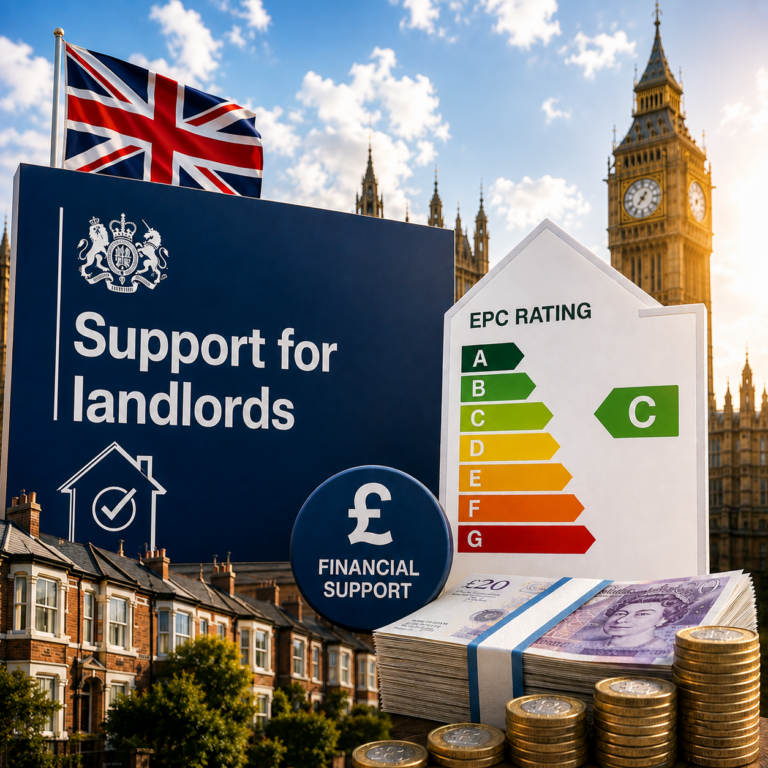
The government claims financial support is available to landlords to meet EPC targets.
In answer to a written parliamentary question, the government claim they want to expand the availability of private finance options to help landlords meet energy-efficiency targets.
The government has announced all private rented properties will need to meet EPC C targets by 2030.
Liberal Democrat MP Gideon Amos asked the government what financial support will be available to landlords to meet EPC C targets.
Minister for energy consumers Martin McCluskey said: “Support is currently available to help landlords improve their properties, including through the Warm Homes: Local Grant and the Boiler Upgrade Scheme, and a zero-rate of VAT until March 2027 on energy-saving measures.
“An eligibility tool is available at the government webpage ‘Find Ways to Save Energy in your Home’, which provides tailored recommendations for home improvements to increase energy efficiency and clean heat.
“More widely, we are continuing to explore longer-term options to stimulate greater availability of private finance options.
“As part of the Warm Homes Plan, the government will establish a Strategic Partnership with the green home finance sector to help build and diversify the range of green financing options available from the broader market.”
The National Residential Landlords Association (NRLA) have previously told Property118 that many landlords will decide the cost of retrofitting is not worth the hassle and choose to sell up.
Chris Norris, chief policy officer for the NRLA, said: “We are firmly of the view that rental properties must be as energy efficient as practicable. However, it is simply not feasible for every property in the market to be retrofitted to meet an EPC ‘C’ rating within the previously proposed time frame.
“The current proposal doesn’t take into account the varying age and condition of housing stock inside and outside of the PRS, the complexity of the work required, or the lack of appropriately skilled tradespeople needed to make improvements.
“Many landlords will therefore have little choice but to sell properties that will be difficult, and excessively costly, to retrofit. This will reduce the supply of available rental properties further reducing available housing during the ongoing, and acute, supply and demand crisis.
“Ministers need to develop a targeted programme of support to facilitate investment, as the Committee on Fuel Poverty and Citizens Advice has previously recommended.”
21 comments on this article
A different perspective could help you spot an issue, avoid a mistake or find a better way forward. Read the comments and add your own views if you wish.
Previous Article
Tenants moving back to their country with only 5 days notice?
4 months ago | 7 comments

4 months ago | 4 comments

4 months ago | 3 comments
Member Since May 2018 - Comments: 2597
5:47 PM, 6th July 2026, About 4 months ago
Reply to the comment left by True Owner at 06/07/2026 – 16:45
One of the difficulties here is that if you are a limited company with 10-100 properties you can offset all your finance costs. But if you are like the majority of landlords and have 1-3 properties and aren’t incorporated then you cannot. Limited companies of course don’t pay capital gains tax.
Significant improvements to property other than for example replacing single glazing with double glazing are capital expenditure and cannot be written off against revenues in the year in which the investment takes place. And if you have to raise extra capital to make capital investments then in comparison to a limited company you are penalised by the tax system for doing this.
The available market data tell us that you don’t significantly increase your rent by making EPC improvements from Band D to C, and you achieve almost no increase in value by making EPC improvements before selling to an owner occupier.
The whole system is set up to penalise the small non-incorporated investor and favour the larger incorporated investor. If a government genuinely wanted to improve this it would allow the smaller landlords to offset their finance costs against rents and introduce the capital allowances that would facilitate improvements in energy efficiency or local energy generation such as photovoltaics.
Comments: 1
6:54 PM, 6th July 2026, About 4 months ago
Government strategy is to ‘professionalise’ the industry. Which basically means force small landlords out as it’s easier to regulate (and milk) a smaller number of operators. Councils just don’t have the resources to deal with the number of current landlords. If it was about carbon reduction you would logically apply the regulations to all UK homes, if it’s about saving the tenants £250 a year on heating that’s easy I’ll reduce the rent by £250 or give the tenants that back each year. Rather that than spend 10k plus on a property build in 1820 that will become a damp mould nightmare once the government ‘approved’ eco companies have botched the insulation.
Member Since December 2025 - Comments: 26
7:05 PM, 6th July 2026, About 4 months ago
I’ve had a work done last year on a flat that qualified for a grant because my tenant is on benefits. This was for wall insulation and solar panels on the roof that would supposedly reduce his energy bills to virtually zero along with storage heaters.
The job was done (BODGED) by government approved contractors using foreign workers that mostly didn’t speak English.
The results were to a very poor standard.
As for the solar panels the roof has a south east elevation and a north west elevation. The north west elevation is also overshadowed by a slightly taller building. Anyone with two brain cells could obviously work out that the solar panels should have been fitted to the south east side which gets lots more sun. But no they fitted them to the north west side. I complained and got told that’s where the government supervisor said they had to go.
So as for power generation in winter months of the 6 panels on a bright sunny where they don’t get any direct sunlight due to the aforementioned taller building at best generate just under 200 watts for about an hour or so. And earlier in the day before the evening sun in winter give about 70 watts.
At this time of year the best I’ve seen when checking them they peaked at 1700 watts late in the day when the sun was towards the west. but through the most part of a bright sunny mid June day they averaged 400 watts leaving him with 80 watts being fed back into the grid whilst having his TV fridge and Internet router on.
The government gave these contractors £40,000 of taxpayers money for this shabby job and the feedback from selling electricity back to the grid falls a long way short of covering his daily standing charges of 57 pence a day. The energy companies only pay 5p per unit of electricity fed back into the grid so over the 6 months of winter his solar had fed 35 units back at 5 pence per unit that means he got a paid £1.75pence for six month’s. So six months worth of unused electricity gave him just enough to cover 3 days standing charges.
Overall the solar panels have not reduced his winter electric bills any noticeable amount though the summer bills have come down by about £3 a week as they cover running the fridge during daylight hours. Had the panels been put on the south east side I’d guess he’d have saved a lot more as they probably would have been giving around 2500 watts for most of the day in the summer and around 1200 watts in winter.
Not happy and will definitely be selling instead of having shabby work done by government approved contractors that have devalued this property.
Lesson learnt.
Member Since February 2025 - Comments: 2
8:01 PM, 6th July 2026, About 4 months ago
Wall insulation can causes moisture trap inside the wall and damp issues, Make the house unsellable or mortgage declines, it’s not just about the money.
Member Since May 2018 - Comments: 2597
12:30 PM, 7th July 2026, About 4 months ago
Reply to the comment left by SW at 06/07/2026 – 20:01
I agree entirely: If you fill a cavity that shouldn’t be filled and then sell the property on, all that you are doing is passing a problem on to the next owner. It doesn’t make sense for government to be incentivising use of cavity wall insulation in view of the government’s previous history on this.
https://www.bbc.co.uk/news/articles/c3w965gz8zgo
What the link says is “….two government schemes aimed at cutting energy use by insulating homes were botched on a vast scale, a spending watchdog has found, leaving tens of thousands of homes in need of remedial work. According to the National Audit Office (NAO) 98% of homes that had external wall insulation installed under the schemes set up by the previous government have problems that will lead to damp and mould if left unaddressed.”
What’s also interesting is that it says “….Nearly a third, or 29%, of the homes that were given *internal* insulation also need fixing….”
Government interference in this area has been a disaster.
Member Since August 2016 - Comments: 1198
1:14 PM, 7th July 2026, About 4 months ago
Reply to the comment left by Beaver at 07/07/2026 – 12:30
Well I’ve got C rated properties (already got cavity wall insulation) and if Gov’t insists I fit solar panels or heat pumps to retain the C rating they can take a running jump. I’ll just sell them.
Member Since May 2018 - Comments: 2597
1:16 PM, 7th July 2026, About 4 months ago
Reply to the comment left by John Hole at 06/07/2026 – 19:05
You might have learnt a lesson, but I don’t think the government has.
Last month the NRLA revealed that “….Victims of the Government’s botched insulation scandal will now be able to claim for repairs of up to £25,000 per property, it has been announced.”
https://www.nrla.org.uk/news/gov-beef-up-customer-protection-botched-energy-efficiency-works
Given the government track record on this why would ANY UK government be pressurising landlords into installing cavity wall insulation, external insulation, or internal insulation in order to meet EPC standards?
Member Since May 2018 - Comments: 2597
1:23 PM, 7th July 2026, About 4 months ago
Reply to the comment left by Dylan Morris at 07/07/2026 – 13:14
I don’t think government should be ‘insisting’ on anything, or pressurising landlords and tenants to do anything, including not using the EPC system to pressurise landlords and tenants: I think tenants should be able to rent any property, including band E and below.
I think that if government wants to help landlords to improve either energy efficiency or energy resilience then government should do it by allowing landlords to offset their finance costs against rents and introducing capital allowances for major insulation retrofits together with capital allowances for energy generation and storage; then let the market sort it out; let the tenants who want to rent band C, B or A properties rent them and pay the higher rents. And let those tenants who want to rent D, E, or F properties rent them as well.
The government’s track record on energy insulation schemes is already really bad and I don’t even believe that all the problems have surfaced yet.
Member Since April 2025 - Comments: 12
10:22 AM, 11th July 2026, About 4 months ago
Most of these schemes only apply to those without proper heating systems or tenants on qualifying benefits!
Member Since May 2018 - Comments: 2597
3:57 PM, 11th July 2026, About 4 months ago
Reply to the comment left by Valerie Hollylee at 11/07/2026 – 10:22
The government is having to compensate tenants who had insulation fitted under some of these schemes:
https://energysavingtrust.org.uk/advice/solid-wall-insulation/#jumpto-11
Government shouldn’t be doing this: It isn’t competent to do it and its track record is extremely poor.