

Landlords face paying National Insurance on rental income
7 months ago | 116 comments


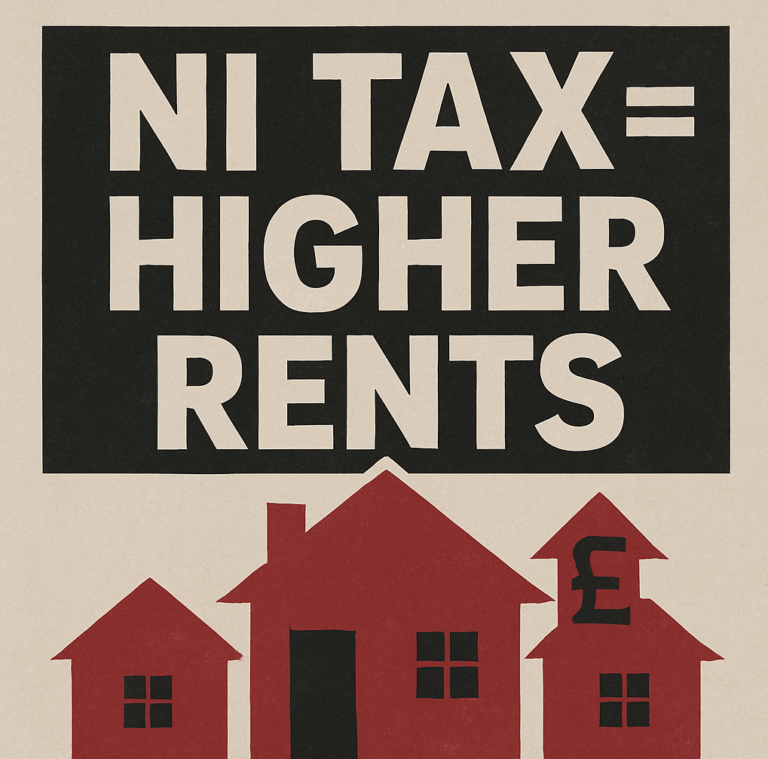
Chancellor Rachel Reeves reported targeting of ‘unearned income’ from landlords with a controversial plan to impose National Insurance contributions on rental income, has sparked an outcry.
Labour wants to raise £2 billion to tackle a £40 billion public finance deficit, according to Treasury sources quoted by The Times.
The move will avoid breaching the government’s pre-election pledges not to raise VAT, income tax or existing National Insurance rates.
The proposal would apply an 8% National Insurance charge to the £27 billion in net property income recorded in 2022-23, potentially generating £2.18 billion.
A Labour insider described property income as a ‘significant potential extra source of funds’.
However, the plan has drawn sharp criticism from the property sector, with experts warning it could shrink rental housing supply and drive-up rents.
Tom Bill, the head of UK residential research at Knight Frank, said: “Targeting landlords won’t lose the government many votes, but such moves invariably end up hurting tenants.”
He warns that landlords are already selling properties due to the Renters’ Rights Bill and stricter EPC regulations for rented homes.
Mr Bill says further taxes could exacerbate supply shortages and put ‘upwards pressure on rents’.
Ben Beadle, the chief executive of the National Residential Landlords Association, echoed these concerns, and said: “Further punitive tax hikes on the rental sector will lead only to rents going up, hitting the very households the government wants to protect.”
Mr Beadle highlights existing pressures, including last year’s stamp duty increase on rental properties and proposed EPC upgrades costing landlords up to £15,000.
He urged the Chancellor to reform the tax system to encourage investment in new rental housing and points to Savills’ analysis that one million additional rental homes will be needed by 2031.
Marc von Grundherr, a director at Benham & Reeves, called the proposal ‘political point-scoring’ rather than sound policy.
He warns that it could squeeze small and medium-scale landlords out of the market, further straining rental supply and increasing rents.
Siân Hemmings-Metcalfe, the operations director at Inventory Base, criticised the plan as ‘short-term populism’.
She argues it risks deterring responsible landlords and undermining tenant protections.
Meanwhile, Sam Humphreys, the head of M&A at Dwelly, added that many landlords operate on thin margins, and this tax could drive them out, leaving tenants with fewer housing options and higher rents.
Every day, landlords who want to influence policy and share real-world experience add their voice here. Your perspective helps keep the debate balanced.
Not a member yet? Join In Seconds
Login with
Previous Article
UK housing market hits three-year high - GetAgentNext Article
The cost of EPCs and minimal returns?
7 months ago | 116 comments


8 months ago | 6 comments
Sorry. You must be logged in to view this form.
Member Since January 2024 - Comments: 341
10:26 AM, 29th August 2025, About 7 months ago
Many of those most affected by these changes will be ordinary working people who rent their homes.
Every extra cost added to landlords — whether that’s new taxes such as NIC on rental profits, licence fees, registration schemes, or the cost of meeting EPC targets — has to be paid for somehow. The reality is that these costs get passed on through higher rents.
And if regulation becomes so burdensome that landlords can’t recover their costs or are put at greater risk of fines and losses, then many will choose to sell up. That reduces the supply of rental properties, which again pushes rents higher.
This isn’t about landlords versus tenants. It’s simply how the economics of housing work. If government wants lower rents, increasing the costs and risks of providing rental housing is not the way to achieve it.
It isn’t rocket science, it is basic common sense.
Member Since September 2018 - Comments: 3508 - Articles: 5
10:30 AM, 29th August 2025, About 7 months ago
Reply to the comment left by Ryan Stevens at 29/08/2025 – 10:26
It isn’t rocket science, it is basic common sense….of which the ones running the asylum, have none.
Member Since May 2015 - Comments: 2188 - Articles: 2
11:12 AM, 29th August 2025, About 7 months ago
Reply to the comment left by Reluctant Landlord at 29/08/2025 – 10:30
As a long since retired Rocket Scientist, I can professionally confirm that landlording has nothing to do with Rocket Science. I can confirm that I have never used Newtons equations of motion in relation to my activities as a landlord, although Einsteins relativity equations do indirectly come into play when using GPS.
Member Since February 2017 - Comments: 57
12:32 PM, 29th August 2025, About 7 months ago
Some have been slow to realise that this is what the government actually want – a massively reduced size PRS with the sold properties going to owner-occupiers. The benefit tenants then either get housed in the new social housing being built or in what is left of the PRS. They do not believe in private sector housing unless it’s corporate level large scale new builds such as John Lewis.
We realised this as soon as she increased the stamp duty levy on buying new rentals last year.
I laugh when I see readers still asking why they don’t understand. Of course they get the maths. It’s by design.
Member Since January 2024 - Comments: 341
12:56 PM, 29th August 2025, About 7 months ago
Reply to the comment left by Robert at 29/08/2025 – 12:32You give governments (of all persuasions) too much credit. Their overriding goal is simply to be in power. To achieve this, they make promises they cannot possibly fulfil. Paying for these pledges—along with the rising interest on their ever-growing debts—requires ever more tax revenue.
Since they’ve pledged not to raise income taxes on ‘workers,’ they turn instead to stamp duty. But higher stamp duty feeds directly into higher rents, as landlords pass on costs in order to preserve their returns. In the end, workers still lose spending power, just by another route.
Member Since January 2024 - Comments: 341
1:33 PM, 29th August 2025, About 7 months ago
According to Migration Watch:
“The financial cost of the UK’s asylum system increased ten-fold from £538 million in the financial year 2011/12 to £5.38 billion million ten years later in 2023/24. A significant driver of this rise is the growing reliance on hotels to accommodate asylum seekers.”
Apparently the average cost per night for a hotel stay is £145 per day, compared with just £14 for ‘shared dispersal housing’.
Therefore, it defies common sense to bash landlords to the stage when they will sell up, at a time when more rental accommodation is needed. This reinforces my view that governments have none.
Member Since February 2017 - Comments: 57
1:45 PM, 29th August 2025, About 7 months ago
Reply to the comment left by Ryan Stevens at 29/08/2025 – 12:56
We will know for sure at the next budget. An easy target for her instead, would be raising CGT levels to income tax levels. She could do this if she wants to keep some of us ‘in’. This would be far simpler than the complexities of trying to apply national insurance to investment income (not currently done).
However, if she does not increase CGT then we will know that she has left the ‘exit’ door firmly open. This is at the same time as clearly disincentivising buying, with the stamp duty surcharge and making it unaffordable for small landlords.
If you put all the pieces of the jigsaw together, including their house building strategies and reducing the barriers on owner-occupier mortgages, it does appear that there is a housing policy which is only gradually being revealed.
If she does increase CGT or increase barriers to selling then obviously I will stand corrected.
Member Since January 2024 - Comments: 341
2:57 PM, 29th August 2025, About 7 months ago
There is no housing policy, there is just a desperate need for tax revenue from the least number of possible Labour voters.
She cannot tax tenants (directly), so she is targeting landlords instead. In addition, she cow tows to large business because she needs them for donations to party funds, etc.
Member Since October 2023 - Comments: 201
4:08 PM, 29th August 2025, About 7 months ago
How is raising £2 billion going to “tackle” the £40 billion black hole?
It wont even touch the sides.
Member Since January 2024 - Comments: 341
4:53 PM, 29th August 2025, About 7 months ago
Reply to the comment left by David100 at 29/08/2025 – 16:08Ummmmm, pays a bit of the interest I suppose.
Anyway, with their election promises, debt is pretty much guaranteed to be much higher by the end of their term.
It is also pretty much guaranteed that property owners and pensions will continue to be a target – biggest tax take from the minimum number of Labour supporters.
Time to sell up, before even more sh*t hits the fan.