
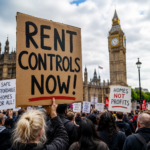
Housing campaigners demand rent controls ahead of new Prime Minister
2 months ago | 4 comments



Landlords watching Labour’s next housing move may find the private rented sector is still expected to absorb pressure where council housebuilding falls short.
An analysis by specialist lender Together claims potential PM Andy Burnham‘s plan for the biggest council housebuilding programme since the post-war period risks becoming a ‘postcode lottery’.
That’s because publicly owned brownfield land is not evenly spread across England.
Mr Burnham has said Labour would use vacant land to reduce costs and deliver a major programme of social and affordable homes.
Together’s chief commercial officer, Ryan Etchells, said: “Building on vacant public land is a sensible idea, but our analysis shows it can only ever be part of the answer.
“There isn’t enough public land to deliver a programme this size, and that’s before considering that the places with the greatest need tend to have the least land.
“As it stands, whether this pledge reaches your community is close to a postcode lottery.”
He added: “They need sites to be assembled and bought, existing land intensified, and the wider public estate brought into play — and all of that needs finance that moves quickly and understands complex, non-standard sites.”
Together’s analysis of Searchland data says publicly owned brownfield land in England has capacity for at most 187,000 to 207,000 homes.
That is less than two-thirds of a 300,000-home social and affordable housing programme previously announced by Labour, before any assessment of whether each site is genuinely deliverable.
The specialist lender says the government does not own enough registered land to build a programme of that size on public land alone.
A third or more of the homes would still need land bought at current market value.
The available land is also heavily concentrated in various areas with Birmingham’s 185 sites having capacity for 11,500 homes.
By contrast, around two-thirds of the 20 areas with the deepest housing delivery shortfalls have little or no significant public land available for housebuilding.
Bournemouth, Christchurch and Poole have a shortfall of around 4,550 homes, while Greenwich is short by around 3,880 and Newham by around 2,870.
Leicester, Sandwell, Thurrock, Southend-on-Sea, Basildon, Portsmouth and Southampton are also listed among the areas with large delivery gaps.
Some of the largest public landholdings sit in areas already meeting or beating housing targets, including Leeds, Wandsworth, Waltham Forest, Newcastle and Nottingham.
For private landlords, Labour’s plans for house building matters because pressure on the PRS tends to rise when social housing supply fails to match demand.
David Smith, a partner and residential property law expert at Bishop & Sewell, said Burnham’s ambition to increase social homes could be positive for the sector.
However, he warns that a clearer role for private landlords is needed.
He said: “Perhaps more encouraging is his ambition to drive an increase in social homes.
“That will be a welcome move for the private rented sector.”
He added: “The sector has, however, been asked to do too much and is somewhat of a dumping ground in which all kinds of housing needs are expected to be addressed.”
The Centre for Policy Studies has separately claimed Mr Burnham’s council house pledge would add to England’s housing subsidy bill.
It argues that £39bn over 10 years may deliver only between 14,335 and 15,494 homes a year.
Its report says the average-sized three-bedroom semi-detached house costs around £251,700 to build.
And that’s even with land provided free, meaning £3.9bn a year would cover 15,494 homes.
The organisation’s head of housing and infrastructure, Ben Hopkinson, said: “The cost of building social housing, like all housing, has been driven up by regulation, construction costs and an unruly planning system.
“Subsidising rents for some on the taxpayer’s dime while refusing to tackle the broader lack of housing for all tenures suggests Andy Burnham is going to be yet another Prime Minister driven by ideology, not what actually works.”
Every day, landlords who want to influence policy and share real-world experience add their voice here. Your perspective helps keep the debate balanced.
Not a member yet? Join In Seconds
Login with
2 months ago | 4 comments

3 months ago | 96 comments

3 months ago | 10 comments