
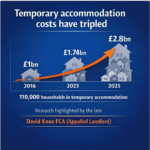
Temporary accommodation costs have tripled since 2016 in line with Property118 predictions
7 months ago | 2 comments


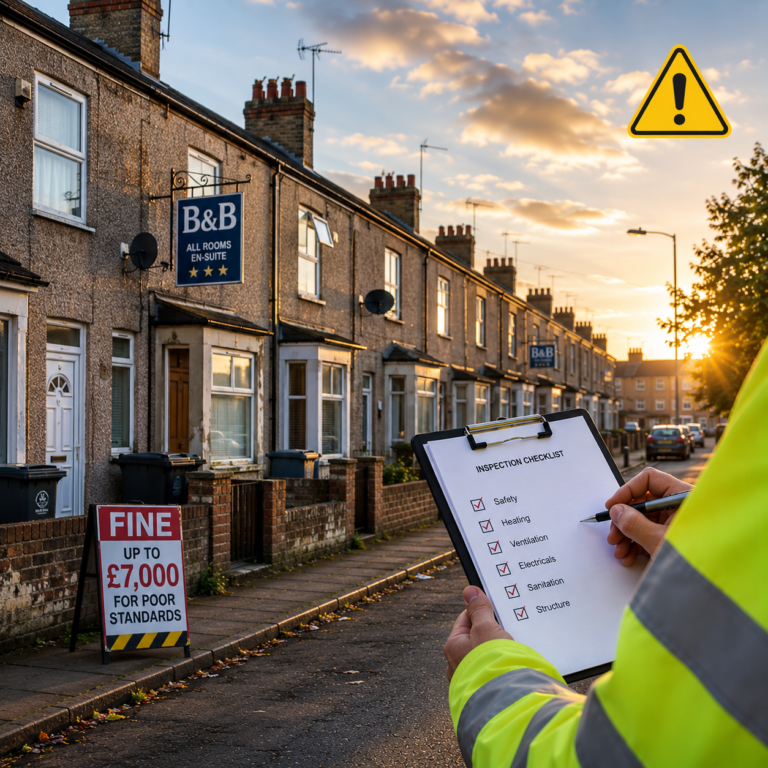
The government has set out plans to tackle poor conditions in temporary accommodation.
Speaking in Parliament, homelessness minister Alison McGovern claimed the government would include a new national target to eliminate the unlawful use of B&Bs.
The government also announced plans to apply the Decent Homes Standard to temporary accommodation.
As previously reported by Property118, the government has pledged to prevent homelessness by the end of this Parliament through its new homelessness strategy.
Ms McGovern told MPs that the government’s homelessness strategy is making progress, including a 63% drop in families with children staying in B&Bs beyond six weeks compared with last year.
She said the £950 million Local Authority Housing Fund is helping councils provide better temporary accommodation.
She added the government will take action against councils that fail to improve temporary accommodation.
She said: “Councils work extremely hard to find suitable accommodation, but we know performance varies between different councils. Through the National Plan to End Homelessness, we are establishing routes to escalate and intervene to address poor performance.
“We will not shy away from calling out councils if they are not taking adequate steps to improve.”
These include requirements for councils to make temporary accommodation suitable and make sure people have access to support services.
Ms McGovern said the government plans to apply the Decent Homes Standard and use powers under the Renters’ Rights Act to tackle poor housing conditions in the private rented sector
She explains: “We are improving quality and increasing protections against poor housing conditions. Our guidance is clear that accommodation must be free of the most serious category 1 hazards, and local authorities must now set out in their temporary accommodation policies how they will ensure this is the case.
“We will soon be consulting on extending the scope of Awaab’s Law from the social rented sector to also include temporary accommodation occupied under licence and tenancies in the private rented sector.
“We intend to apply the reformed Decent Homes Standard to temporary accommodation wherever possible, and will publish guidance by the end of 2026 to help landlords prepare for this.
“We have recently achieved Royal Assent to the Renters’ Rights Act, which introduces a new power for local authorities to issue fines up to £7,000 where a category 1 hazard is found in private rented homes, and are considering extending this to other forms of temporary accommodation.”
Ms McGovern also adds they will keep Local Housing Allowance (LHA) rates under review.
She said: “We recognise some private renters need support with their rent. That is why we will work across government to keep Local Housing Allowance rates under review in order to deliver on the government’s priorities, including maintaining the long-term fiscal sustainability of the welfare system. Local Housing Allowance rates were set to the 30th percentile of local market rents from April 2024.
“For those who need further support, renters facing a shortfall in England can apply for the Crisis Resilience Fund Housing Payment. The Fund provides immediate support to people in crisis, including residents who face shortfalls in meeting their rent or need help with moving costs.”
During the Autumn Budget, ministers announced that LHA rates will remain frozen for a second consecutive year in 2026/27.
According to government data, almost 1.7 million private rented households across the country were receiving housing cost support as of August this year, with 53% of those households facing a gap between their housing benefit payments and their monthly rent.
3 comments on this article
A different perspective could help you spot an issue, avoid a mistake or find a better way forward. Read the comments and add your own views if you wish.
Previous Article
England's housing delivery set to fall sharply
7 months ago | 2 comments

6 months ago | 13 comments
Member Since May 2025 - Comments: 92
9:31 AM, 26th June 2026, About 4 months ago
This is what happens when you have lawyers as prime ministers – they feel compelled to create more laws.
The key part of this article is “staying in B&Bs beyond six weeks”.
Currently if you stay in any accomodation more than 30 days then a tenancy is effectively created and the RRA, LTA acts apply by default so this article is pointless and they are going to introduce more laws when they are not needed – the legislation is already applicable.
I am very strict on occupancy durations for my AirBnB. For a start I am exempt from Selective Licencing but the moment anyone stays longer than 30 days and they have no permanent home it would be subject to SL and I would have to pay the stupidly high fees. It would also mean I would have to evict through the courts rather than just chuck them out.
Now if the government was serious about tackling poor housing standards then the RRA should apply to social and council housing. The government is the biggest rogue landlord in the country. Stats for my local council showed about 5% of housing failed fire safety including missing fire alarms. Missing gas safety inspections etc. I suppose I am going to have to say Two Tier Andy from now on rather than Two Tier Kier….
Member Since June 2021 - Comments: 60
10:35 AM, 27th June 2026, About 4 months ago
Reply to the comment left by Suspicious Steve at 26/06/2026 – 09:31
It’s 6 weeks in total. If they are in a hotel, B&B, or holiday let, they are kicked out every 28 days, and a new booking has to be made, but they have to physically leave, even if it’s just for a few hours.
Member Since January 2015 - Comments: 1635 - Articles: 1
10:35 AM, 27th June 2026, About 4 months ago
Reply to the comment left by Suspicious Steve at 26/06/2026 – 09:31
Most MPs have a legal background