

Buying six properties? The Stamp Duty bill depends on where they are

For many years, landlords have referred to “Stamp Duty” as though it were a single UK tax. In reality, that is no longer the case.
Today, there are three separate property transaction taxes operating across the United Kingdom, each with its own legislation, rates and reliefs. The differences can be significant, particularly for portfolio landlords and property investors buying multiple dwellings.
England and Northern Ireland continue to operate under the Stamp Duty Land Tax (SDLT) regime. Wales replaced SDLT with Land Transaction Tax (LTT), while Scotland introduced Land and Buildings Transaction Tax (LBTT). Although all three taxes serve a similar purpose, they no longer produce the same outcome.
A good example is the purchase of six or more residential properties.
Six properties, three different tax bills
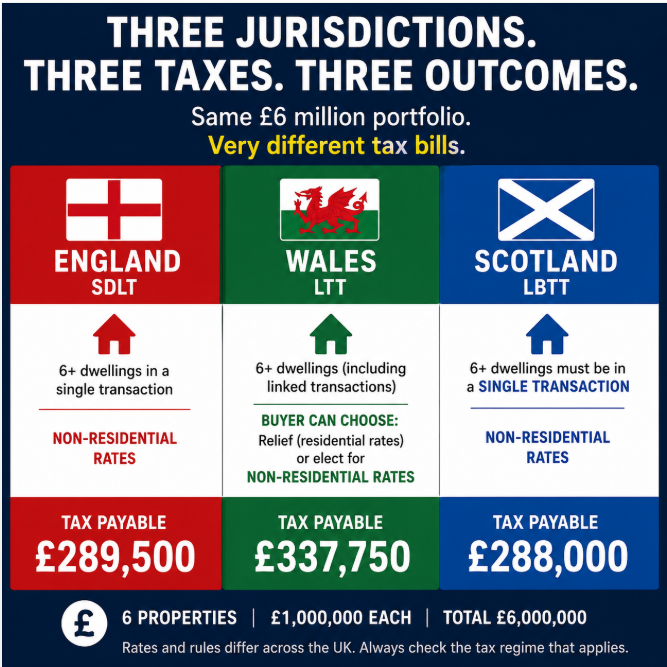
Where six or more dwellings are purchased in a single transaction, all three jurisdictions provide a mechanism for the purchase to be treated as non-residential rather than residential.
That sounds simple enough, until you compare the figures.
Assume six residential properties are purchased for £1 million each, making the total consideration £6 million.
Under the current rules the tax payable would be approximately:
| Jurisdiction | Tax payable |
|---|---|
| Scotland | £288,000 |
| England | £289,500 |
| Wales | £337,750 |
The Welsh tax bill is almost £50,000 higher than England’s, despite the portfolio and purchase price being identical.
The rules aren’t identical either
The differences extend beyond the tax rates themselves.
England generally allows linked transactions to be aggregated, meaning several linked purchases can qualify for non-residential treatment where they comprise six or more dwellings.
Wales has a similar approach, although purchasers may also have the option of electing for non-residential treatment or using Multiple Dwellings Relief, depending on which produces the better outcome.
Scotland is more restrictive. Simply buying six dwellings through linked transactions is not necessarily enough. The legislation generally requires the six dwellings to form a single transaction before non-residential treatment becomes available.
For advisers acting on UK-wide portfolio acquisitions, understanding these distinctions is essential.
What happens if the properties are spread across the UK?
Suppose an investor purchases:
- two properties in England,
- two properties in Wales,
- two properties in Scotland.
Many people assume that six properties should trigger the “six or more dwellings” rules.
They don’t.
Each jurisdiction only taxes land situated within its own borders. England ignores the Welsh and Scottish properties. Wales ignores the English and Scottish properties. Scotland ignores the English and Welsh properties.
As a result, none of the three tax authorities sees six dwellings. Each only sees two.
England has another surprise for overseas investors
England also imposes an additional 2% SDLT surcharge on many non-UK resident purchasers of residential property.
Neither Wales nor Scotland has introduced an equivalent overseas purchaser surcharge.
This means that a Portuguese resident buying a £1 million buy-to-let property in England may pay an additional £20,000 simply because of their tax residence.
Curiously, where six or more dwellings qualify for non-residential treatment in England, that 2% surcharge generally falls away because it applies only to residential transactions.
In other words, an overseas investor purchasing a single property may pay more tax than another overseas investor purchasing an entire qualifying portfolio.
One country, three tax systems
These differences demonstrate how far property taxation has diverged since devolution.
From a constitutional perspective, the United Kingdom remains one country.
From a property tax perspective, it increasingly resembles three separate jurisdictions operating under their own rules.
For landlords, investors and professional advisers, assuming that “Stamp Duty” works the same everywhere can prove to be an expensive mistake. Before exchanging contracts on any substantial acquisition, particularly one involving multiple properties or cross-border portfolios, it is worth checking which tax regime actually applies. The answer may not be the one you expect.
BOOK A CONSULTATION
1 comment on this article
Learn from your peers’ experience
A different perspective could help you spot an issue, avoid a mistake or find a better way forward. Read the comments and add your own views if you wish.


Member Since June 2026 - Comments: 8
3:20 PM, 25th June 2026, About 4 months ago
The ‘six properties’ framing is apt – that’s roughly where serious portfolio territory begins. From the UK ownership data I track, only 32,961 active freehold-owning companies (about 8%, or 1 in 12) actually hold six or more freeholds, so genuine multi-property buyers are a small, concentrated group – and they’re exactly the ones for whom the England vs Scotland vs Wales tax differences compound across a whole portfolio rather than a single purchase. At that scale jurisdiction isn’t a detail, it’s a portfolio-level decision: the same six properties can carry materially different total tax depending on where they sit. – Dror