



Government’s Right to Rent consultation draws CIH criticism
9:17 AM, 7th May 2026, 2 months ago
9
Categories:
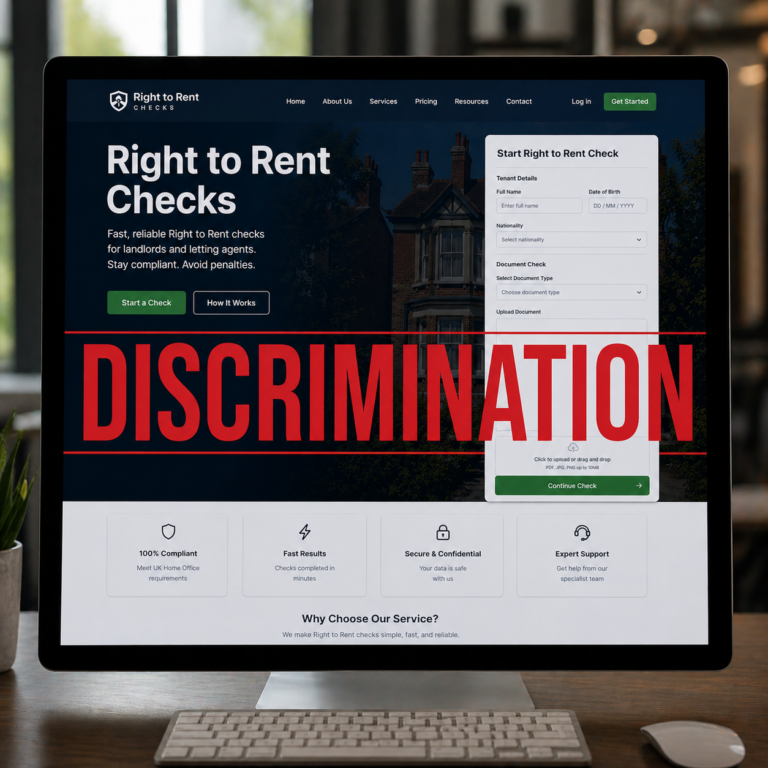
A government consultation to tighten Right to Rent (RtR) checks, has led the Chartered Institute of Housing (CIH) to declare that revisions to the code would not address deeper issues within the policy.
It said it “welcomes the updated code of practice, but we have serious reservations about right to rent checks and their discriminatory effects, which will not be remedied by an updated code”.
Government proposals for the RtR state that prospective tenants must not be treated unfairly if they choose a different method of completing checks than a landlord or letting agent prefers.
The rules, brought in under the Immigration Act 2014, require immigration status checks before a tenancy begins in England.
Landlords and letting agents have until 29 April to respond to the consultation.
CIH opposes RtR
The organisation said it had opposed the policy at its introduction and has continued to do so.
It referred to Home Office research from the pilot phase, which identified discrimination before the wider rollout, alongside early evidence from the Joint Council for the Welfare of Immigrants.
That research includes findings from Generation Rent in 2022 showing that more than two in five migrant renters struggled to find a landlord or agent willing to let to them.
The 2024 Voice of the Landlord Survey found 56% of respondents who said they could not let to people without a UK passport attributed that to the risk of a civil penalty linked to compliance.
Separate research from 2023 into Ukrainian refugees found more than half had difficulty securing a landlord or letting agent due to their status, despite public messaging confirming their right to remain.
Landlords are unaware
CIH said this was “only a snapshot of evidence of problems faced by migrants, and by non-White applicants more generally, in the private rented sector”.
It added that “a code of practice is of little use if landlords are unaware of it or ignore it, as many are or do”.
It said landlords can overlook applicants presenting non-UK documentation without making explicit refusals, particularly where demand is strong.
The organisation also pointed to the Renters’ Rights Act, which will make discrimination based on benefits or having children unlawful, with civil penalties of up to £7,000.
The Chartered Institute of Housing also noted that ministers have powers to extend protections further and said immigration status could be included for those with permission to remain.
The organisation also called for new research into the code’s effectiveness, alongside wider analysis of discrimination linked to compliance and penalties.
It said it would be willing to contribute to the research.
Tags:
cih, discrimination housing, immigration checks, landlord checks England, Private Rented Sector, Renters’ Rights Act, right to rent
Comments
Have Your Say
Every day, landlords who want to influence policy and share real-world experience add their voice here. Your perspective helps keep the debate balanced.
Not a member yet? Join In Seconds
Login with
or
Previous Article
UK rents climb again in AprilRelated Articles

Rents set to rise as landlord risks grow
2 months ago | 1 comments

Exclusive: Propertymark warns Renters’ Rights Act will force landlords to rethink
2 months ago | 1 comments
Member Since June 2019 - Comments: 885
9:04 AM, 7th May 2026, About 2 months ago
Make eviction automatic for those who reach the end of their visa and we will happily accept such people. With the current certainty of difficult and expensive court proceedings facing paid for lawyers why would we take that option?
Member Since October 2023 - Comments: 231
10:41 AM, 7th May 2026, About 2 months ago
The government are trying to force landlords to accept tenants who are higher risk.
The only consideration for landlords should be the risk/reward ratio.
Let the government supply housing on socialist principles, USING THEIR OWN MONEY.
Member Since March 2022 - Comments: 377
10:42 AM, 7th May 2026, About 2 months ago
Being a landlord is risky enough with yet more risks in the pipeline to worry about. There are over a hundred ways you can slip up and incur the inevitable huge fine that seems to be de rigueur for everything landlord related these days Why are we expected to be half ar$ed, untrained and unpaid immigration officials? The Government know who the official immigrants are and should issue them with a Right to Rent certificate as part of their processing, that is held on a database that a landlord can easily check out for free. Any unofficial migrant will not have a certificate so a landlord’s choice is easy.
Of course, just to require migrants to prove their right to rent could be seen as discriminatory. Should it apply to everybody? A British passport is fine but what if you don’t have one? That’s when it could get more sticky. Of course compulsory identity cards could be a solution but that is another step towards a police state in my view.
Member Since July 2024 - Comments: 121
11:50 AM, 7th May 2026, About 2 months ago
I have a preference for Muslim or hard working S E Asians. They’ve made great tenants. But landlords should not be immigration police . Hopefully one year from now all my properties will be sold. I live in a place with ID cards and everything revolves around our ID’s including exiting the country, banking, phone contracts, health and hospitals. But then again I trust my government and we have more privacy here than in UK.
Member Since October 2024 - Comments: 217
3:27 PM, 7th May 2026, About 2 months ago
The 2 main government have thrown a lot of responsibilities, obligations, financial destruction, immigration checks etc on the landlord without the government paying anything or giving any incentive for the work they do for the tenants to give them a roof over their house plus ensuring the house is safe, compliant in everyway for very little returns. In this country labour costs are high and we cannot charge our labour costs to business, tenants or the government.
There is a lot of work involved and this stupid government officials, charities and other know it all companies don’t understand all the work that happens on the background to make it possible.
The financial costs, time, tension, headaches, insults from some tenants and uncooperative tenants makes, the small returns that the landlords get is not worth the effort.
They clearly do so for making tenants happy.
It will not take to long before next government completely change the dynamics.
This RRA type of reform with diabolical way of controlling immigration without any pay cannot work for too long.
Why don’t the home office do their work properly to dig out people who don’t have any rights to stay. Or pay landlord for checks done.
Home office personnel gets paid and the landlords have to tow the line and help the Home office.
In modern society it does make any sense.
Member Since October 2020 - Comments: 1258
3:51 PM, 7th May 2026, About 2 months ago
Reply to the comment left by Paul Essex at 07/05/2026 – 09:04
I’m not a fan of the R2R checks, but there is zero risk for a landlord who notifies the Home Office of the tenancy if a tenants visa is not renewed, and then follows the advice given, such as evicting under ground 7b.
Member Since August 2025 - Comments: 55
4:30 PM, 7th May 2026, About 2 months ago
At present big company investors may think oh its a lucrative business renting. Wait until they get few drinkers,anti social behaviour,updating properties in a weird way without informing the lanlords and when it becomes impossible to live they simply will vacate and move on to another to destroy again. And then the cost to put it right exceeds the value of property they will soon learn their lesson. What these organisations don’t understand it’s difficult to monitor what the subcontractors do plus administration costs. Smaller landlord could control the management better but they have been killed by the RRB by the control of thier assets has been taken away without any respect to even good landlords.canot understand how anyone can be allowed to rake control of someone else’s investment which is like someone ordering the house owner to get out of thier own residence .
Joe
Member Since June 2019 - Comments: 885
5:13 PM, 7th May 2026, About 2 months ago
Reply to the comment left by DPT at 07/05/2026 – 15:51
Any eviction causes cost and stress, I do not trust that section 7 eviction would be any less hassle.
Member Since October 2020 - Comments: 1258
9:07 PM, 7th May 2026, About 2 months ago
Reply to the comment left by Paul Essex at 07/05/2026 – 17:13
Theres a possibility of eviction with any tenant. In 18 years of housing mainly overseas tenants with short to medium term visas, Ive never had one for which this has been an issue. Not having their visa renewed means their employment contract also ends, so they dont wish to hang around with no income.