


Open Letter to the SNP: why did Scotland’s PRS stop growing?

8:51 AM, 16th March 2026, 3 weeks ago
8
Categories:
Housing debates in Britain often become ideological very quickly. Some argue that the private rented sector is part of the problem; others argue that it is part of the solution.
In reality, housing systems tend to be shaped by something far less dramatic than political narratives. They are shaped by supply, investment and incentives.
Scotland now provides one of the most interesting real-world policy experiments in housing regulation anywhere in the United Kingdom. Over the past decade, the Scottish Government has introduced some of the most ambitious rent regulation policies in Britain, including rent freezes during the cost-of-living crisis and proposals for longer-term rent control zones.
These policies were introduced with the intention of protecting tenants from rapidly rising housing costs. However, the question that now deserves attention is not ideological; it is empirical.
What has the evidence shown so far?
Scotland’s private rented sector expanded rapidly for two decades
Over the past twenty years, Scotland experienced a remarkable expansion in the private rented sector. According to Scottish Government housing statistics, the number of privately rented homes increased from roughly 120,000 in 1999 to around 370,000 by 2016. That expansion added more than 250,000 homes to Scotland’s housing supply.
The growth reflected several structural factors. Mortgage products designed specifically for rental property allowed individual investors to enter the housing market. Many landlords purchased neglected properties and renovated them for rental use. Others converted larger houses into shared accommodation or supported new developments by purchasing homes off-plan.
Taken individually, these decisions may appear small. Collectively, they represented a substantial addition to the country’s housing stock.
For almost two decades the private rented sector became an important part of how Scotland housed a growing and increasingly mobile population.
A change in trajectory
The trajectory becomes clearer when the figures are viewed together.
| Year | Private rented sector | Households in temporary accommodation | Policy context |
|---|---|---|---|
| 1999 | ~120,000 homes | ~4,000 households | PRS begins expanding rapidly |
| 2016 | ~370,000 homes | ~10,000 households | PRS reaches peak expansion |
| 2020 | ~340,000 homes | ~11,800 households | PRS begins contracting |
| 2025 | ~320,000 homes | 17,000+ households | Record pressure on temporary accommodation |
The trajectory of the sector appears to have changed. More recent figures suggest the number of privately rented households in Scotland has declined from its peak, falling to roughly 320,000 by the early 2020s. Landlord registrations have also declined over the same period. At the same time, the wider housing system has come under increasing strain.
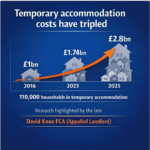
Temporary accommodation use has risen sharply in recent years. Official statistics show that roughly 11,800 households were living in temporary accommodation in Scotland in 2020. By 2025 that figure had risen to more than 17,000 households, the highest level recorded.
More than 10,000 children are now growing up in temporary accommodation while councils struggle to find permanent housing.
These figures do not in themselves prove causation. Housing markets are complex and influenced by many factors, including interest rates, construction costs and demographic change. However, the change in trajectory raises a question that policymakers may need to examine carefully.
For nearly two decades Scotland’s private rented sector expanded rapidly. Since the mid-2010s it has begun to contract.
What explains that change?
The wider context of Scotland’s housing system
To understand this question properly, it is necessary to consider the longer historical context.
In 1980 Scotland had roughly 700,000 council homes. Today that figure is closer to 320,000.
The loss of nearly 380,000 social homes over several decades represents one of the largest structural shifts in Scotland’s housing system.
During roughly the same period the private rented sector expanded significantly, helping to provide accommodation for households who might once have lived in social housing.
Understanding how these two trends interact is essential for housing policy.
If the supply of social housing declines while private investment in rental housing also slows, pressure on the housing system inevitably increases.
Policy changes affecting the sector
Over the past decade Scotland has introduced several major policy reforms affecting the private rented sector.
- The Private Housing (Tenancies) (Scotland) Act 2016, which introduced new tenancy structures and rent pressure zone powers
- Additional regulatory requirements affecting landlords and letting agents
- The emergency rent freeze and subsequent rent caps introduced during the cost-of-living crisis
- Proposals for longer-term rent control mechanisms
Each of these policies was introduced with understandable objectives, including protecting tenants and improving housing security. However, policies that affect rental income and investment returns inevitably influence the behaviour of investors who provide housing.
Housing supply in the private rented sector ultimately depends on private capital. When investors believe the regulatory environment is predictable and sustainable, investment tends to flow into housing. When that environment becomes more uncertain, investment decisions can change.
Taxation and investment incentives
Housing investment is influenced not only by regulation but also by taxation policy.
In Scotland, investors purchasing additional residential property pay the Additional Dwelling Supplement, currently set at 8%, which is higher than the equivalent surcharge applied in England.
Scottish landlords are also affected by the distinct Scottish income tax structure, alongside the UK-wide restrictions on mortgage interest relief introduced in recent years.
Individually these policies may have been introduced for understandable fiscal reasons. Taken together, however, they raise an important question about incentives.
If increasing housing supply requires sustained private investment, how do current taxation and regulatory policies influence the willingness of investors to finance rental housing in Scotland?
The central policy question
Housing shortages ultimately come down to one simple problem. There are not enough homes available for the number of households who need them. The question facing policymakers is therefore not simply how rents behave in the short term, but how housing supply evolves over time.
For almost twenty years Scotland’s private rented sector expanded rapidly, adding hundreds of thousands of homes to the housing system. In recent years that trajectory has changed.
The number of privately rented homes has begun to fall, temporary accommodation use has reached record levels, and councils are struggling to house vulnerable families.
If Scotland wishes to increase housing supply, one question now deserves careful attention.
Why did the private rented sector stop expanding?
Questions for the Scottish Government
In the spirit of constructive policy discussion, several questions may be worth examining.
What factors explain the contraction of Scotland’s private rented sector after its peak in the mid-2010s?
How has the Scottish Government assessed the impact of rent regulation policies on housing investment and supply?
What evidence exists regarding the long-term effects of rent freezes and rent caps on housing availability?
How do taxation policies affecting landlords influence investment decisions within the housing market?
If Scotland wishes to increase housing supply, what role should private investment play alongside social housing development?
A policy challenge worth answering
If Scotland wishes to increase housing supply, the country faces a straightforward but important policy question. Over several decades the number of social homes declined significantly. During roughly the same period the private rented sector expanded, helping to provide housing for hundreds of thousands of households.
In recent years that trajectory has begun to change. The private rented sector appears to be contracting, while the number of households living in temporary accommodation has reached record levels. This raises a question that goes beyond ideology or political preference.
If Scotland needs more homes, what conditions will encourage the investment required to provide them?
A shared objective
Landlords, tenants, housing charities and policymakers should ultimately share the same goal.
Scotland needs more homes.
Increasing housing supply will require contributions from several sources, including social housing construction, private development and individual investment in rental property.
If policymakers wish to expand housing availability, understanding the incentives that drive housing investment may be just as important as regulating rents.
Scotland’s housing policies have effectively created a real-world experiment.
The evidence emerging from that experiment may now be one of the most valuable guides for future housing policy.
This discussion echoes the work of the late David Knox FCA, who wrote for Property118 under the pseudonym Appalled Landlord. David spent years analysing housing statistics and policy trajectories, often highlighting patterns that were not yet widely recognised in public debate. Several of his articles examined how changes in regulation, taxation and investment incentives could reshape the housing system over time. David passed away in 2020, but revisiting the questions he raised now provides a useful starting point for examining how Scotland’s housing policies are affecting supply today.
Invitation to respond
If the Scottish Government, relevant ministers or housing organisations wish to respond to the questions raised in this article, Property118 would be pleased to publish that response in full.
Constructive debate about housing policy is long overdue.
What keeps Property118 independent?
More than 3 million monthly Google search impressions now direct landlords towards our reporting and discussions.
We have created a new page explaining how readers help protect that independence and keep the platform focused on outcomes, not agendas.
Tags:
Additional Dwelling Supplement Scotland, housing supply Scotland, landlord regulation scotland, Private Rented Sector Scotland, property investment Scotland, rent control Scotland, renters rights debate, Scotland Housing Policy, Scottish housing crisis, temporary accommodation Scotland
Comments
Have Your Say
Every day, landlords who want to influence policy and share real-world experience add their voice here. Your perspective helps keep the debate balanced.
Not a member yet? Join In Seconds
Login with
or
Related Articles

Open Letter to the SNP: why did Scotland’s PRS stop growing?
3 weeks ago | 8 comments
Member Since June 2020 - Comments: 36
10:39 AM, 16th March 2026, About 3 weeks ago
Brilliant article. If the Scottish Government and Shelter really want to be objective and correct the flow of investment which will benefit them and the tenants, they will reply in certain and concrete terms.
Member Since May 2017 - Comments: 763
11:06 AM, 16th March 2026, About 3 weeks ago
You would make a much better housing minister than the idiots we’ve had in the last 15 years – unless its all part of their greater plan to get rid of all of us to clear the way for the likes if blackrock. In which case they’re achieving their target extremely well
Member Since October 2023 - Comments: 201
12:59 PM, 16th March 2026, About 3 weeks ago
Another factor that is not even mentioned, is the loss of tax revenue along with the reduction in the PRS.
People often say “well the houses didn’t go away, they were transferred into owner occupier”
Yes its true, the properties didn’t go away, but the tax revenue from the landlords for those properties did!
Not as a one-off, but year after year of missing revenue.
Member Since June 2020 - Comments: 36
1:02 PM, 16th March 2026, About 3 weeks ago
Reply to the comment left by JB at 16/03/2026 – 11:06
John Lewis have already stepped down and probably others will too as landlording is a difficult and intensive job. People who take on this market get to understand as JL have found.
Member Since December 2023 - Comments: 1573
2:34 PM, 16th March 2026, About 3 weeks ago
Since 2016, Scotland has seen approximately 170,000 new properties built. The population has increased by a broadly similar number.
So, why are there so many people in temporary accommodation?
My theory is,
1. More tenants are likely to remain in homes that are larger than their immediate needs – because the PRS is shrinking and they cannot downsize.
2. Landlords are selling and some former rental properties are moving to owner occupied. Owner occupied are the homes that are most likely to have empty bedrooms.
3. Some former rental properties have switched to holiday lets. This saves the owners having to pay CGT.
We are already seeing a similar trend in England. I think it will get much worse.
When private landlords start to get disproportionately penalised by the Local Authority for minor errors of admin, other landlords will take note.
In all this, it is the tenants that suffer the most. I don’t think an Act of Parliament has ever been so poorly named as the Renters Rights Act.
Member Since January 2024 - Comments: 340
8:19 PM, 16th March 2026, About 3 weeks ago
The tax benefits of Furnished Holiday Lettings have pretty much been removed since 5/4/25, including CGT benefits.
Member Since November 2016 - Comments: 99
8:20 PM, 22nd March 2026, About 2 weeks ago
Being a landlord in Scotland is a bit like when Side show Bob stands on the rakes.
The additional dwelling supplement is too high and should be cut to 5%.
The First tier tribunal is under funded and has not kept up with the increase in regulation.
Section 24 Tax needs to be abolished.
The plan to ban rent increases between tenancies needs to be removed.
Recognition that Rent controls leading to new tenants subsidising older tenancies needs to happen.
Member Since May 2018 - Comments: 1996
11:40 AM, 23rd March 2026, About 2 weeks ago
Whilst I don’t live in Scotland I know a few landlords who live in Scotland or have lived in Scotland. Some are ‘accidental’ landlords who happen to have become landlords for family reasons rather than as any deliberately thought through ‘investment’ strategy. And other Scottish landlords I know who live in Scotland but are investing in residential property have deliberately chosen to invest in residential accommodation in England over the last ten years because of repeated attacks by the SNP on residential property in Scotland. Seeing the writing on the wall from the SNP, one of the Scottish landlords I know divested himself of his residential property portfolio in Scotland and moved to England.
Whether the Renters Rights Act will make any difference to the balance of the attractiveness of an investment in residential property in Scotland or elsewhere in the UK vs. some other investment I don’t know. Some of those Scottish landlords might choose to invest in commercial property instead.
But I don’t see the ‘logic’ of making investment in residential property unattractive if you have a lot of people in temporary accommodation.