


How much are councils spending on temporary accommodation? The numbers are staggering!
9:50 AM, 20th March 2026, 3 weeks ago
4
Categories:
Temporary accommodation is often described as a short-term solution. In practice, it has become one of the fastest-growing costs in the entire housing system.
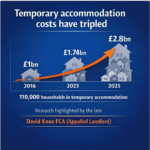
Across England alone, councils are now spending around £2.8 billion a year on temporary accommodation. Just a few years earlier, the total was far lower. In simple terms, spending has more than doubled within a decade. That money is not being spent building new homes; it is being spent managing the consequences of housing shortages, and the scale of the increase raises a question that deserves careful attention.
Where exactly is the money going?
The fastest-growing cost in local government
Temporary accommodation is provided by councils when households qualify for help under homelessness legislation. It can include bed and breakfast accommodation, hotels, hostels, privately rented properties secured on short-term contracts and nightly paid emergency accommodation. Many of these options are significantly more expensive than standard housing.
Recent figures suggest that a substantial share of total spending is now absorbed by the most expensive forms of emergency accommodation, including hotels, hostels and nightly paid placements.
For families placed in these properties, the situation can be extremely difficult. For councils trying to balance budgets, the financial impact is enormous.
The trajectory since 2016
The trend becomes much clearer when the figures are viewed together.
| Year | Estimated spending on temporary accommodation | Context |
|---|---|---|
| 2016 | ~£1.2 billion | Rising pressure begins attracting wider attention |
| 2020 | ~£1.6 billion | Temporary accommodation use continues to grow |
| 2023 | ~£2.3 billion | Councils warn of escalating financial pressure |
| 2025 | ~£2.8 billion | Temporary accommodation becomes a major fiscal burden |
Viewed over a longer period, the scale of the increase is hard to ignore. What was already a serious cost in 2016 has since become one of the most expensive symptoms of housing shortage in Britain.
A chart that tells the story quickly
The numbers are easier to understand when set against the underlying housing pressure.
Scotland’s housing pressure indicators
| Indicator | Mid-2010s | Latest figures |
|---|---|---|
| Private rented homes | ~370,000 | ~320,000 |
| Households in temporary accommodation | ~10,000 | 17,000+ |
| Children in temporary housing | ~6,000 | 10,000+ |
| Council spending on temporary accommodation | Rising | £100m+ annually in Scotland |
The pattern is difficult to miss; as pressure in the wider housing system has increased, temporary accommodation use and public spending have increased with it.
London: the epicentre of spending
London boroughs are now spending millions of pounds every day on homelessness services and temporary accommodation. In several boroughs, annual spending on temporary accommodation alone has exceeded £100 million. That means money that might otherwise support core local services is being redirected into emergency housing costs. It also highlights something uncomfortable about the current model.
Large sums of public money are now being spent managing the consequences of housing shortages, rather than increasing housing supply itself.
England is not alone
Scotland faces the same underlying problem. Temporary accommodation in Scotland has reached record levels. More than 17,000 households are now living in temporary housing, including over 10,000 children. At the same time, Scottish councils are spending more than £100 million a year on hostels, hotels and related emergency accommodation.
This matters because it shows that the rise in temporary accommodation is not simply a local administrative issue. It reflects structural pressures across the housing system.
Where supply fails to keep pace with demand, the result is almost always the same; more households end up in temporary accommodation.
The warning that appeared years earlier
For long-time readers of Property118, this pattern may sound familiar. Several years ago, David Knox FCA, writing under the pseudonym Appalled Landlord, examined what looked at the time like an unusually sharp rise in one city.
Manchester City Council’s spending on temporary accommodation had increased from roughly £2.25 million to almost £13 million in just five years.
At the time, the increase looked extraordinary, today, it looks more like an early warning. Across Britain, councils are now experiencing the same broad pattern: rising housing pressure, rising emergency placements and rapidly escalating costs. What appeared to be a local anomaly in Manchester has become a national trend.
The councils spending the most
When spending is broken down by region, certain areas stand out immediately. Large metropolitan authorities and London boroughs tend to face the highest costs because they combine high housing demand with limited supply and very expensive short-term accommodation options. Authorities such as Newham, Westminster, Birmingham, Manchester, Lambeth and Camden are regularly cited among the highest spenders. In some cases, individual councils are now spending more than £100 million a year on temporary accommodation alone.
The deeper policy question
Temporary accommodation spending tells us something important about the housing system; it represents the cost of housing shortages after they have already occurred.
When housing supply expands, fewer households require emergency accommodation. When supply contracts, the pressure appears first in waiting lists, then in homelessness services, and eventually in temporary accommodation budgets. That is why the rise in temporary accommodation costs should be seen not simply as a financial issue, but as a structural indicator of housing supply pressure.
A question worth asking
Over the past decade, governments across Britain have introduced a wide range of housing policies.
- Taxation changes affecting landlords
- Regulatory reforms in the private rented sector
- Rent regulation experiments in some parts of the UK
- Ambitious housebuilding targets
At the same time, councils are now spending billions of pounds each year on temporary accommodation.
The obvious question therefore becomes this: Are housing policies increasing supply, or simply increasing the cost of managing shortages?
What keeps Property118 independent?
More than 3 million monthly Google search impressions now direct landlords towards our reporting and discussions.
We have created a new page explaining how readers help protect that independence and keep the platform focused on outcomes, not agendas.
Comments
Have Your Say
Every day, landlords who want to influence policy and share real-world experience add their voice here. Your perspective helps keep the debate balanced.
Not a member yet? Join In Seconds
Login with
or
Related Articles

Open Letter to the SNP: why did Scotland’s PRS stop growing?
4 weeks ago | 8 comments

An open letter to Shelter Scotland
4 weeks ago | 31 comments
Member Since April 2018 - Comments: 365
10:29 AM, 20th March 2026, About 3 weeks ago
That’s why they needed to raise the extra tax and fines from landlords.Talk about rubbing your face in it. Who are all these people that actually need temporary accommodation! Wouldn’t it have been better all around to have treated landlords kindly and they might have solved the problem, instead the tax payer suffers.
Member Since January 2016 - Comments: 235
11:49 AM, 20th March 2026, About 3 weeks ago
It’s not a coincidence that these numbers started shooting up just as S24 started to kick in. My argument to my completely useless faux Tory MP at the time was just this – if the cost of a tax (temp housing) is greater than the tax-take itself then why impose such a tax. Spreadsheet Phil was in No 11 at the time but obviously the inconvenient truth didn’t figure in his reasoning.
Member Since April 2023 - Comments: 88
10:11 AM, 22nd March 2026, About 3 weeks ago
Having previously worked for a number of local authorities housing and homelessness teams, I witnessed first hand the effect that a number of housing policies and reform of welfare benefits especially the cap on local housing allowance ( housing benefit) has had on the increased numbers of homeless households and the astronomical costs of temporary accommodation provision.
I also witnessed the often adversarial and negative attitude towards private sector landlords from housing options , which quite frankly stunned me!
It has been clearly evident for the last two decades at least, how important our private landlords are in the provision of accommodation, therefore you would think that local authorities would be positively courting them by for example, ensuring they host regular landlord forums to address any concerns and offering financial incentives to landlords to work with the council.
In my experience, the councils which had a positive and progressive attitude and working relationship with private landlords and proactive housing options teams, managed their temporary accommodation needs and budgets better than those without!
There needs to be greater scrutiny of the administration of local authorities Housing teams and their statutory compliance and provision of public services ,especially housing options, temporary accommodation and private sector housing teams….
Member Since April 2018 - Comments: 365
11:07 AM, 22nd March 2026, About 3 weeks ago
Reply to the comment left by Ma’at Housing Solutions at 22/03/2026 – 10:11
Do please send your experience to your local MP or even a newspaper. My MP, a Lib Dem seems to have a hostile view to all private landlords which I can not understand.