



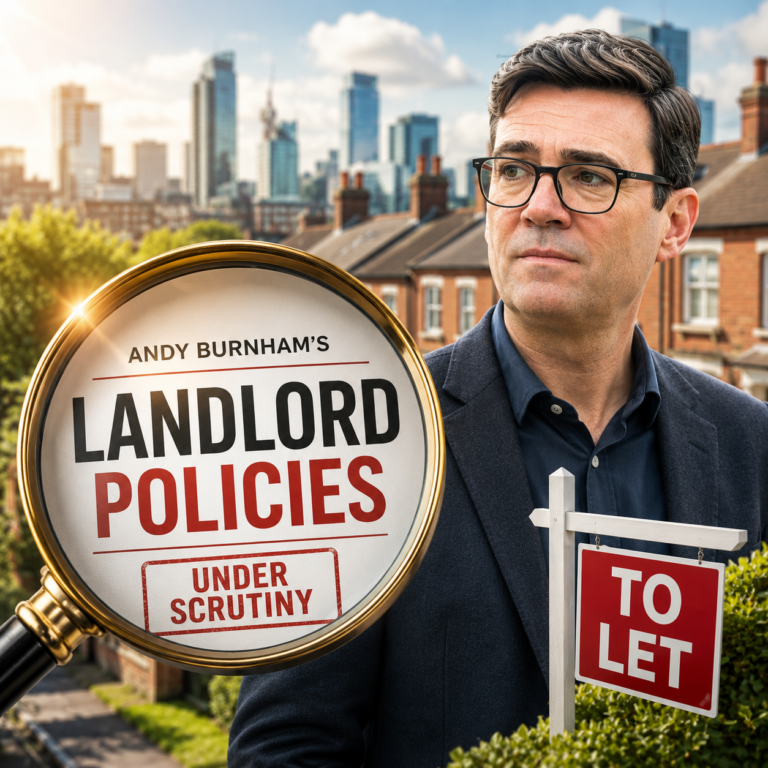
Andy Burnham’s landlord policies under scrutiny
9:26 AM, 21st July 2026, 3 months ago
4
Categories:
Landlords face renewed questions over rent controls, licensing and property standards after Andy Burnham entered Downing Street.
The government’s new prime minister replaced Sir Keir Starmer after becoming Labour leader last week, making him the seventh person to hold the office since 2016.
In his first Downing Street speech, Mr Burnham announced that he would ‘end rough sleeping in our country’, with ministers planning to move people who have slept rough for long periods into secure housing.
The initial measures include the ‘acquisition of suitable homes’, although no further detail was provided on where the properties would come from or how the programme would operate.
No details yet
Conservative shadow housing secretary Sir James Cleverly said there was ‘precious little detail’ about how the policy would be funded.
He also questioned whether money had been taken from other projects to meet the cost.
Sir James said: “In Manchester, Burnham promised to end rough sleeping, but failed because he didn’t do the hard work necessary.
“Now, again, he is making pledges without any plan for delivery.”
More council homes
Mr Burnham has also promised to build more council homes, and while campaigning to become mayor of Greater Manchester in 2016, he pledged to bring in rent controls.
He needed permission from Westminster to do that and in February 2023, he signed an open letter calling on for an immediate freeze on private sector rents until the cost-of-living crisis had ended.
Mr Burnham returned to the subject in his first speech as Labour leader on Friday.
He said the sale of council homes had left ‘the country chasing rents in the private rented sector through the benefits system’.
Good Landlord Charter
Licensing has formed another part of his approach to the sector and during his 2016 mayoral campaign, he blamed Westminster for creating an ‘unregulated private rented sector’.
He has previously proposed a ‘three warnings and you’re out’ system for landlords who fail to provide good-quality housing.
Under the proposal, the government could use compulsory purchase orders to acquire properties where owners refuse to complete required improvements.
Greater Manchester’s Good Landlord Charter was also introduced during his tenure as metro mayor.
The scheme was designed to set standards for landlords and letting agents operating across the region.
Reaction from the housing sector to Prime Minister Andy Burnham
Ben Beadle, the chief executive of the National Residential Landlords Association, writing on the organisation’s website, said: “Having worked closely with the new PM it is clear he has a personal, and seemingly genuine, interest in housing and property standards.
“He also demonstrates a pragmatism and, dare I say it, a flexibility in terms of his approach.”
He added: “The proof will be in the pudding, but rest assured we will continue to represent your interests Westminster and beyond when Parliament returns after the summer recess.”
Nathan Emerson, the CEO of Propertymark, said: “Over the coming months, it will be essential that the sector has a clear opportunity to engage with the UK Government on key housing issues, helping to ensure that the manifesto commitment to deliver 1.5 million homes across England becomes a reality.
“Looking at the bigger picture, a diverse housing mix must be delivered with a regional focus and supported by robust local infrastructure.
“Building homes is the challenge; building well-designed, functional communities must be the goal.”
Justin Young, the chief executive officer of the Royal Institution of Chartered Surveyors, said: “We look forward to working constructively with his government, bringing our standards, data and professional expertise to support practical reform across housing, infrastructure and the built and natural environment.
“The new Prime Minister takes office at a critical time for the built and natural environment.
“Increasing the supply of quality affordable homes, strengthening infrastructure, and supporting the transition to a lower-carbon economy will require stable, long-term and evidence-led policymaking.”
Nick Leeming, the chairman of Jackson-Stops, said: “Andy Burnham takes office having placed housing firmly at the top of his agenda.
“Building more homes is essential, but the health of the market also depends on helping existing homes circulate more freely, so that more people can make the move that is right for them.
“Our latest research suggests that removing stamp duty costs could bring more than 300,000 owner-occupied homes onto the market across England within less than a year.”
Vanessa Hale, the chief executive of Real Estate:UK, said: “Bringing forward the new housing and modern workplaces this country needs also takes a long time – too long.
“Mr Burnham will know from his time in charge of Manchester that creating a positive climate for investment results in more development, economic growth and jobs.”
Tags:
Andy Burnham landlords, council homes, Landlord Licensing, Private Rented Sector, rent controls, rough sleeping
4 comments on this article
Learn from your peers’ experience
A different perspective could help you spot an issue, avoid a mistake or find a better way forward. Read the comments and add your own views if you wish.

Member Since May 2018 - Comments: 2550
10:06 AM, 21st July 2026, About 3 months ago
The Governor of the Bank of England has recently warned Andy Burnham that he needs to grow the economy. Of course, if you don’t grow the economy you don’t have enough money for defence. When you are the mayor of a regional city you learn that it is essential for your city to attract investment. You need to look attractive….somewhere where investors are going to want to invest their capital, knowing that it is a safe place and isn’t going to be attacked.
If the government wants more housing then it has to pay for it, somehow, or find investors to invest their capital in it. Where’s the government going to get all that new money for council houses? And anyway, where is the evidence that investing money in your council is the most efficient and effective way to provide social housing?
When you invest in residential property you do it because historically it has been a safe place for your capital. The after tax returns are poor and its saving grace has been that over time there is the advantage of a capital gain. I watched Andy Burnham’s speech on Channel 4 last night. He has talked about growth in every postcode. But there was no word of ‘how’ this was going to be achieved. Most of the employment in this country is in small business and you don’t get economic growth by attacking small business, as the labour government has done over the last two years. He also talked about ending rough sleeping….but I don’t remember him saying anything significant about getting economic growth, or about defence spending.
Clearly, Andy Burnham wants to spend money (that should be spent on defence) although there was no discussion of where it was going to come from. Neil Kinnock came on and suggested he would get the money by equalising capital gains tax with income tax. One of the things that socialist chancellors and labour leaders never get is that they destroy incentive. But they don’t just destroy incentive they also destroy investor confidence…and when they destroy investor confidence they make market delivery less likely and cause their own failures to be more acute.
I heard this morning that Angela Rayner has just been made housing secretary.
Member Since January 2023 - Comments: 343
8:15 PM, 21st July 2026, About 3 months ago
Reply to the comment left by Beaver at 21/07/2026 – 10:06
Burnham narrative is just simply cost of living crisis management NOT growth management so he will demand PRS undergoes rent freeze until Cost of living crisis vanishes. Which it never will so we are stuffed with extended year on year rent freezes and as LLs we will stop investing full stop as they did in Scotland. Even BTR stopped developments. Pennyflop is a yes man so while he said rent controls never worked he will change his tune and say rent freezes DO work as he is ambitious so will want to make a mark on Burnham.
Member Since October 2024 - Comments: 234
10:54 PM, 21st July 2026, About 3 months ago
The article says:
“Under the proposal, the government could use compulsory purchase orders to acquire properties where owners refuse to complete required improvements.”
Why would any landlords refuse to complete improvements?
Only if the rents are low or frozen in the futture. Landlords do have to pay mortgage interest, compliance certificates and usual maintenance work.
Is a large expense like improving EPC etc always doable?
Some other costs the government may ask by way of improvements.
Then there may be mass exodus.
The compulsory purchase orders sounds like discounted properties from the forced to sell properties from landlords.
This is communism. Some social tenants living in PRS properties expectation are very high. Already have eyes on purchasing properties from the landlord at a discount with the help of the council.
Like my new tenant asked when he came to pick up the keys a series of questions like
How much is the property?
What mortgage have I got?
Would I give him money to buy? I said he can ask the bank, he said being a muslim he cannot pay interest, but if I give him money, he will pay it back.
I said that first he needs to start paying me rent. It is to be arrears, so I have to wait a month. Secondly, I dont have any money as I need the money and have a large family, who needs the money so if I sell, the money is for me and my family.
We have to sell our place and try and move into that house within 2 years, Thats the plan.
Member Since May 2018 - Comments: 2550
10:05 AM, 22nd July 2026, About 3 months ago
Reply to the comment left by Tiger at 21/07/2026 – 22:54
The really big question for me about Andy Burnham for the moment is “…what did he learn while being mayor of Manchester.” In February Andy Burnham appeared on a Guy Martin television programme where they retrofitted a two-bed semi-detached house in Stretford, Greater Manchester.
https://www.passivhaustrust.org.uk/news/detail/?nId=1546
They spent a massive amount of money gutting the house and retrofitting it in proportion to the value of the house itself, but despite doing that they still didn’t meet the standard they were seeking to meet. So Andy Burnham ought to know that retrofitting houses is very expensive indeed and that it far exceeds the government’s estimates of what it’s going to take to move houses from EPC Band D to Band C. And unless he’s an idiot he must also know that the only way you can service the extra investment is to put the rent up.
But what else did he learn? Was he listening to all those North Western businesses struggling with their business rates and Rachel Reeves increases to employers national insurance? Was he listening to the North Western businesses wanting to grow, but brought down by Rachel Reeves’ last two budgets? Was he listening to those North Western landlords telling him that they have no powers to tackle anti-social behaviour? Does he understand that cities, markets and businesses want to grow and can, but only if they aren’t penalised for investing and a socialist government takes its foot off their necks?
Andy Burnham must have learned in Manchester that regional cities depend upon being attractive to investors and investment. It’s no different to being a country, especially if you are trying to persuade the international money markets to buy your debt. He clearly already understands we need to spend more money on defence and he also clearly understands that he will spook the money markets if he spends more in interest than he takes in tax revenues.
But does he actually understand that if attacks assets and causes a collapse in their value then he will further stimulate the flight of capital, an economic collapse and a catastrophe?
If Andy Burnham is not an idiot then he’ll have heard the Governor of the Bank of England’s warning that he’s got to get economic growth. And again, if he’s not an idiot then he’ll realise he doesn’t have the money he needs to build all those council houses; the only way the housing crisis can be resolved is if he and his government don’t attack investors for investing in housing.
So we start Andy Burnham’s premiership hoping that he’s not actually an idiot who doesn’t learn, that he’s realised that cities, countries and governments depend upon investor confidence. And one of the first things he does is put Angela Rayner in charge of housing.
So there’s your next set of questions. What did Angela Rayner learn about buying her council house, allowing other people to live in it, then selling it as her principle private residence? What did Angela Rayner learn from buying her £800,000 flat in Hove and her £40,000 unpaid stamp duty tax bill? Did she realise just how difficult and complicated the tax system is? Having admitted her error in September 2025 did she then begin to understand and learn something about what it takes to invest in housing? Did she finally realise that she isn’t going to build 1.5 million new homes if the government keeps attacking investors, and that she hasn’t got enough money to build lots of council houses?
There are lots of unanswered questions because Andy Burnham has been avoiding answering questions from the media. For me though, the appointment of Angela Rayner as housing secretary is a really odd choice, unless he only wants her there to reverse right-to-buy.