

Efficiency You Can Measure, What Greening a Website Taught Us About Energy Standards
 by Dave Fuller
Efficiency You Can Measure: What Greening a Website Taught Us About Energy Standards
By Dave Fuller, Managing and Technical Director, Accent Design Group Ltd
For more than fifteen years, we at Accent Design have built and maintained the Property118 website. We created the brand, developed the site and the internal software that runs behind it, and we look after it every day. Over that time one principle has held firm: efficiency is not a one-off project, it is a habit. That thinking recently led us to move Property118 onto a fully sustainable, renewable-powered host, and to start measuring the site’s energy use and page weight in earnest.
What follows is an honest account of what we did, what the numbers now show, and why it matters to you as a landlord far beyond the technicalities of web hosting. Because the discipline behind a lean, efficient website is precisely the discipline the law is now asking you to apply to your properties.
Why a website has an energy footprint at all
It is easy to think of a website as weightless. It is not. Every page a visitor loads has to be stored, served and transmitted, and all of that draws electricity, from the data centre through the network to the device in your hand. A heavier page, one bloated with oversized images, unnecessary code and sluggish scripts, uses more energy every single time it loads. Multiply that across tens of thousands of visits and the footprint becomes real.
We wrote about this in more detail in our article The Environmental Cost of Digital, but the short version is this: a faster website is almost always a greener website, and a greener website is almost always a faster one. The two goals pull in the same direction, which is rare and worth taking advantage of.
What we actually did, and what the numbers show
The first move was to migrate Property118 to a host running entirely on sustainable energy. The second was to keep reducing the download weight of the site so that each page does more with less.
We do not ask you to take the results on trust. Two independent tools tell the story.
On performance, GTmetrix (tested 18 July 2026) awards the Property118 homepage an overall Grade A, with a Performance score of 96% and a Structure score of 95%. The Core Web Vitals, the measures Google uses to judge real-world experience, are strong across the board: a Largest Contentful Paint of 1.4 seconds, a Total Blocking Time of just 25 milliseconds, and a Cumulative Layout Shift of 0, meaning the page stays put as it loads rather than jumping around under your finger.
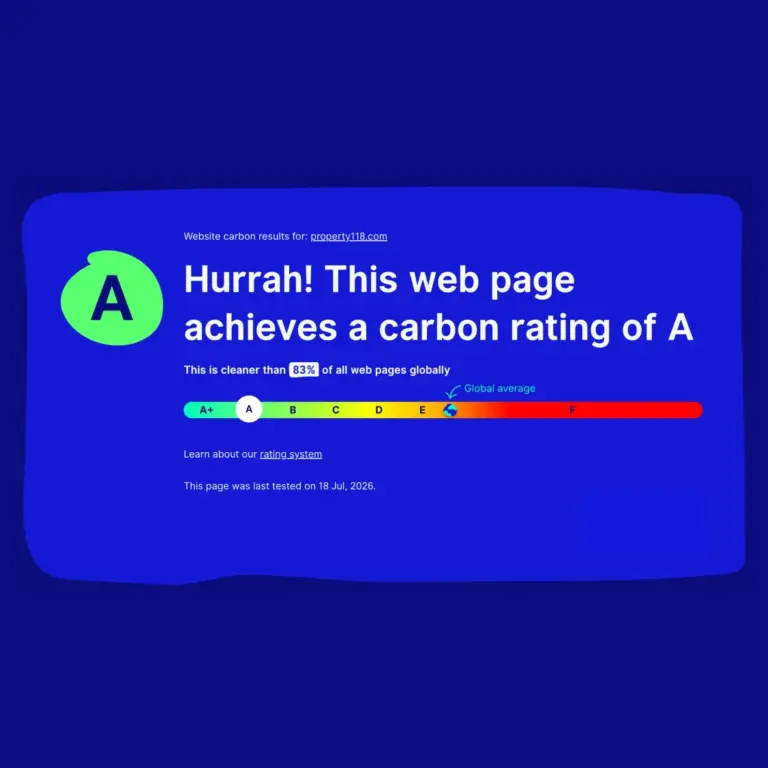
On sustainability, the Website Carbon Calculator (tested 18 July 2026) gives the site a carbon rating of A, confirms it is running on sustainable energy, and rates it cleaner than 83% of all web pages tested globally. Each visit produces only 0.07g of CO2. That is the payoff from the hosting move and the weight reduction working together.
These are genuinely good results, and I am pleased with them. But I want to be straight with you: this is not finished. Cleaner than 83% still leaves the very top tier ahead of us. That 0.07g per visit can be pushed lower with further weight savings, and we have more improvements already planned as part of the ongoing maintenance and support work we do on the site. You can read more about our wider approach on our Digital Sustainability page. Efficiency, digital or otherwise, is a direction of travel, not a destination.
Which brings us to your properties
If that last sentence rings a bell, it should. It is the exact position the law now takes on the energy efficiency of rental homes, through the Minimum Energy Efficiency Standards, or MEES.
The parallel is close. We audited the site, found the waste, cut it, switched to a cleaner supplier, and we keep measuring. A landlord looking at a property faces the same sequence: assess the current performance, identify what is dragging it down, make the improvements that pay off, and stay ahead of a standard that keeps rising. In both cases the reward is lower running costs, a better experience for the people using it, and an asset that holds its value.
Where MEES stands today
Here is the current position, drawn from the government’s own landlord guidance, which is the source worth checking before you act on anything.
The live legal minimum is EPC band E. Since 1 April 2020, landlords have not been permitted to let or continue to let a property covered by the MEES Regulations if its EPC rating is below E, unless a valid exemption is registered. If you hold a property sitting at F or G, it needs improving to at least E, or a registered exemption, before it can be lawfully let.
The bigger issue is the direction of travel. The government has committed to a long-term aim for as many privately rented homes as possible to reach EPC band C or equivalent by 2030. Following its 2026 consultation, the government is still working through the detailed policy design, so the precise mechanics, dates and cost arrangements are being finalised rather than fully settled in law. That is an important distinction, and it is why I would not treat any single secondary source as gospel. Check the GOV.UK guidance directly, and take professional advice on your particular properties.
What is not in doubt is the trajectory. The floor is rising from E towards C, and the assessment methodology itself is being reformed to look beyond simple running costs at things like fabric performance. Planning early, while the timeline still gives you room, is far cheaper than scrambling at a deadline.
A practical takeaway
You do not need to be a surveyor to start thinking like one. The same four steps that took our website from ordinary to Grade A apply to a property:
First, measure honestly. Get a current EPC. Ratings shift over time and the certificate itself lists the improvements that will move the needle most.
Second, target the biggest wins first. On a website that meant image weight and code bloat. On a property it usually means insulation and heating. Spend where the return is greatest, not where the job is easiest.
Third, check what help exists. Just as we chose a green host rather than building our own, there are grants and funding schemes for energy improvements. They change often, so confirm what is current before you commit.
Fourth, keep going. A single upgrade is not the finish line any more than a single good test result is. The standard will keep rising; staying comfortably ahead of it is cheaper and calmer than meeting it in a panic.
The honest close
I am proud of where the Property118 site has reached: a GTmetrix Grade A, a Website Carbon rating of A, running on renewable energy, cleaner than most of the web. And I am equally clear that there is more to do, with further improvements on the way. That combination, real progress plus genuine room to improve, is not a weakness to hide. It is what good stewardship of any asset actually looks like, whether that asset is a website or a home you rent out.
Efficiency you can measure is efficiency you can improve. That is true of our work on Property118, and it is true of the properties you let.
Dave Fuller is Managing and Technical Director of Accent Design Group Ltd, the Norwich digital agency that has designed, built and maintained the Property118 website for over fifteen years.
Performance and carbon figures cited were tested on 18 July 2026 via GTmetrix and the Website Carbon Calculator. Regulatory details reflect government guidance current at the time of writing; readers should verify the latest position at GOV.UK and seek professional advice on their own properties. Last reviewed: 18 July 2026.
1 comment on this article
Learn from your peers’ experience
A different perspective could help you spot an issue, avoid a mistake or find a better way forward. Read the comments and add your own views if you wish.
Previous Article
Savills warns the RRA is causing prime rental market concernNext Article
Andy Burnham's landlord policies under scrutiny
Member Since June 2013 - Comments: 3324 - Articles: 82
10:52 AM, 21st July 2026, About 2 months ago
Thanks for the insight and background Dave. Interesting. Not something many of us have thought about, the website, even if we do like companies to be as green as possible.